

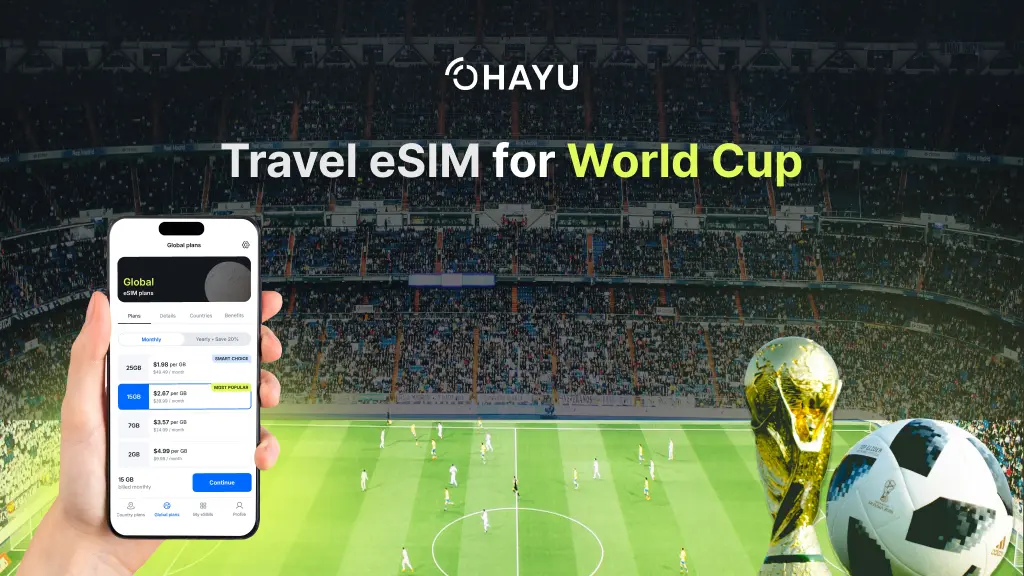
In 2026, FIFA takes place in the United States, Canada, and Mexico, so it is a hell of a trip for the football fans. In this post, I will review World Cup eSIM plans that can get you connected in all three countries and save you much time and effort.
How to get mobile internet during the World Cup
I visited the 2022 FIFA World Cup in Qatar, and here is some advice from my experience. FIFA match ticket is digital, with no paper backup and no over-the-counter replacement at venue gates. If you don’t have internet to access that ticket, you won’t be able to enter the stadium. Mobile data is also required at every host country border to present travel authorization forms: eTA in Canada, ESTA in the US, and FMM in Mexico.
FIFA’s official telecom sponsor, Verizon, has upgraded all 11 US host stadiums with 3-5x additional 5G capacity. They expect fans to consume more than 50 terabytes of data per match. This upgrade should strengthen the network when a large crowd of fans loads tickets or calls for rides.
World Cup eSIM has to get the signal at the stadium with 80,000 other phones. So even if you have a strong local provider SIM, like Verizon or T-Mobile in the US, it’s smart to have a backup plan or an international eSIM that can connect to several networks.
Ohayu Global plan handles this kind of pressure with a multi-network. It can connect to several local carriers in each host country and might switch the signal if the primary network becomes overloaded. The plan starts at $9.99/month, which might be well below the $72-192 in roaming fees of some home operators for a 12-day tournament trip.
What to look for in the eSIM for FIFA 2026
If you are comparing different eSIM offers, like Holafly, Airalo, Saily, or Ohayu, it is necessary to check: covered countries, supported networks, and if they are disclosed before the purchase, data volume and price per GB, if top-ups are available (you don’t want to get low on data in the middle of the game), and speed limitation for ‘unlimited plans’.
Multi-country coverage
Choose a plan that works in every World Cup host country you are planning to visit.
Local networks
Ohayu can connect to several mobile carriers in each destination. In the US, it’s AT&T and T-Mobile that provide the widest 5G coverage across all 11 host cities. Canada’s Bell/Telus shared network covers Toronto and Vancouver. In Mexico, Telcel has the widest national reach, with Movistar running 5G in Mexico City, Guadalajara, and Monterrey.
Data volume
For a 5-10 day single-country trip with moderate data use (navigation, digital ticketing, and messaging), 5 GB is enough. A 2-3 week multi-country trip with heavy social sharing or hotspot use needs more data – around 10-15 GB.
Top-up availability
If you exceed your data limit, you don’t necessarily need to buy a new plan. Choose an eSIM that allows to add data to an existing package, without going through installation and activation.
16 host cities
The cities are grouped into three regional clusters to reduce travel distances during the group stage.
| Country | Host cities | Note |
| USA (11 cities) | Atlanta, Boston, Dallas, Houston, Kansas City, Los Angeles, Miami, New York/NJ, Philadelphia, San Francisco, Seattle | Final at MetLife Stadium, July 19 |
| Canada (2 cities) | Toronto, Vancouver | |
| Mexico (3 cities) | Mexico City, Guadalajara, Monterrey | Opening match at Estadio Azteca, June 11 |
Which plan fits your trip
According to the US Travel Association, more than 80% of World Cup travelers are open to visiting locations beyond the event to experience the country. Four trip profiles cover most fans traveling to FIFA 2026.
In transit or for a layover
Most long-haul routes from Europe, East Africa, or East Asia connect through one of the three host countries. Some travelers extend the stopover. For example, spend a night in Mexico City before a connecting flight to Dallas, or have an afternoon exploring Manhattan before a match in New Jersey. An Ohayu global plan can cover these spontaneous side trips without committing to a full 30-day single-country plan.
Group stage across two countries
Group assignments follow regional clusters across borders. For example, South Africa in Group A plays Mexico City, then Atlanta, then Monterrey: two matches in Mexico, one in the US. A single-country plan won’t fit this like a global package that does not require reinstallation or settings update for every new country.
Group stage in one country
The most common profile: fly in for three group-stage matches, stay 5-10 days, fly home. Most fans in this group land in American cities, since the US hosts most of the matches. A 5 GB single-country plan handles a trip that length.
Knockouts or the full tournament
Knockout matchups are confirmed only days before each game, and the next venue can land in any of the three countries. Fans following a deep run rebook flights and accommodation on short notice. The Ohayu global plan covers the full tournament window without a reinstall when the next destination is announced.
| Trip type | Ohayu plan | Price |
| Multi-country / full tournament | Global eSIM (monthly) | From $9.99/month |
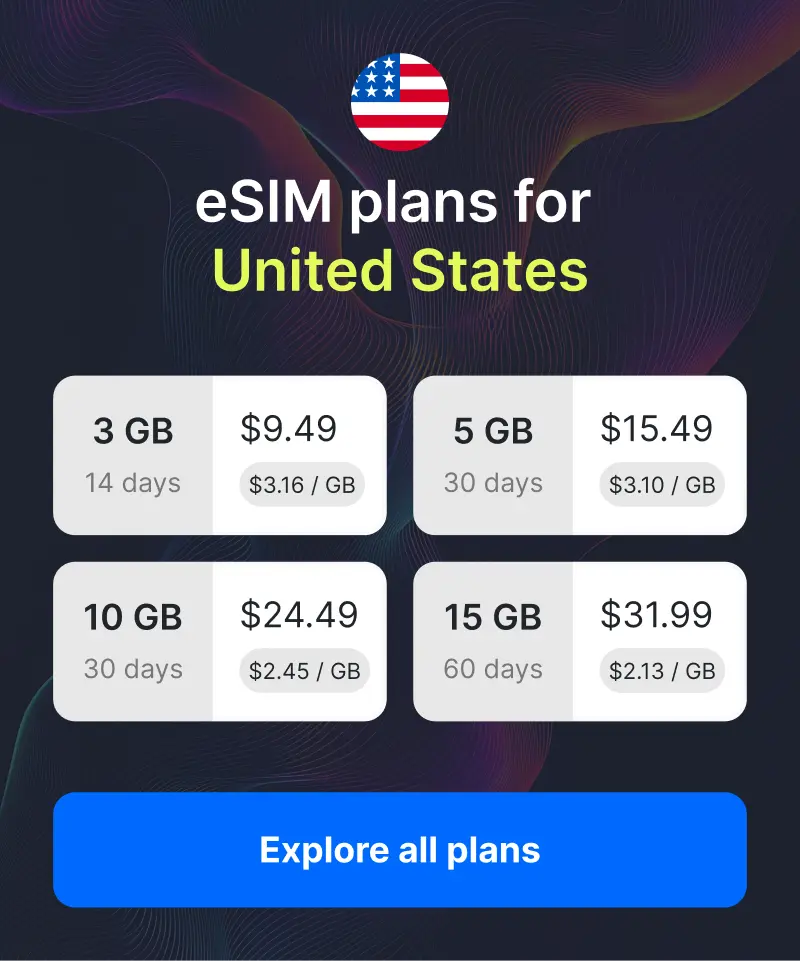
| USA only | US 5 GB / 30 days | From $9.49 |
| Canada only | Canada 5 GB / 30 days | From $13.99 |
| Mexico only | Mexico 5 GB / 30 days | From $13.99 |
Ohayu Global eSIM covers the countries that host FIFA, such as France, Spain, Argentina, Canada, Mexico, the USA, and 120+ other destinations. eSIM automatically switches between local networks, so there is no need to buy or reinstall a new SIM for every new game destination. All unused gigabytes roll over to the next month, so you can further use them as a regular travel eSIM.
Roaming passes vs local SIMs vs World Cup eSIM
Day-pass roaming costs between $6 and $16 per country per day, depending on which carrier you have at home. A fan who attends the group stage in two countries over 12 days will add $72 to $192 to a trip that already includes flights and accommodation.
The full tournament makes the math harder. A 39-day trip through all three nations pushes the roaming total to somewhere between $234 and $624. Most plans also throttle speeds once the daily allowance is hit, so even after payment, fans can lose the connection at the worst moment, like at the stadium gate.
Local SIMs cost less per day but stay tied to one country. Going elsewhere means another airport queue and a new activation.
| Criteria | Roaming (day pass) | Local SIM | World Cup eSIM |
| Cost | $6-16/day per country | $40+ per purchase | From $9.99/month |
| Multi-country | No, resets at the border | One country only | Yes, 120+ countries |
| Setup | On landing, billed on use | Airport kiosk, queue | At home, pre-departure |
| Speed cap | 0.5-2 GB/day on most plans | Varies by carrier | No caps |
| Compatibility | Low risk | Medium-high risk | Low risk |
Set up before you fly
eSIM installation requires a stable Wi-Fi connection, and a congested airport terminal is hardly the best place to set up a plan for the first time. Ten minutes at home before departure removes the problem.
Follow these steps to make sure your mobile connection is up and running the moment you land:
- Confirm your phone is eSIM-compatible and carrier-unlocked.
- Purchase your plan at ohayu.com before the trip.
- Install the eSIM profile through the in-app process, QR code, or manual steps.
- Label the eSIM ‘World Cup’ in your phone settings.
- Upon arrival, disable the data roaming on your home SIM once the eSIM is active to avoid accidental charges.
- Download offline maps for each host city. Treat these as primary navigation at stadium zones.
- Save match tickets, ESTA/eTA/FMM confirmations, hotel bookings, and flight details offline.
FAQ
Not with a Global eSIM. One global plan covers the USA, Canada, and Mexico and connects to local carrier networks in each country.
For most fans, 5 GB covers a single-country group-stage trip, and 10-15 GB covers a multi-country itinerary with heavier use. Most Ohayu plans support top-ups if the estimate runs low.
Yes, but the stadium signal is the hardest part of any match day. In case of signal overload, download the ticket and offline maps before leaving the hotel.
A global plan switches local carrier networks automatically. A country-specific plan stops at the next checkpoint, so any itinerary that touches more than one tournament country needs the global option.
Bottom line
A World Cup eSIM solves a specific set of problems that don’t usually happen all at the same time, except this event. Digital ticket access at the gate, catching rides in unfamiliar cities, group coordination across time zones, and data continuity at every border are the main concerns for FIFA travelers. Global plan handles that on a single activation, without the cost of roaming or buying a new SIM card at every airport.