

The Digital Nomad Visa Spain is a newly introduced visa for foreign remote workers who plan to live as residents while working for companies located outside the country. The visa allows you to stay in the country for up to 12 months, with the possibility of extending your stay up to 5 years.
Spanish visa has strict requirements, and the main one is stable employment with a high salary. Thus, applicants must provide their employment contract, permission from their company to relocate, and proof that the company has been operating steadily for more than a year. As for income, for those who travel alone, the minimum income per month should be €2,600. This amount is increased for couples or families with children. A good perk is that up to 20% of freelancers’ income can come from Spanish local companies.
Are you planning to apply for a Spain digital nomad visa? In this article, we’ll take a closer look at the requirements, application process, taxes, processing time, and all the other issues related to getting a visa.
Who can apply for the Digital Nomad Visa in Spain?
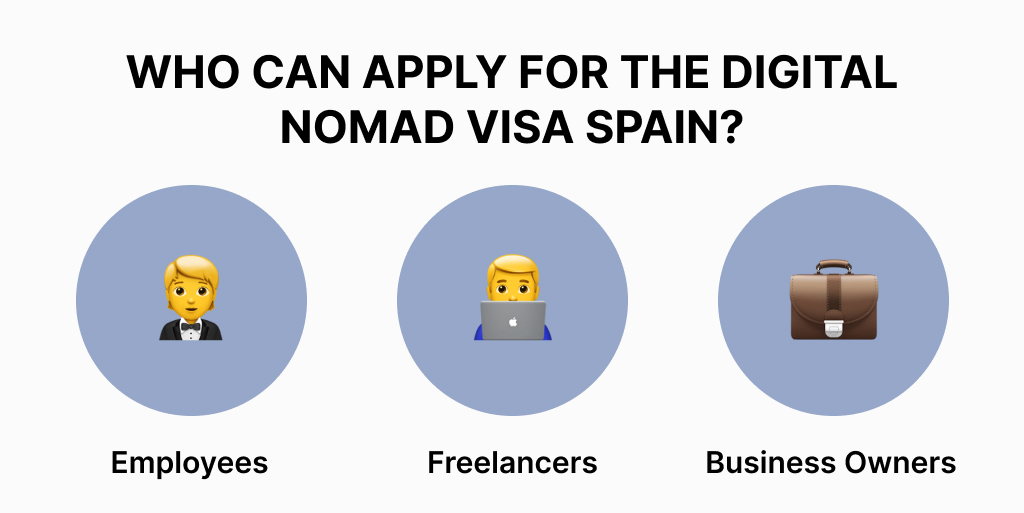
Citizens of non-EU/EEA countries can apply for a digital nomad visa if they work remotely for companies registered outside of Spain or run their businesses. These are the following categories:
Employees
First of all, the visa is suitable for those who officially work for a foreign company and perform their tasks remotely. In this case, you need a confirmation letter from your employer to open a visa. Some other important requirements include:
- The company must exist for at least 1 year before the application is submitted.
- An official employment contract with the firm for at least 3 months.
- A letter from the employer confirming the permission to work remotely from Spain.
Freelancers and self-employed persons
You can apply for a visa if you work as a freelancer. In this case, you should provide contracts with all your clients and confirm your annual income. The requirements are as follows:
- At least 80% of income should come from clients located outside of Spain. It means that the maximum share of revenue from Spanish clients should not exceed 20%.
- At least 3 years of experience in the relevant field.
Business owners & entrepreneurs
The visa is also open to those who run their own company remotely. To obtain a permit, you should meet the following requirements:
- Your company must be registered outside of Spain.
- The business must have been in operation for at least 1 year.
- The company’s financial statements confirm its stable profit.
- Confirmation that the majority of clients are located outside of Spain.
Countries eligible for Spanish Digital Nomad Visa
The visa is open to citizens of any country outside the European Union (EU) and the European Economic Area (EEA). This means that citizens of the EU, EEA, and Switzerland do not need such a visa, as they already have the right to live and work in Spain without additional permits. You can check the availability of the Spanish visa on the map below.
Digital Nomad Visa requirements
As you have already understood, only those who work remotely outside the country can apply for a digital nomad visa in Spain. These can be residents of the United States, Mexico, Australia, or other countries that are not members of the European Union. Applicants are selected according to clear criteria, which you can find below:
Consistently high income
The applicant must have a stable income of at least 200% of the minimum interprofessional wage (SMI). As of 2024, this amount is €2,646 per month or €31,752 per year. If the applicant brings family members with him or her, you need additional revenue:
- for the first dependent – another 75% of the basic amount (EUR 1,984.50 per month);
- for each subsequent dependent – 25% (EUR 661.50 per month).
Professional experience and education
You should prove your professional competence in the field of work. It can be done in one of two ways:
- a higher education diploma that corresponds to the declared profession;
- at least 3 years of work experience in the relevant field.
Health insurance
To obtain a visa, you need health insurance valid in Spain and covers all expenses without a deductible. It means the insurance should cover the treatment in full, at no additional cost to the applicant. The minimum insurance coverage is €30,000 per year. The Spanish authorities only accept insurance policies from accredited international or Spanish companies, such as Adeslas, Sanitas, or Cigna.
Purity before the law
The applicant should provide a police clearance certificate for the last 5 years from the country where he or she has lived. It must be officially apostilled and translated into Spanish. It confirms the person has not been convicted of serious offenses and does not pose a threat to public order in Spain.
Minimum residence requirement
The applicant must not have resided in Spain for the last five years before applying. Also, it is impossible to apply if you are currently staying in the country illegally. There is no minimum period of first-time stay. However, if you plan to extend the validity of the residence permit after the initial period expires, you should spend at least six months during each 12 months.
A place to stay in Spain
Last but not least, you should assure the Spanish government that you have a place to live during your trip. The following papers are suitable for this purpose:
- a rental agreement;
- a document of ownership of real estate.
If you have not yet rented an apartment, you may submit guarantee documents or other proof of financial ability to provide accommodation upon arrival.
To summarize, here is your checklist of the ideal candidate for a digital nomad visa in Spain.
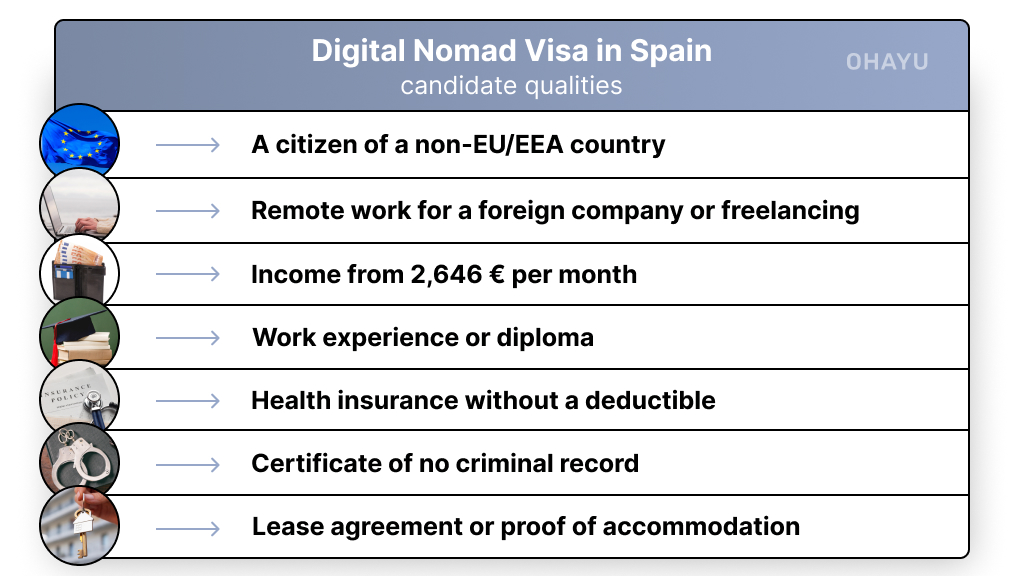
- A citizen of a non-EU/EEA country.
- Remote work for a foreign company or freelancing.
- Income from 2,646 € per month.
- Work experience or diploma.
- Health insurance without a deductible.
- Certificate of no criminal record.
- Lease agreement or proof of accommodation.
Documents to apply for Digital Nomad Visa Spain
You need to prepare and submit a series of papers. We have collected the main certificates and forms you need during the application process:
- NIE. Before applying for a visa, obtain a foreigner’s identification number (NIE). It is used to identify foreigners in Spain. You can order the document from the Spanish Consulate in your country.
- Completed national visa application form. Each applicant or his/her representative must fill in and sign the form. If you plan to stay with your family, each member must fill out a separate application.
- Photo. One passport-size color photograph taken against a light background, in full-face, without dark or reflective glasses and hats covering the oval of the face.
- A valid international passport. Provide the original and a copy of the biometric data pages of your passport. It must be valid for at least 1 year and have two blank pages. Passports issued more than 10 years ago are not accepted.
- Valid UK residence permit (for non-British citizens).
- Certificate of no criminal record. Applicants of legal age must provide a police clearance certificate issued by the country or countries of residence within the last 2 years. In addition, you need to submit a declaration of no criminal record for the last five years. This certificate must not be older than 6 months unless otherwise specified in the document itself. For references from the UK, an ACRO certificate is required.
- Proof of residence in the consular district. A certificate confirming the applicant’s legal residence in the consular district is required.
- Proof of identity and powers of the representative (if applicable). If the application is submitted through a representative, provide a copy of the representative’s identity card or passport, and a copy of the power of attorney or official document confirming the representation. The originals must be presented at the time of application. Foreign papers should be legalized or apostilled and, if necessary, accompanied by an official translation into Spanish.
- Health insurance. Include a certificate confirming the availability of public or private health insurance, concluded with an insurance company authorized to operate in Spain.
How to apply for a Spanish Digital Nomad Visa?
When you are convinced that you meet all the criteria and are ready to try life in Spain, the most crucial stage comes. Applying for a permit requires a careful selection of all documents and proper execution of the application. Here’s how to get started and how the process works:
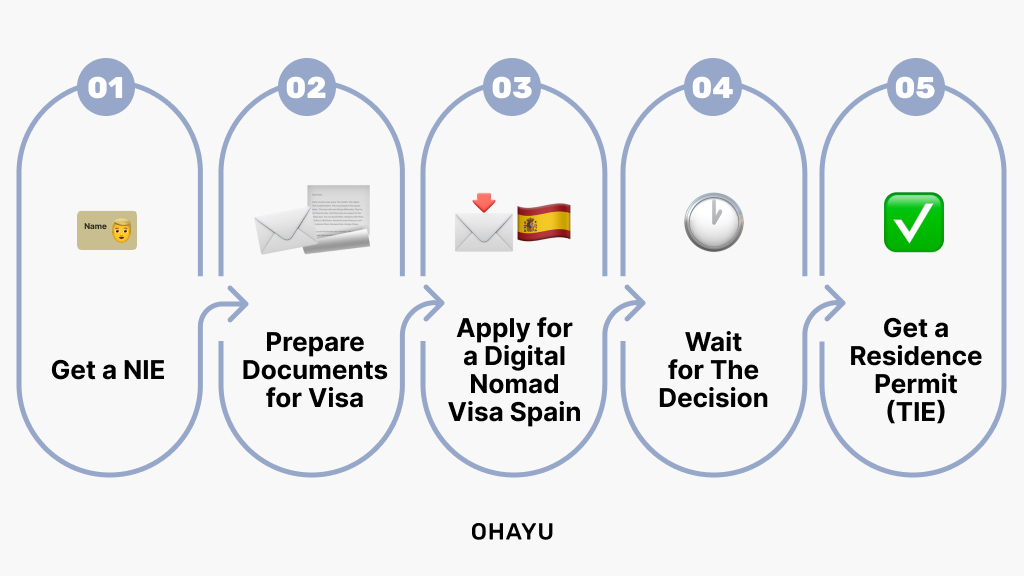
Get a NIE
NIE is an identification number for foreigners in Spain. It is required for all official procedures, including opening a bank account and paperwork. To obtain it, you need to cope with several steps:
- Make an appointment at the Spanish Consulate in your country or the Spanish Migration Office.
- Submit the following papers:
- A completed EX-15 form.
- Valid passport + copy of the first page.
- Justification of why you need an NIE (for example, visa application).
- Paid receipt of Modelo 790 Código 012 (approximately €10).
- Wait for the number to be issued (from 1 week to 1 month).
Prepare documents for visa
Read the list of documents and prepare the package. You can use this checklist of required documents for Spain Digital Nomad Visa:
- Completed national visa application form (Form EX-07).
- A photo (passport size).
- Valid passport (not older than 10 years, with at least 2 free pages).
- Residence permit in the UK (or another country if you are not applying from your home country).
- Police clearance certificate (obtained in your home country, must be translated into Spanish and apostilled).
- Health insurance that covers the entire period of stay (the policy must be from a Spanish company).
- Proof of residence in Spain (rental or booking of accommodation).
If you are an employee:
- Contract with your employer confirming your employment for at least 3 months.
- A letter from the employer authorizing remote work.
- Bank statements or salary certificates for the last 6 months.
If you are a freelancer or entrepreneur:
- Contracts with clients that prove a stable income.
- Certificate of registration of your company.
- Tax returns for the last 6 months.
- Bank statements confirming your income.
Apply for Digital Nomad Visa Spain
You can apply in two ways:
- Through the Spanish Consulate in your country (processing time – 10 to 45 days).
- Through a migration office (if you are already in Spain on a tourist visa).
To make an appointment, you need:
- Visit the consulate’s website and book an appointment.
- Take all the prepared documents.
- Pay the visa fee at the time of application or in advance.
Wait for the decision
After submitting the documents, the consulate or migration office will check your application. The processing time varies from 10 to 45 days, depending on the workload of your consulate. You may be asked for additional documents, in which case the processing time may increase.
Get a residence permit (TIE)
Upon arrival in Spain, you need to apply for a TIE (Tarjeta de Identidad de Extranjero) – a plastic resident card. You have to do this within 30 days of your arrival. You can make an appointment to apply for a TIE through the website. After applying, you will receive a temporary document, and after 30-45 days – a ready-made TIE card.
Visa application timeline
The process of applying for and obtaining a visa involves collecting documents, visiting the consulate, and filling out the necessary applications. It makes the procedure quite time-consuming and tedious. The most time-consuming task is preparing a package of documents, and the entire visa process takes approximately 3-4 months.
Here are the approximate timeframes for each stage:
| Stage | Estimated timeframe |
| Checking eligibility | 1 – 2 days |
| Obtaining NIE (Foreigner’s ID Number) | 1 week – 1 month |
| Gathering required documents | 2 – 4 weeks |
| Booking an appointment at the Spanish Consulate or Immigration Office | Varies (1 – 4 weeks) |
| Submitting the visa application | 1 day |
| Processing time for visa approval | 10 – 45 days |
| Receiving the visa and traveling to Spain | 1 – 2 weeks |
| Applying for TIE (Residence Permit Card) | Within 30 days after arrival |
| Waiting for TIE approval | 30 – 45 days |
| Receiving TIE and finalizing residency | 1 day |
Spain Visa Calculator (Schengen)
How much does it cost to apply for a Digital Nomad Visa in Spain?
To get a digital nomad visa, you need to pay fees. These amounts are insignificant and range from €80 – €100. However, you will spend most of the money on notary services and translation of documents: it can cost from €1000. One more big expense that awaits you when applying is the payment of private health insurance, which is a mandatory condition for applicants.
We have collected the average prices for each of the services in the table below.
| Expense | Estimated cost (€) |
| Visa application fee | €80 – €150 |
| NIE (Foreigner’s ID Number) fee | €10 – €20 |
| Criminal record certificate | €0 – €50 |
| Apostille/legalization of documents | €30 – €100 per document |
| Official translations | €20 – €50 per page |
| Health insurance | €50 – €200 per month |
| Proof of financial means | Varies |
| Consular fees (varies by country) | €10 – €30 |
| TIE (Residence Card) fee | €15 – €20 |
| Miscellaneous (travel, notarization, etc.) | €100 – €300 |
Spain taxes for digital nomads
Since living in Spain on a Digital Nomad Visa makes you a resident of the country, you will have to pay taxes. Thus, if you stay in the country for more than 183 days a year, your income will be taxed according to a specially defined scale:
- Up to €12,450 – 19%;
- €12,451 – €20,200 – 24%;
- €20,201 – €35,200 – 30%;
- €35,201 – €60,000 – 37%;
- €60,001 – €300,000 – 45%;
- More than €300,000 – 47%.
However, there is good news. Digital nomads who obtain a residence permit in Spain are subject to the special Beckham Law tax regime. It allows you to pay a flat tax rate of 24% on annual income up to €600,000. If the income exceeds this amount, the tax rate increases to 47%.
Internet quality in Spain
If you have passed all the stages and have an approved visa, it’s time to get ready for your trip! Since the main purpose of the travel is to work remotely, the Internet is an important point in the Digital Nomad packing list. To work without interruptions, you need a stable and high-quality connection. One of the most reliable and affordable options is eSIM.
An eSIM (Embedded SIM) is a digital SIM card that allows you to connect to a mobile operator without having to insert a physical SIM card. It works great for digital nomads who travel, work remotely, and need reliable Internet access. You can connect such a SIM to both a smartphone and a laptop (the main condition is that the device supports the technology and can share mobile internet using a hotspot). It’s fast, secure, and often cheaper than roaming on your home provider.
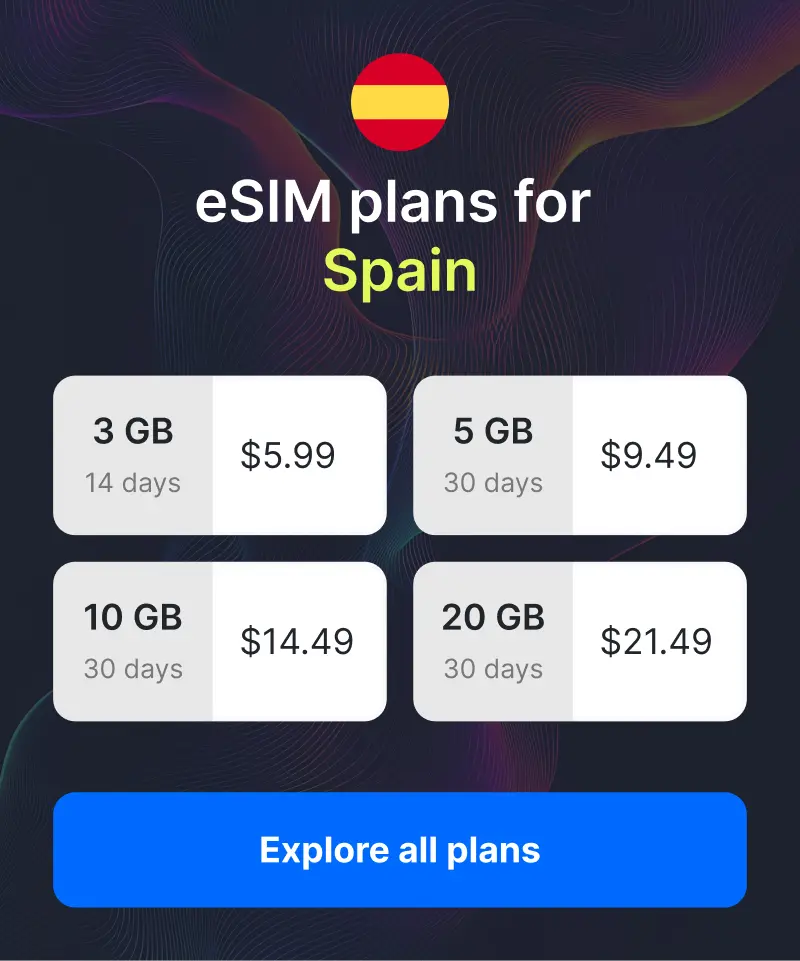
Ohayu has travel eSIM plans for Spain with fixed data and unlimited gigabytes. The prices start from $5.99 for 3GB (14 days). You can choose the plan before the trip and activate it using airport Wi-Fi when you arrive in Spain.
One question remains: how to activate it? Just a few steps and the Internet is running on your device:
- Make sure your smartphone supports eSIM.
- Choose a data plan and purchase an eSIM.
- Get a QR code and install the eSIM using the in-app instructions.
- Activate eSIM and start using the mobile Internet after you arrive in Spain, using airport Wi-Fi.
Final words
To summarize, a digital nomad visa is a good opportunity to live in Spain without interrupting your work. Although the application process is quite laborious and time-consuming, if you meet all the requirements and provide the necessary documents, the chances of getting a visa are quite high. Weigh the pros and cons, analyze your eligibility, and start processing.