

There are four major mobile networks in Japan: NTT Docomo, au by KDDI, SoftBank (including the Y!mobile subbrand), and Rakuten Mobile. All of these carriers offer wide 4G/5G coverage on the major Japanese islands. However, some of them have less reliable connections on smaller and more remote islands due to the distance from the towers and base stations. Signal strength there can also be limited by terrain and weather conditions. That’s why it is very important to do prior research before your trip, or even have a backup eSIM like Ohayu that connects through supported partner networks where coverage is available, based on local operator agreements.
In this article, we will analyze the main differences between the major operators’ coverage, speed, and plans.
Japanese mobile market overview
The telecommunications industry in Japan is mature and highly competitive. Most of the market is controlled by NTT Docomo, au (KDDI), and SoftBank, with a new entrant, Rakuten Mobile, disrupting the industry.
According to a GlobalData report, telecom revenue is expected to rise at a compound annual growth rate (CAGR) of 2.2 percent between 2024 and 2029. The primary force behind this growth is cellular communications.
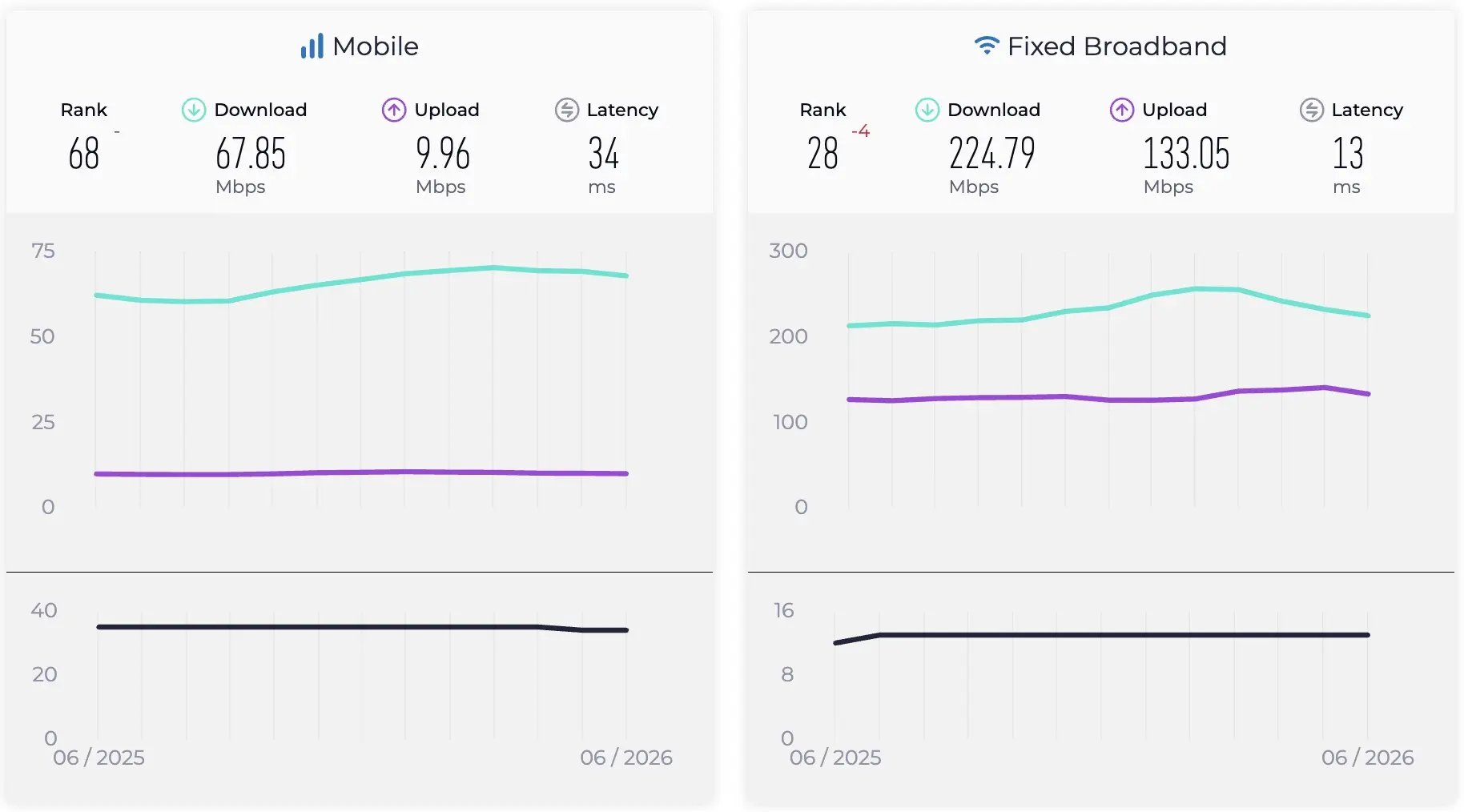
According to the Speedtest Global Index (retrieved in June 2026), Japan ranked 68th by mobile download speed globally. The median download speed was 67.85 Mbps, and the median upload speed was 9.96 Mbps, with a latency (important for real-time apps) of 34 ms.
| Place | Country | Median mobile download speed |
| 4 | Bahrain | 267.68 Mbps |
| 7 | South Korea | 240.68 Mbps |
| 11 | North Macedonia | 192.48 Mbps |
| 12 | China | 179.33 Mbps |
| 14 | Denmark | 176.61 Mbps |
| 24 | Serbia | 152.36 Mbps |
| 33 | New Zealand | 141.29 Mbps |
| 56 | Romania | 84.59 Mbps |
| 59 | United Kingdom | 75.57 Mbps |
| 68 | Japan | 67.85 Mbps |
This table contains data from Speedtest Global Index, retrieved in June 2026.
In 2020, the Japanese government introduced the 5G Investment Promotion Tax System, which allowed corporations investing in 5G to get a 15% tax credit or a 30% special depreciation for investments in local 5G infrastructure. It was designed to encourage 5G deployments.
Japan has also supported digital development through the Digital Garden City Nation Initiative, a government program that has subsidized 5G, fiber-optic rollout, IoT deployments, and digital transformation projects across municipalities and private enterprises. These efforts aimed to accelerate 5G development and create new opportunities for local industries.
At a 2022 GSMA summit in Tokyo, Japan’s Ministry of Internal Affairs and Communications (MIC) shared a plan for further fiber-optic expansion across the country. By the end of fiscal 2027, the country aims for 99.9 percent fiber household coverage, and by fiscal 2030 for 99% 5G population coverage. This infrastructure supports the deployment of 5G and, later, 6G. In July 2024, NTT Docomo announced 5G standalone download speeds of up to 6.6 Gbps.
eSIM in Japan
The eSIM technology is gaining popularity and supporting the growth of the cellular market in general.
All four mobile networks in Japan support eSIM (embedded SIM) for contract users. However, tourists cannot buy most carrier plans directly, because Japan has strict rules on mobile phone identification under the Act on Identification by Mobile Voice Communications Carriers. This law requires operators to verify the identity of anyone purchasing a SIM with a phone number (whether a physical SIM or an eSIM). Data-only SIMs without a phone number are not covered by this requirement.
To buy a regular carrier eSIM or SIM card with a phone number, Japanese operators usually require:
- Residence status in Japan, and
- Identity verification (for example, a residence card or passport, usually with Japanese-language forms that tourists cannot easily complete).
For carrier eSIMs by Docomo, au, SoftBank, and Rakuten, ID verification and Japanese-language apps and forms are required, so tourists generally cannot buy these plans directly from the providers. Some carriers and MVNOs offer prepaid options for visitors, described below.
With travel eSIM providers like Ohayu, you don’t need to show your ID, communicate in Japanese, or do the paperwork. Ohayu offers tourists access to the supported local Japanese networks without ID registration because it provides data-only eSIMs that do not require issuing a Japanese phone number.
Another benefit is a wide selection of data plans. Short-term travelers can choose a smaller plan and, for many plans, top it up in the app when needed. Visitors staying longer may require a package that includes more data, or choose the Global plan, one eSIM that covers 120+ countries, including Japan.
Top 4 mobile operators in Japan
The Japanese mobile market is highly competitive. Most mobile users are subscribed to the three largest domestic network operators. According to Telecommunications Carriers Association (TCA) data for Q2 (September 2025), NTT Docomo had the biggest network, with approximately 91.91 million subscribers. KDDI was the second-largest carrier, with 71.46 million contracts. SoftBank had about 56.38 million subscribers. Rakuten Mobile, the newest of the four network operators (since 2020), had 9.33 million mobile subscribers.
au by KDDI
Au is a major Japanese mobile company. It is widely known for collaborating with SpaceX Starlink to connect remote base stations. This satellite link helps au reach remote areas.
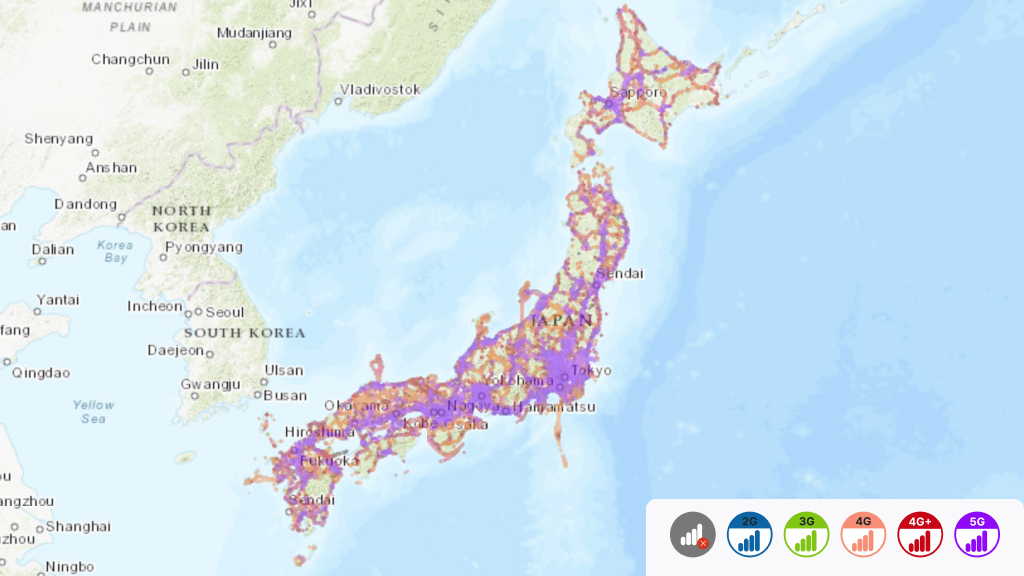
For short-term visitors and tourists, the carrier provides prepaid plans under a different brand name, povo2.0.
NTT Docomo
NTT provides strong nationwide coverage and reliable service, especially outside major cities. The company invests heavily in network infrastructure and technology. According to Opensignal (May 2025), its users see the most resilient network experience in the rural parts of Japan.
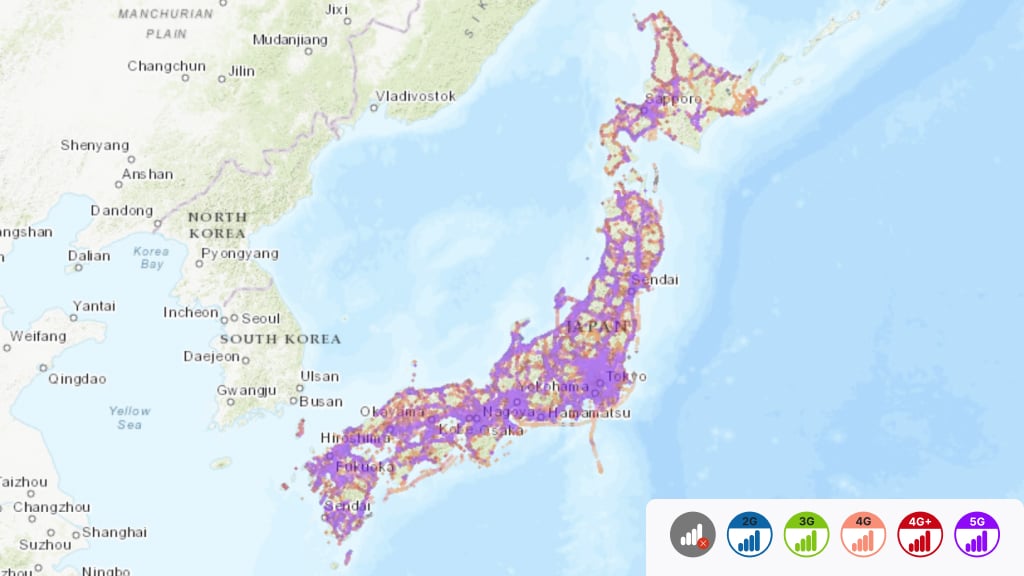
NTT Docomo doesn’t sell prepaid SIM cards for tourists directly. Nevertheless, third-party companies (MVNOs) offer prepaid plans to tourists (often with a delivery destination). These companies purchase network access from Docomo and sell it to the customers.
SoftBank
SoftBank has good 5G performance, especially in urban centers. It had the best 5G availability in Opensignal’s April 2025 report and still led for time on 5G in the April 2026 report, meaning its users spent more time on an active 5G connection than on any other network.
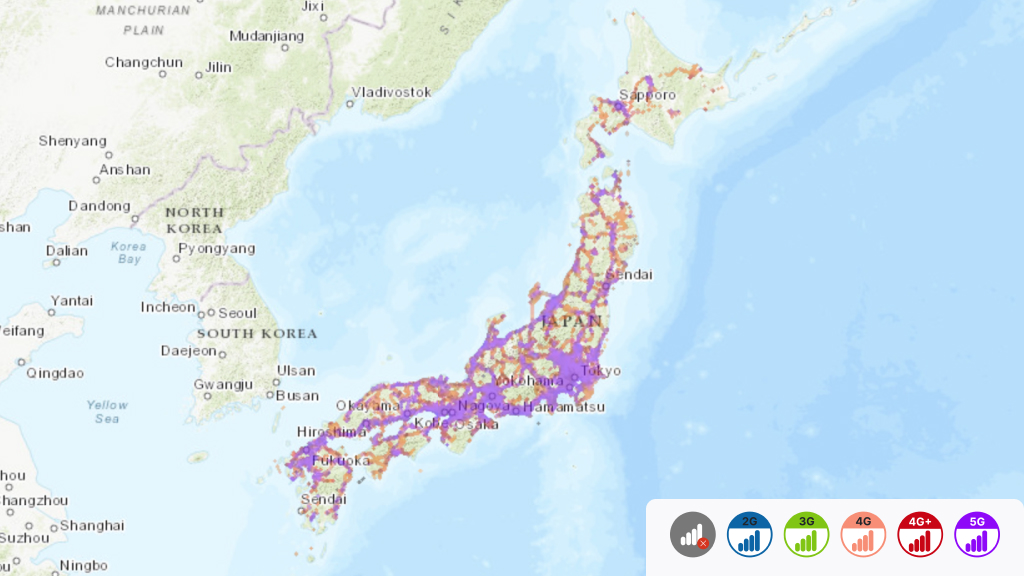
SoftBank’s official prepaid option is called Simple Style.
Rakuten
Rakuten holds a smaller but growing share of the Japanese mobile market. Its technical achievement was the construction of a completely virtualized, cloud-native network. According to Opensignal (November 2024), the operator has refined its consistent quality, and it led in upload speeds in Opensignal’s April 2026 report.

Meanwhile, the company is increasing its network. To achieve this, it uses several frequency bands, including the platinum band (700 MHz), which has improved signal penetration in buildings and tunnels. Furthermore, the provider collaborates with other carriers, such as KDDI (au), to ensure broader availability, particularly in more rural areas.
Rakuten Mobile does not have dedicated tourist prepaid SIMs. Instead, its primary option is the Rakuten SAIKYO plan. It offers unlimited monthly data across the nationwide network.
Additionally, national calls are free from the mobile app.
Comparison of Japanese mobile operators
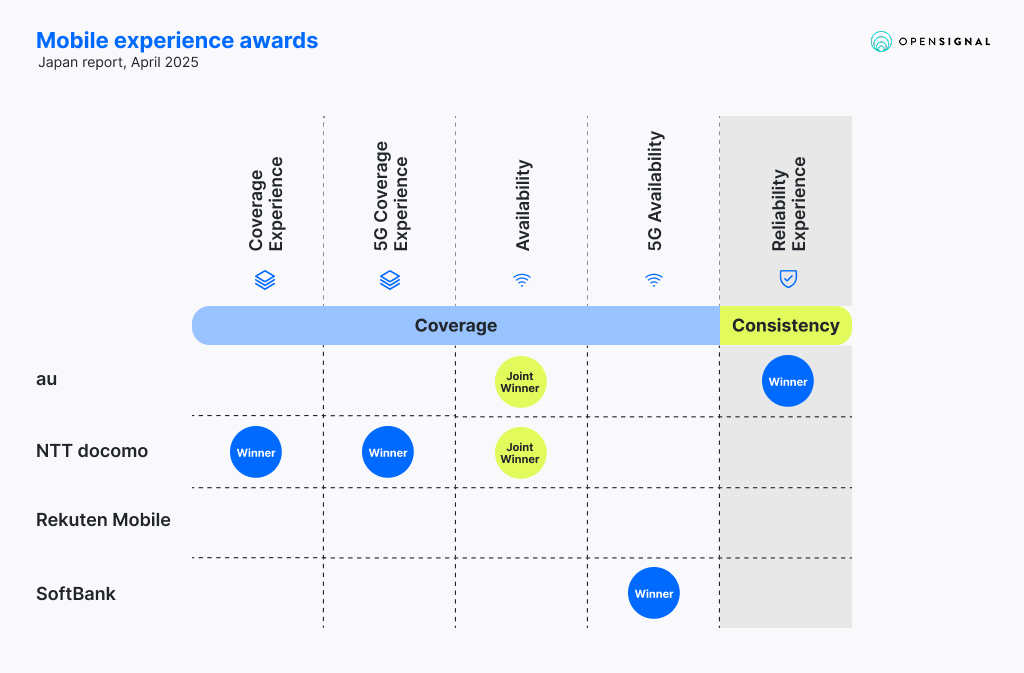
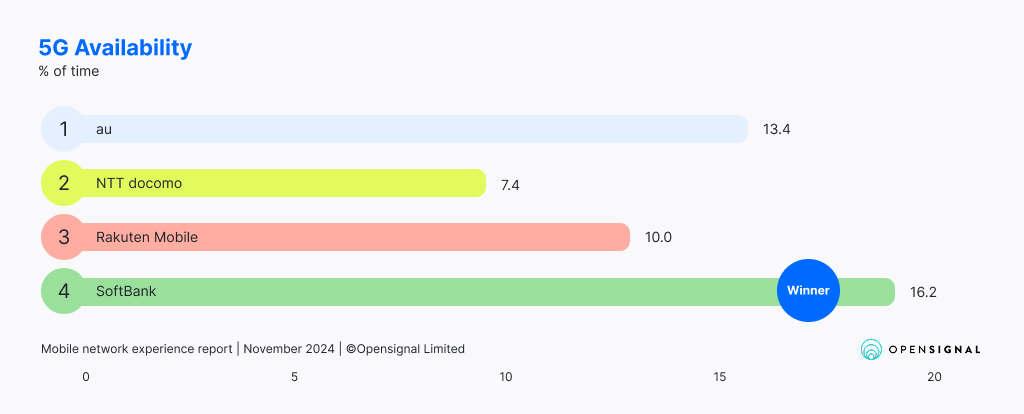
In Opensignal’s Mobile Network Experience Report for Japan from April 2026 (data collected January to March 2026), au won the most awards, including all experiential awards, Consistent Quality and Reliability Experience. SoftBank had the best Download Speed Experience and the most time on 5G, and Rakuten Mobile led in upload speeds. The awards and charts below come from the earlier April 2025 edition of the report, in which NTT Docomo had the highest 5G download speed and coverage, Rakuten the best 5G upload speed, and SoftBank the best 5G availability.
5G Speed
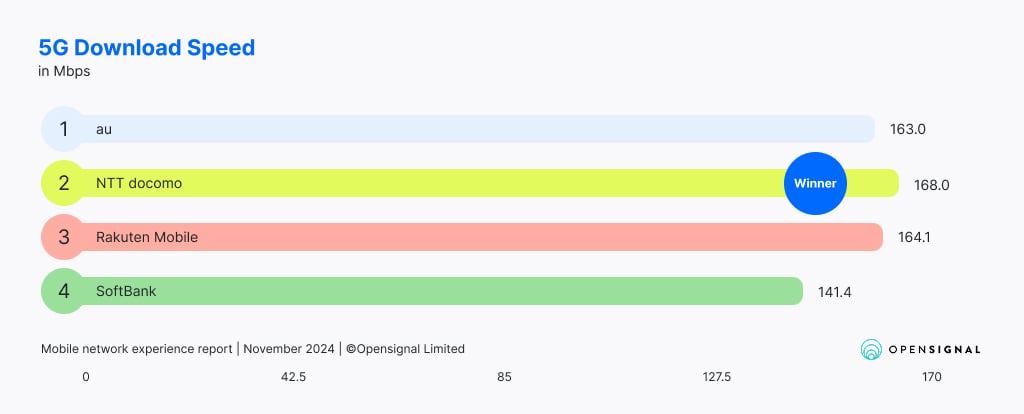
In the April 2025 report, NTT Docomo had the highest 5G download speed at 168.0 Mbps.
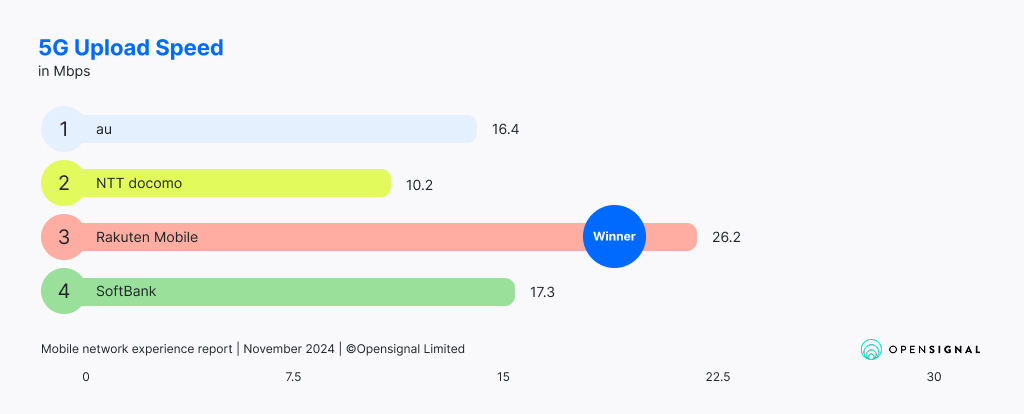
In the same report, Rakuten’s 5G upload speed was 26.2 Mbps, ahead of the second-place result of 17.3 Mbps.
5G Coverage and availability
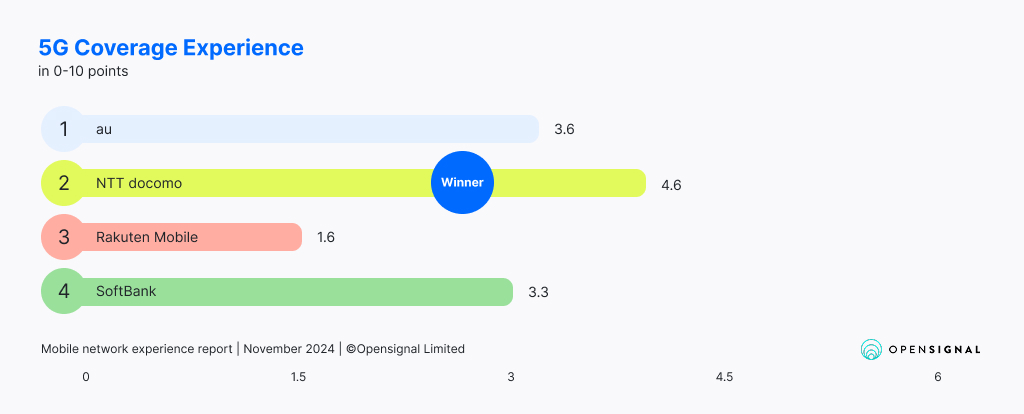
In the April 2025 report, NTT Docomo was the 5G Coverage Experience leader, which means that its 5G was accessible at more locations than the competitors.
The 5G Availability winner in April 2025 was SoftBank. Its users spent the most time connected to an active 5G signal.
Japanese mobile providers comparison table
| Japanese mobile operators | Mobile download speed* | Key strengths |
| au (KDDI) | 60.7 Mbps | Most awards, incl. all experiential awards, Consistent Quality and Reliability Experience*; Starlink-backed remote-site connectivity |
| NTT Docomo | 55.7 Mbps | Highest 5G download speed and 5G coverage in the April 2025 report; most resilient rural experience (Opensignal, May 2025) |
| SoftBank | 65.1 Mbps | Best Download Speed Experience*; users stay on 5G longest* |
| Rakuten Mobile | 39.6 Mbps | Fastest upload speeds, overall and 5G*; 700 MHz “platinum band”; fully cloud-native network |
| Ohayu (travel eSIM) | Depends on the local network | Connects to supported local partner networks; data-only plans; no ID needed; convenient for tourists and multi-city travel |
| MVNOs (IIJmio, BIC SIM, b-mobile, Sakura, Nippon SIM) | Varies by host network | Prepaid options; operate on Docomo, KDDI, or SoftBank networks |
*Download speed values and the marked results are based on Opensignal’s Mobile Network Experience Report – Japan, April 2026.
Final thoughts
Major mobile networks in Japan mainly offer cellular plans for residents, each with its own special features. For example, NTT Docomo might be your best bet if you need the signal to reach farther into rural areas. If top download speed and time on 5G matter more to you, SoftBank is appealing, while au won the most awards in Opensignal’s April 2026 report, including Reliability Experience. Rakuten, on the other hand, offers a plan with unlimited data.
Tourist-friendly solutions such as online eSIMs by Ohayu make it easier for travelers to use local networks without ID verification or searching for local stores. With a range of data plans, you can make your stay in Japan more comfortable. Take a closer look at what each provider offers and compare the pros and cons. Choosing the right plan and timing your trip well will make it easier to stay connected throughout your stay in Japan.