

There are four major mobile networks in Japan: NTT Docomo, au by KDDI, SoftBank (including the Y!mobile subbrand), and Rakuten Mobile. All of these carriers offer consistent 4G/5G coverage on all major Japanese islands. However, some of them have less reliable connections on smaller and more remote islands due to the distance from the towers and base stations. Signal strength there can also be limited by terrain and weather conditions. That’s why it is very important to do prior research before your trip, or even have a backup eSIM like Ohayu that connects through supported partner networks where coverage is available, based on local operator agreements.
In this article, we will analyze the main differences between the major operators’ coverage, speed, and pricing.
Japanese mobile market overview
The telecommunications industry in Japan is mature and highly competitive. Most of the market is controlled by NTT Docomo, au (KDDI), and SoftBank, with a new entrant, Rakuten Mobile, disrupting the industry.
According to a GlobalData report, telecom revenue is expected to rise at a compound annual growth rate (CAGR) of 2.2 percent between 2024 and 2029. The primary force behind this growth is cellular communications.
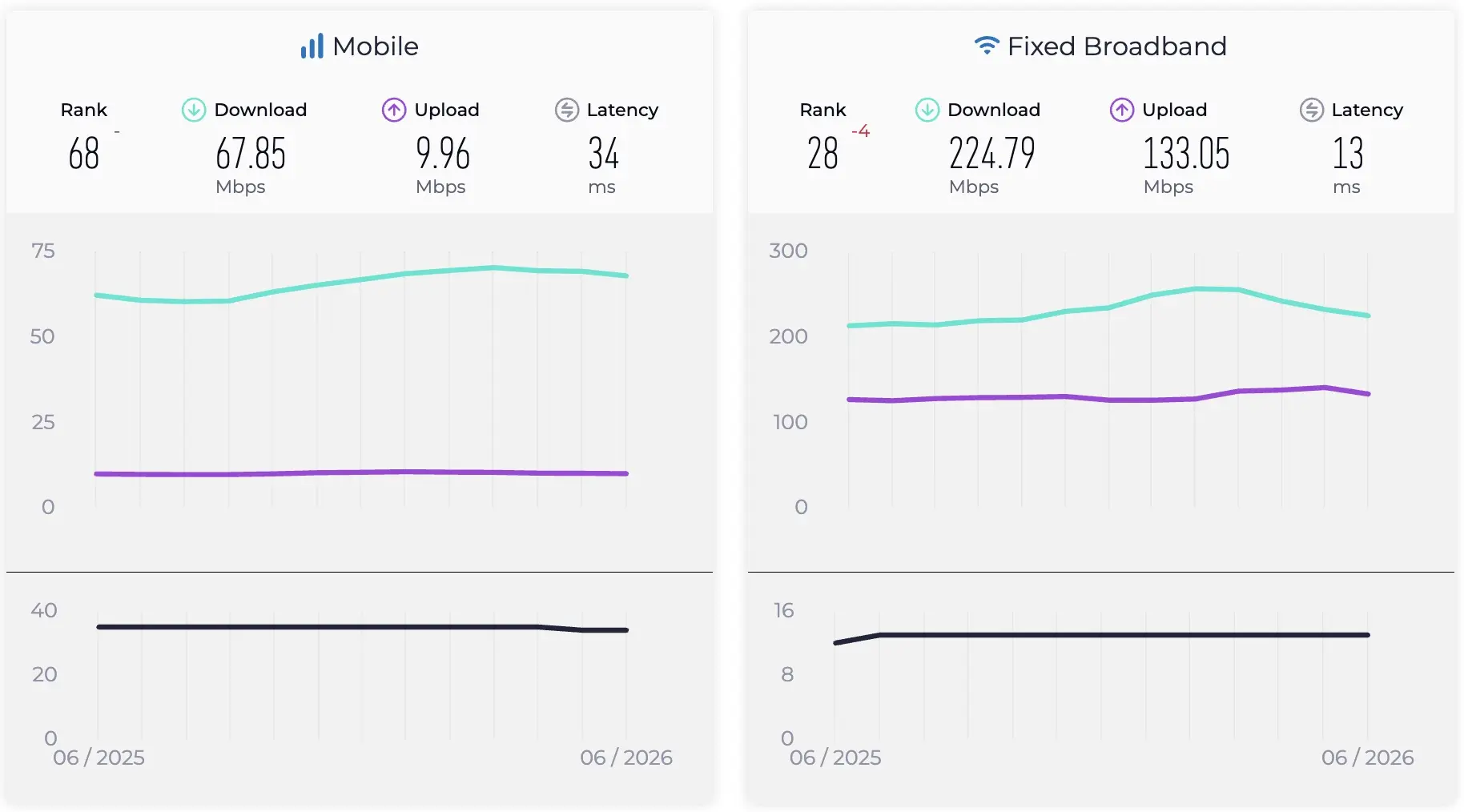
Speedtest Global Index indicates that Japan ranks 68th by mobile download speed globally. The mean download speed is 67.85 Mbps, and the upload speed is 9.96 Mbps, respectively, with a latency (important for real-time apps) of 34 ms. These figures reflect a relatively stable and reliable network.
| Place | Country | Median mobile download speed |
| 4 | Bahrain | 267.68 Mbps |
| 7 | South Korea | 240.68 Mbps |
| 11 | North Macedonia | 192.48 Mbps |
| 12 | China | 179.33 Mbps |
| 14 | Denmark | 176.61 Mbps |
| 24 | Serbia | 152.36 Mbps |
| 33 | New Zealand | 141.29 Mbps |
| 56 | Romania | 84.59 Mbps |
| 59 | United Kingdom | 75.57 Mbps |
| 68 | Japan | 67.85 Mbps |
This table contains data from Speedtest Global Index, retrieved in June 2026.
In April 2020, the Japanese government introduced the Open Innovation Promotion Tax Incentive (OITI), which allowed corporations investing in 5G to get a 15% tax credit or a 30% special depreciation for investments in local 5G infrastructure. It stimulated 5G enterprise deployments.
Japan is also advancing digital development through the Digital Garden City Nation Initiative, a government program that subsidizes 5G, fiber-optic rollout, IoT deployments, and digital transformation projects across municipalities and private enterprises. These combined efforts continue to accelerate 5G development and create new opportunities for local industries.
At the GSMAs Summit, Japan’s Ministry of Internal Affairs (MIC) shared a plan for further fiber-optic expansion across the country. By 2027, the country expects to have 99.9 percent fiber cable infrastructure and 99% 5G coverage. This investment bolsters the deployment of 5G and the upcoming 6G. In July 2024, NTT rolled out the fastest 5G standalone signal in Japan and reached 6.6 Gbps for downloads, according to GlobalData.
eSIM in Japan
The eSIM technology is gaining popularity and supporting the growth of the cellular market in general. To be specific, one of the reports by the IMARC Group predicts that the Japanese eSIM market will grow to reach $2,650.1 million by 2033.
Currently, all four mobile networks in Japan support eSIM (embedded SIM) for contract users. However, tourists cannot buy most carrier plans directly, because Japan has strict regulations on mobile phone identification under the Telecommunications Business Act. This law requires operators to verify the identity of anyone purchasing a mobile number (whether a physical SIM or an eSIM).
To buy an eSIM or a SIM card, Japanese operators require:
- Residence status or a long-term contract, and
- Identity verification (for example, a residence card or passport, usually with Japanese-language forms that tourists cannot easily complete).
For carrier eSIMs by Docomo, au, SoftBank, and Rakuten, ID verification and Japanese-language apps and forms are required, so tourists generally cannot buy these plans directly from the providers.
With travel eSIM providers like Ohayu, you don’t need to show your ID, communicate in Japanese, or do the paperwork. It can be purchased online in USD or Euro currencies. Ohayu offers tourists access to the supported local Japanese networks without ID registration because it provides data-only eSIMs that do not require issuing a Japanese phone number.
Another benefit is a wide selection of data plans. Short-term travelers can select 3 GB for a week and top it up when needed. Visitors staying longer may require a package that includes more data, or choose the Global plan that covers 120+ countries, including Japan, South Korea, China, the USA, and can automatically switch networks when users cross borders.
Top 4 mobile operators in Japan
The Japanese mobile market is highly competitive. Most mobile users are subscribed to the three largest domestic network operators. NTT Docomo has the biggest network and approximately 91.91 million subscribers in Q2 (September 2025). KDDI is the second-largest carrier, with 71.46 million contracts. SoftBank reports having about 56.38 million subscribers. Rakuten Mobile is the newest international entrant with 9.33 million mobile subscribers.
au by KDDI
Au is a major Japanese mobile company. It is widely known for collaborating with SpaceX Starlink to connect remote base stations. Due to the satellite integration, au has a good reputation for reliability and coverage.
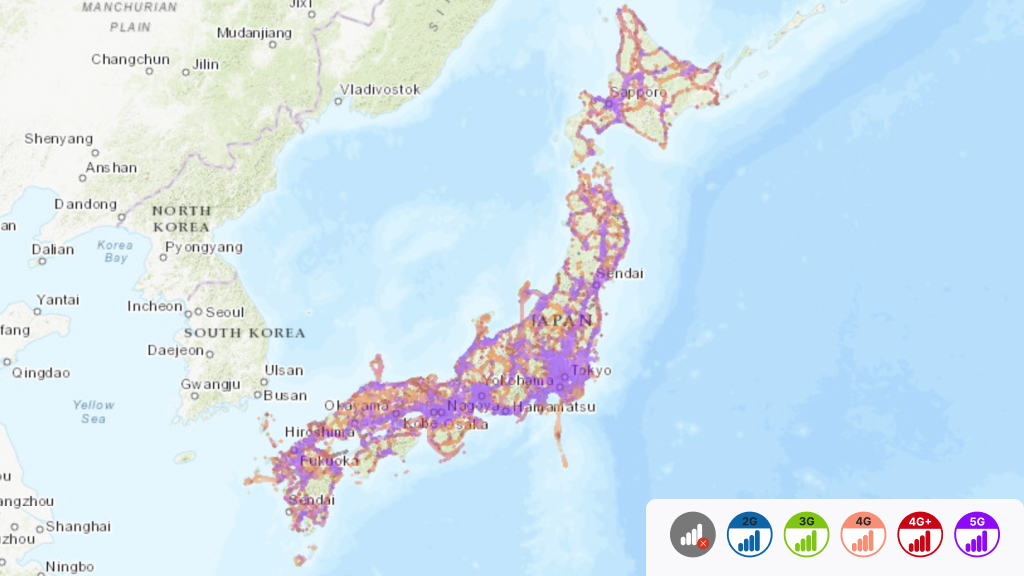
For short-term visitors and tourists, the carrier provides prepaid plans under a different brand name, povo2.0 (in-app and Japanese language-only). SIM cards are available in Lawson convenience stores and are sold in various sizes:
- 3 GB / 7 days at $14.90 (¥2,200);
- 25 GB / 30 days at $31.00 (¥4,580);
- 7-day unlimited data package at $30.45 (¥4,500).
NTT Docomo
NTT provides strong nationwide coverage and reliable service, especially outside major cities. The company invests heavily in network infrastructure and technology. As a result, users experience the most resilient service in the rural parts of Japan.
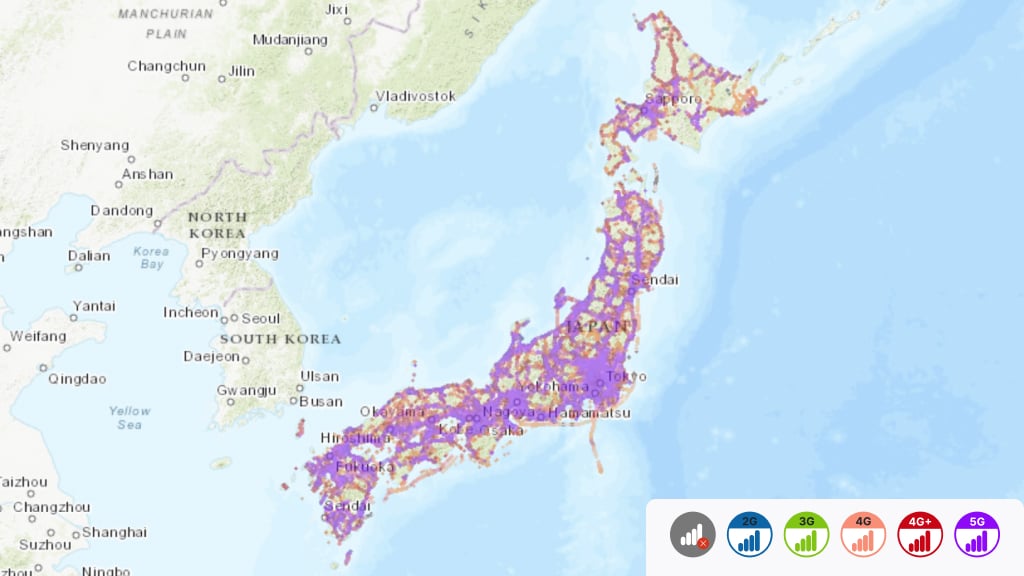
NTT doesn’t sell prepaid SIM cards for tourists directly anymore. Its recent Japan Welcome SIM service was withdrawn in 2023. Nevertheless, third-party companies (MVNOs) offer prepaid plans to tourists (often with a delivery destination). These companies purchase network access from Docomo and sell it to the customers.
Some popular MVNOs are:
- Sakura provides an extensive range of packs from 5 GB for $20.15 to 100 GB for $74.30 per month.
- bMobile offers 10-day and 21-day packages with 5 GB for $13.40 and 7 GB for $20.10.
- eConnect Japan has plans for heavy internet users, e.g., 50 GB for $36.50, 50 GB with 5G for $43.30, and 100 GB for $48.70 (limited to 31 days).
- Nippon SIM offers a variety of SIMs (10 GB for $16.80 to 100 GB for $101.35) with long-term usage – 180 days.
SoftBank
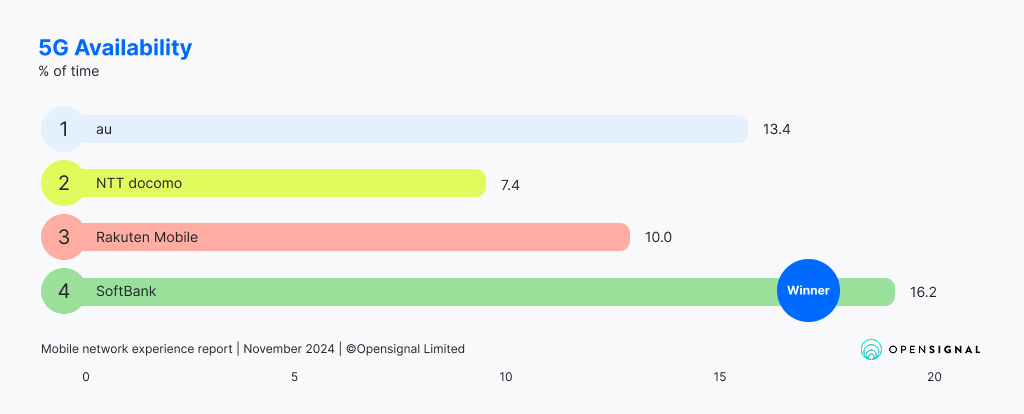
SoftBank has a good 5G performance, especially in urban centers. The company boasts the best 5G availability, and its users are on an active 5G connection longer than on any other network. This reveals the company’s commitment to the expansion of its high-speed service.
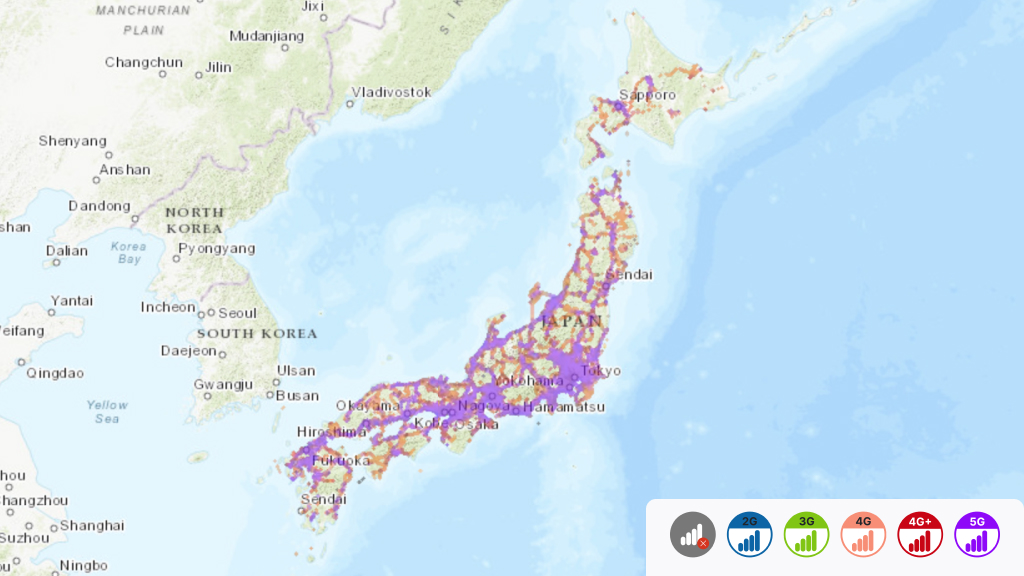
SoftBank’s official prepaid option is called Simple Style, available for 4G and some 3G devices. Here are some of the prepaid plans:
- $6.60 (¥990) – 200 MB for 2 days;
- $19.80 (¥2,970) – 700 MB for 7 days;
- $36.50 (¥5,478) – 3 GB for 30 days.
There is also a SIM card rental service. The rate is $0.75 a day.
Rakuten
Rakuten holds a smaller but growing share of the Japanese mobile market. Its technical achievement was the construction of a completely virtualized, cloud-native network. The operator has refined its consistent quality and is now competitive in areas such as upload speeds.

Meanwhile, the company is increasing its network. To achieve this, it uses five major frequency bands, including the new platinum band (700 MHz), which has improved signal penetration in buildings and tunnels. Furthermore, the provider collaborates with other carriers, such as KDDI (au), to ensure broader availability, particularly in more rural areas.
Rakuten Mobile does not have dedicated tourist prepaid SIMs. Instead, they have a “Rakuten SAIKYO” as their primary option. It offers unlimited monthly data across the nationwide network. It also has a free international roaming allowance of up to 2 GB per month in more than 90 countries.
Prices vary by age group and data usage. For example, users aged 23-64 can expect to pay (incl. taxes):
- $7.30 (¥1,078) – up to 3 GB.
- $14.75 (¥2,178) – up to 20 GB.
- $22.20 (¥3,278) – unlimited.
Additionally, national calls are free from the mobile app.
Comparison of Japanese mobile operators
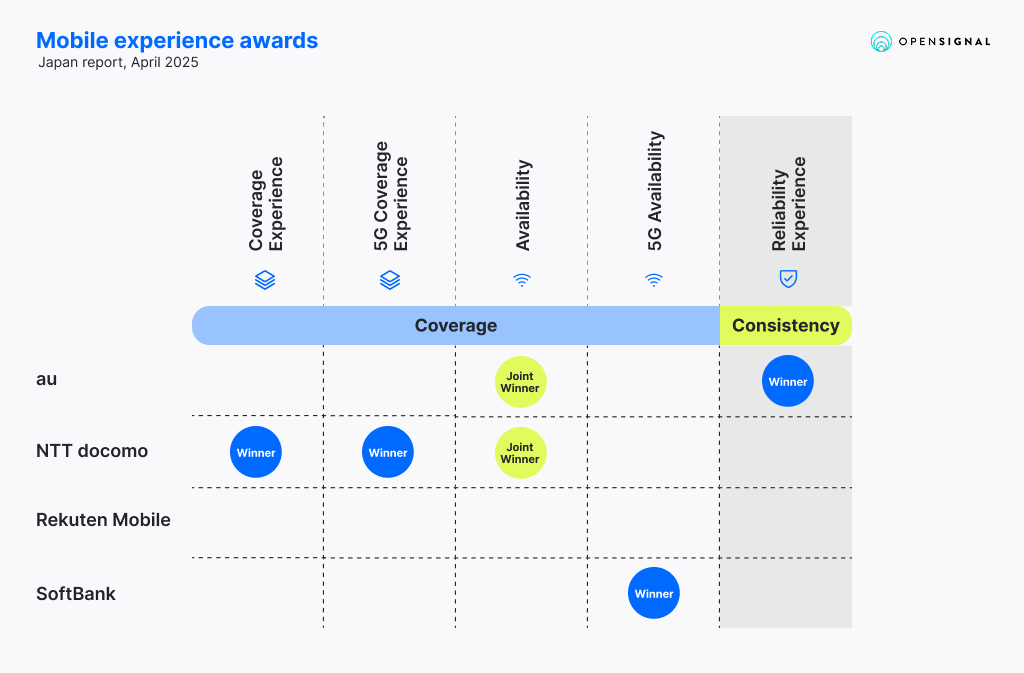
Based on the Mobile Network Experience Report by OpenSignal (April 2025), au is the winner in overall and 5G performance categories, NTT Docomo has the highest 5G download speed and coverage, Rakuten has the best upload speed, and SoftBank leads in availability. To see the difference between the carriers in detail, we should examine the coverage maps, plans, prices, and additional features each of them has.
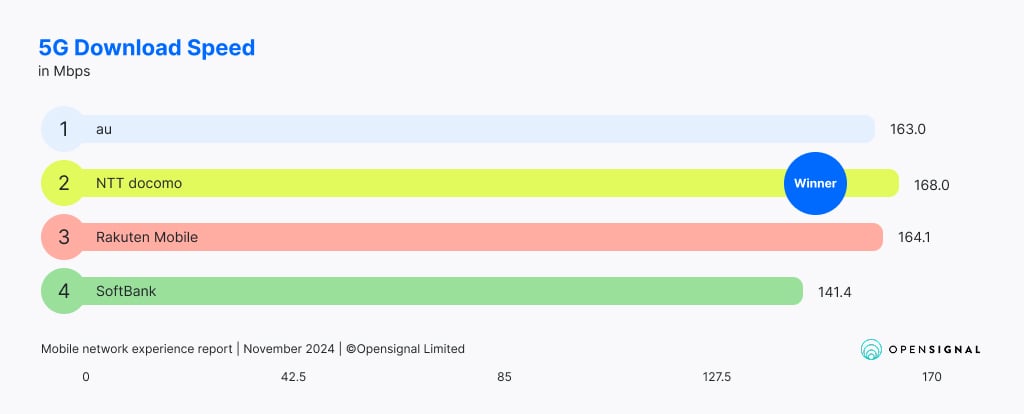
5G Speed
For 5G download speed, NTT has the highest rate at 168.0 Mbps.
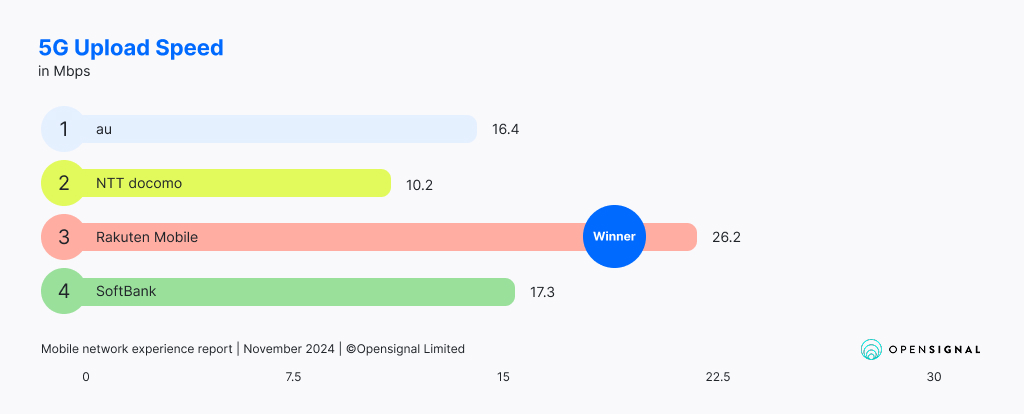
Rakuten’s 5G upload speed is 26.2 Mbps, significantly faster than the second-place result of 17.3 Mbps.
5G Coverage and availability
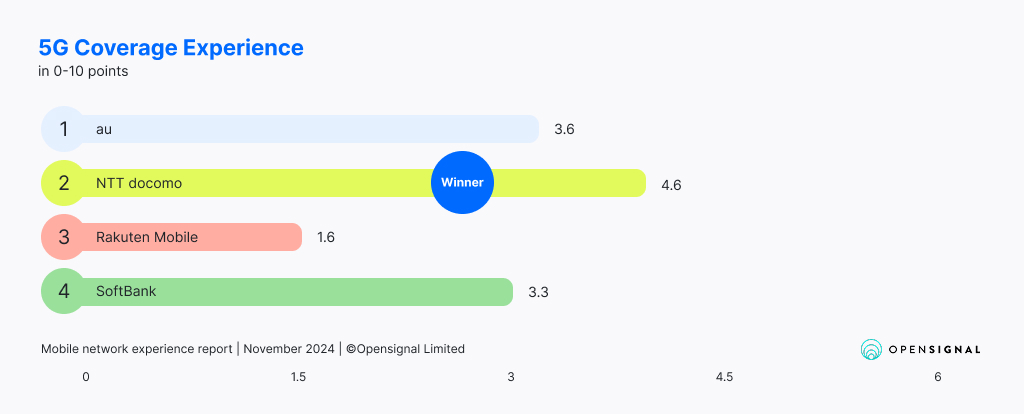
NTT is the 5G Coverage Experience leader, which means that its 5G is accessible at more locations than the competitors.
The 5G Availability winner is SoftBank. Its users have the highest time connected to an active 5G signal.
Japanese mobile providers comparison table
| Japanese mobile operators | Mobile download speed* | Key strengths |
| au (KDDI) | 60.7 Mbps | Strong overall and 5G experience; high reliability; extensive coverage in cities and regional areas; Starlink-backed remote-site connectivity |
| NTT Docomo | 55.7 Mbps | Best 5G download speeds; excellent rural and mountainous reach; very consistent nationwide performance |
| SoftBank | 65.1 Mbps | Best overall download experience; users stay on 5G longest; strong performance in dense urban zones and transport corridors |
| Rakuten Mobile | 39.6 Mbps | Fastest 5G upload speed; expanding footprint with new 700 MHz “platinum band”; fully cloud-native network |
| Ohayu (travel eSIM) | Depends on the local network | Connects to supported networks like Docomo, KDDI, or SoftBank; data-only plans; no ID needed; convenient for tourists and multi-city travel |
| MVNOs (IIJmio, BIC SIM, b-mobile, Sakura, Nippon SIM) | Varies by host network | Lower-cost prepaid options; operate on Docomo, KDDI, or SoftBank networks; flexible short-term plans |
Download speed values are based on Opensignal’s Mobile Network Experience Report – Japan, April 2026.
Final thoughts
Major mobile networks in Japan offer cellular plans for permanent residents, each with its own special features. For example, NTT Docomo might be your best bet if you need the signal to reach farther into rural areas. If top download speed matters more to you, then KDDI is appealing, while SoftBank is a solid choice for strong 5G availability. Rakuten, on the other hand, provides unlimited data at a competitive price.
Tourist-friendly solutions such as online eSIMs by Ohayu make it easier for travelers to use local networks without ID verification or searching for local stores. With a range from fixed-data to unlimited plans, you can make your stay in Japan more comfortable. Take a closer look at what each provider offers and compare the pros and cons. Choosing the right plan and timing your trip well will make it easier to stay connected throughout your stay in Japan.