


Verizon, T-Mobile, and AT&T are the three largest US mobile operators with their own networks. The competition between these providers is not only in coverage (it’s a big deal to build a network for all 50 states), but also in network quality, speed, pricing, and, of course, roaming terms for international travel.
In 2026, T-Mobile has the highest mobile speed and 5G availability, Verizon works well in cities and has premium coverage quality, and AT&T gets clients with lower prices and with business services.
For travelers, there are also online eSIMs like Ohayu that connect to supported local US networks without a physical SIM card or store visits and have cheaper prepaid plans for short visits.
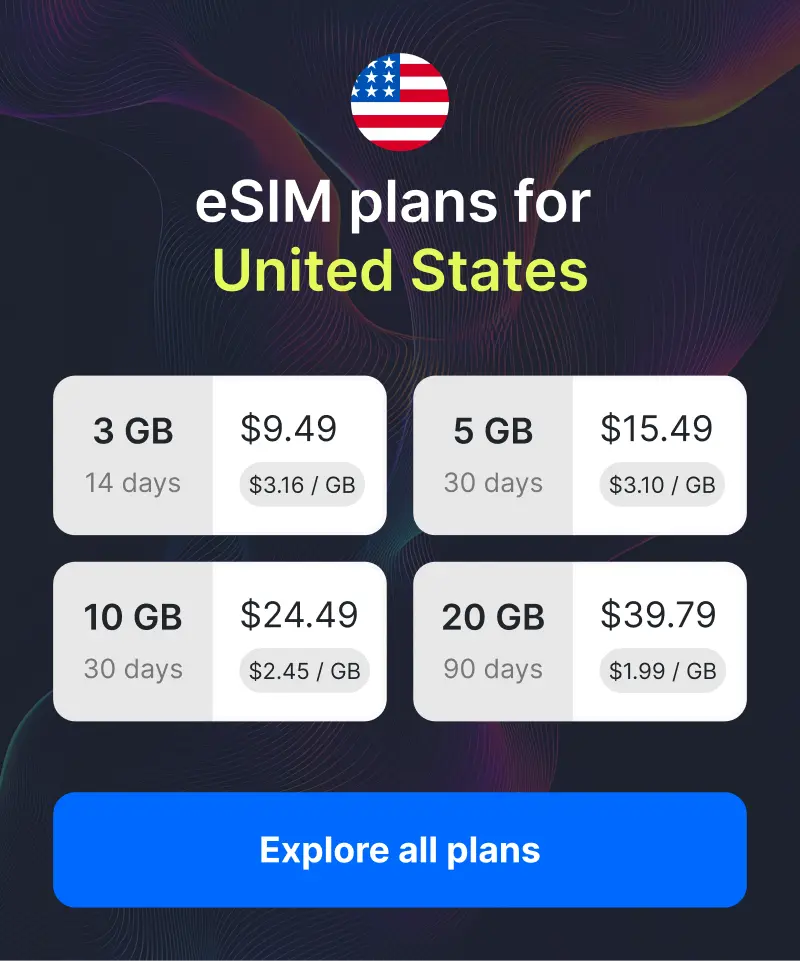
Before buying, check that your phone supports eSIM. Dial *#06# (it’s not a call and does not charge you) – if your phone displays an EID number, it’s eSIM-compatible.
US mobile market overview
The United States has one of the most competitive telecom markets in the world. The country is geographically so large that network coverage and signal quality are very different between states.
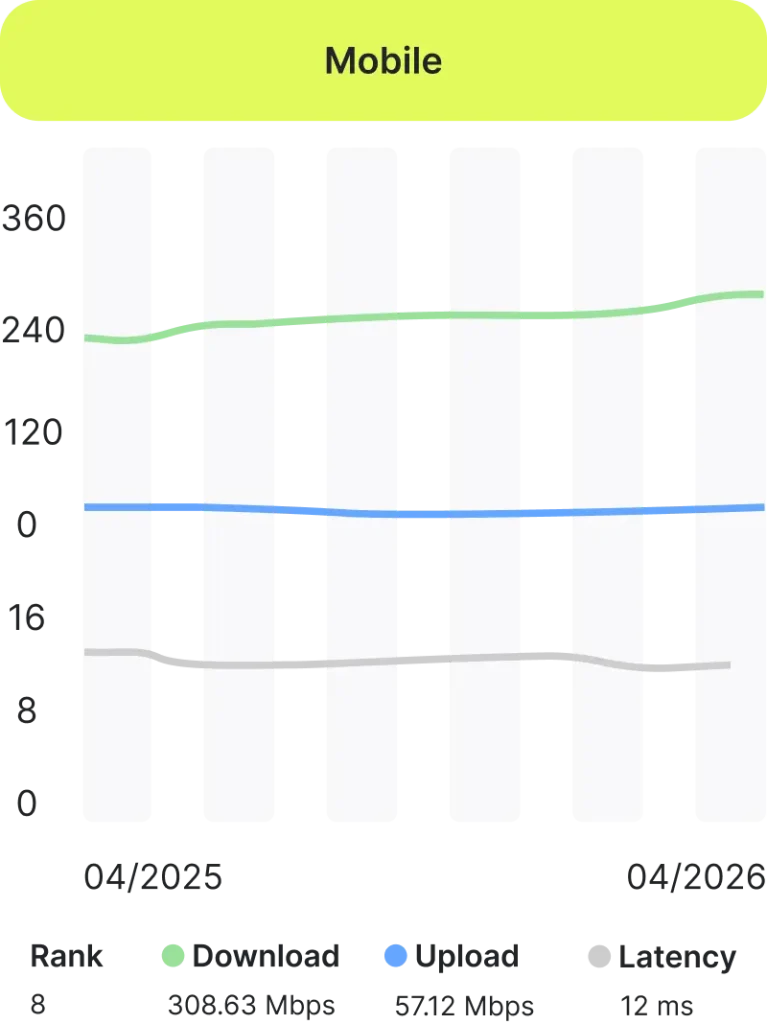
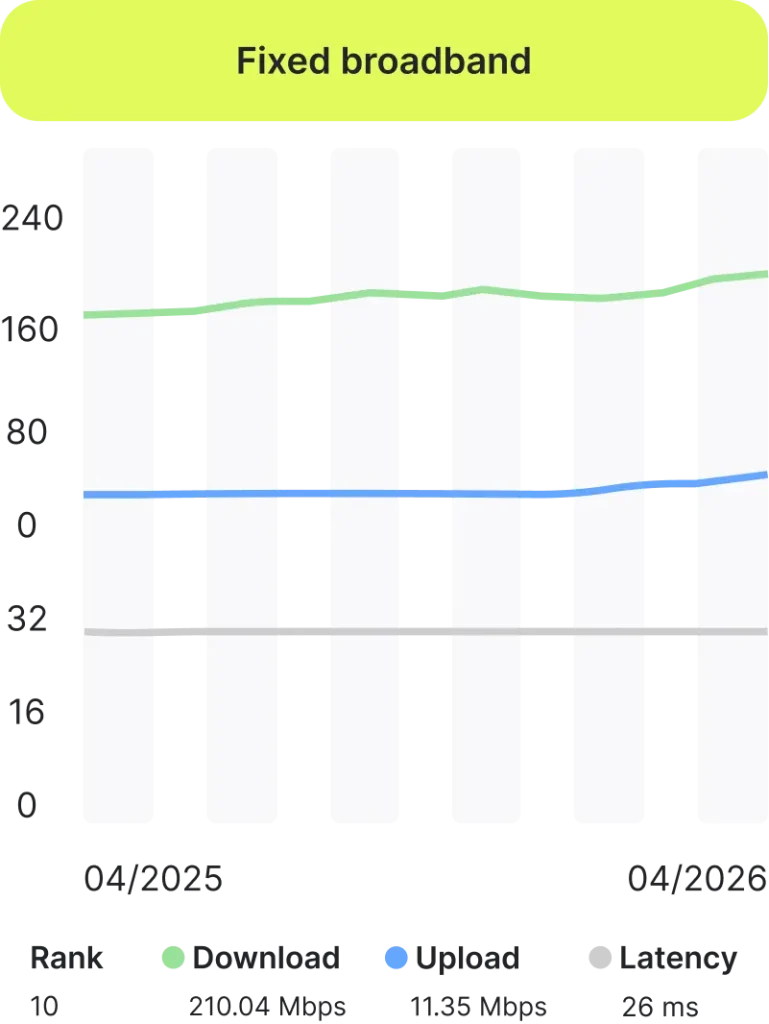
According to Speedtest, the United States ranks 10th in the global network speed ranking. The average download speed is 308.63 Mbps, and the upload speed is 57.12 Mbps. With only 12 ms latency, this is one of the best mobile internet characteristics in the world.
US mobile coverage
In New York, Chicago, Miami, Los Angeles, Dallas, and San Francisco, 5G is a standard. However, in highways, deserts, mountains, and national parks, you will most probably have LTE. Here are the reasons for that:
- Geography. The country is huge, landscape differs. In cities, the signal is stable because operators invest in infrastructure.
- Frequency spectrum (low-band and mid-band). Low frequencies penetrate walls better and cover longer distances. High frequencies provide fast Internet but cover a small area. It explains why the Internet is fast in cities and slow in villages.
- Market development and competition. In cities, operators compete for customers and build strong infrastructure. In remote locations, competition is weaker, so the connection quality also varies.
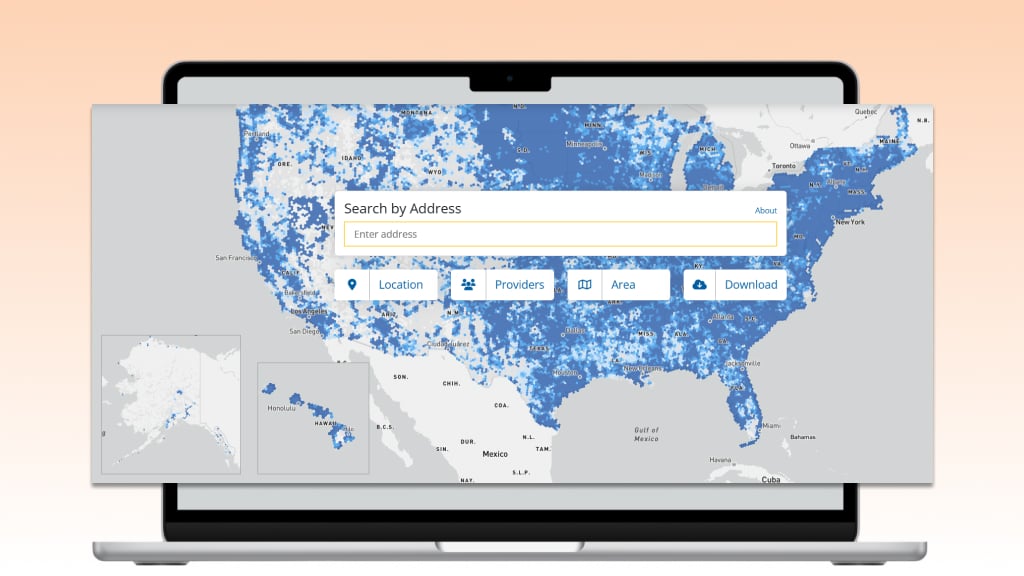
- Federal programs. Authorities encourage the development of communications in villages. For example, the Federal Communications Commission (FCC) continues to set rules based on a broadband coverage map. This stimulates investment to improve 5G in the countryside, you can check it by address using this coverage map.
5G technology
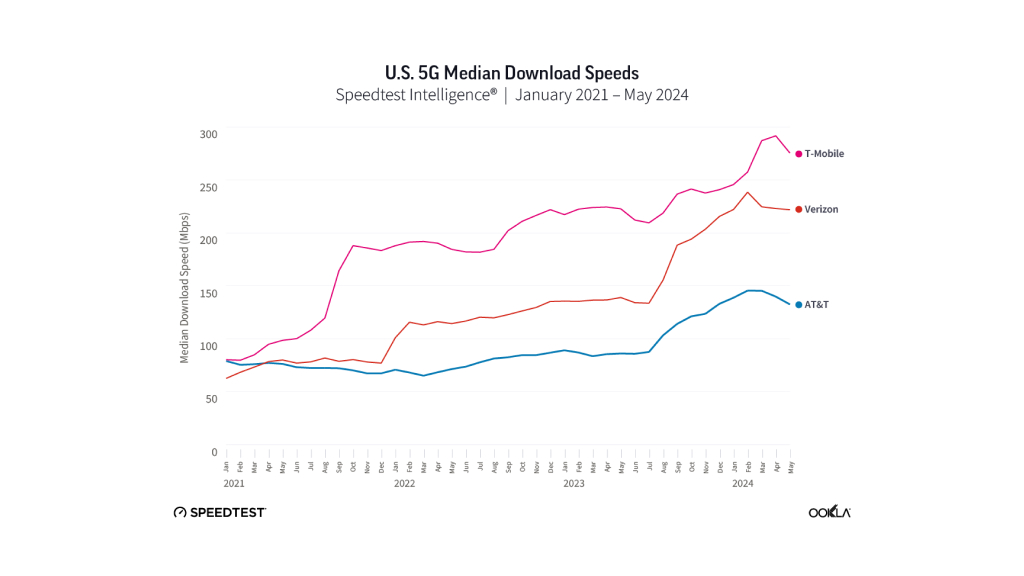
The United States is one of the leaders in 5G. Ookla demonstrates how each operator introduced 5G from 2021.
Top 3 US mobile operators
There are three main mobile operators in the US: Verizon, T-Mobile, and AT&T. They cover almost the entire country.
Apart from the 3 major providers, there are also plenty of MVNOs (mobile virtual network operators). These companies lend network capacities from one of the 3 main networks with their own tariffs and services. There are also more than 100 regional operators that work only in certain states and have roaming for other regions.
Now let’s take a closer look at the market leaders.
Verizon
Verizon is one of the most popular US mobile networks. It doesn’t have the highest speed, but it is known for its excellent coverage throughout the country (mix of low-band, C-band, and mmWave spectrum).
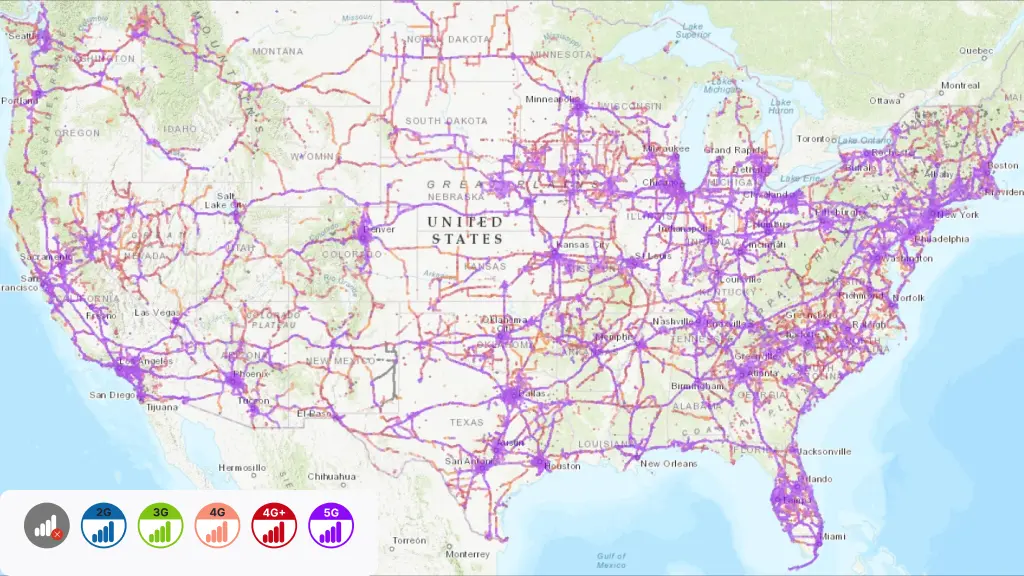
The operator has one of the best coverage for mobile communications and 4G LTE. Users receive 5G ultra-broadband (Verizon’s fastest Internet) almost all over the country, while the main business facilities are located in the central and eastern parts. The most densely covered states with 5G edge are Ohio, Georgia, Tennessee, Missouri, and South Carolina.
Verizon prices 2026
| Plan | Data | Approx. monthly price |
| Unlimited Welcome | Unlimited | From $65 |
| Unlimited Plus | Unlimited + premium data | From $80 |
| Unlimited Ultimate | International features included | From $90 |
Features
- 4G LTE technology: Verizon has very wide 4G LTE coverage. They were the first to launch this technology in 2010.
- High level of 5G: The provider is actively developing a 5G network. The company uses mmWave (faster but with a smaller coverage radius) and Sub-6 GHz (slower but with greater coverage) technologies for 5G.
- Additional perks: The operator has unlimited plans covering video, music, and streaming
- Plans: Verizon has discounts for the military, teachers, nurses, students, and first responders. Plans start from $10.
Main Verizon MVNOs
| Name | Price |
| Visible | from $25 |
| Red Pocket | from $10 |
| Charity | from $29 |
| Spectrum | from $30 |
| enTouch | from $10 |
| Selectel Wireless | from $15 |
| US Mobile | from $8 |
| Lexvor | from $25 |
| MobileX | from $15 |
| Credo | from $35 |
T-Mobile
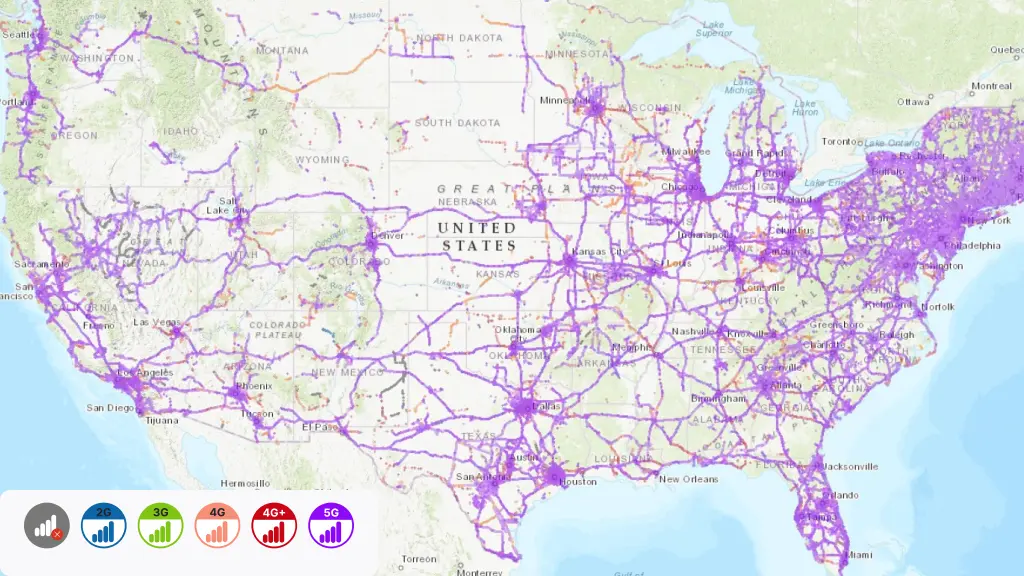
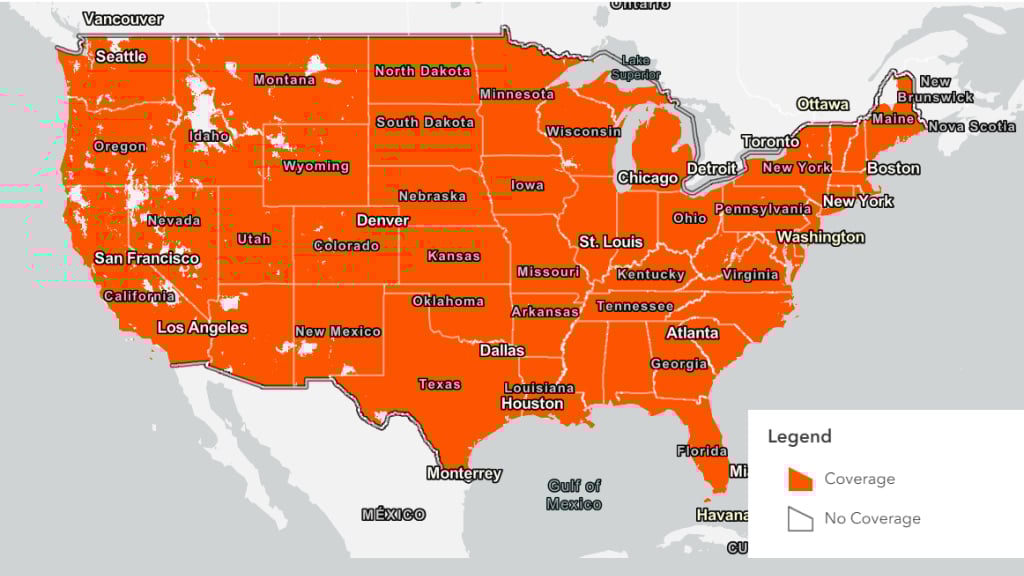
T-Mobile is the fastest mobile operator in the US. It has good coverage in cities, but compared to Verizon, its network has weaker coverage in the countryside. T-Mobile uses a low-frequency spectrum for 5G.
T-Mobile prices 2025
| Plan | Data | Approx. monthly price |
| Essentials Saver | Unlimited | From $50 |
| Go5G Plus | Unlimited premium data | From $90 |
| Go5G Next | Frequent phone upgrades | From $100 |
Strengths
- Unlimited plans with bonuses: Often, these include access to streaming services (Netflix, Apple TV+, Paramount+) at no extra cost.
- Affordability: Cheaper family plans, bonuses for veterans and the military, and extras (discounts on international calls or mobile Internet roaming).
- Technical innovations: The company actively integrates technologies like VoLTE (Voice over LTE) for better call quality.
Main T-Mobile MVNOs
| Name | Price |
| Access Wireless | from $15 |
| Google Fi | from $20 |
| Red Pocket | from $10 |
| Mint | from $15 |
| Tello | from $8 |
| Lycamobile | from $24.50 |
| AirTalk Wireless | from $10 |
| Ultra Mobile | from $10 |
| H2O | from $18 |
| Gen Mobile | from $9 |
| Ting | from $25 |
AT&T
AT&T is the third-largest US mobile provider that also sells home internet, TV, and business solutions.
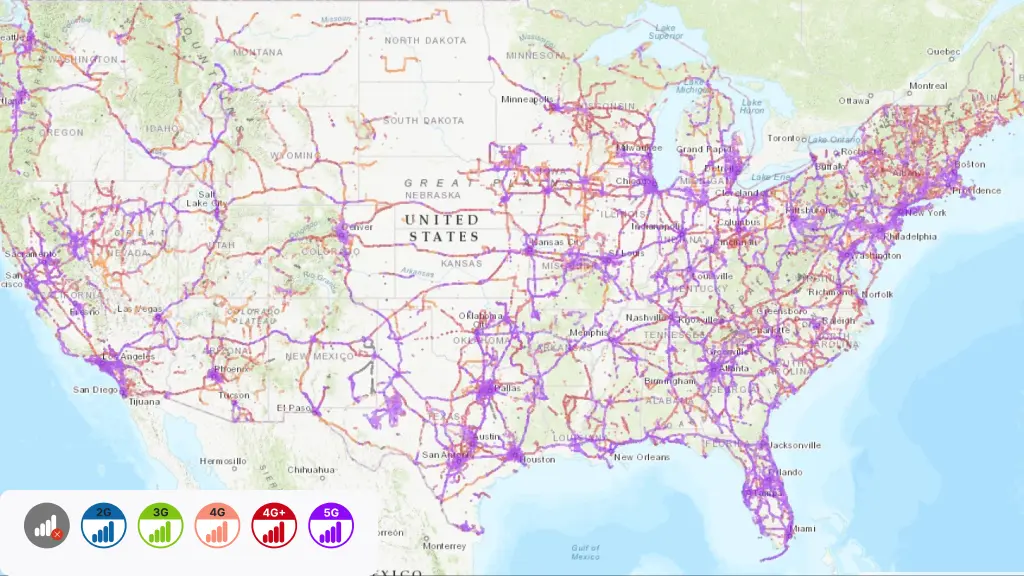
Compared to Verizon, AT&T’s coverage is weaker in the countryside, but for most users in cities and suburban regions, this won’t be a problem. The operator is actively developing 5G.
AT&T prices 2026
| Plan | Data | Approx. monthly price |
| Unlimited Starter | Unlimited | From $66 |
| Unlimited Extra | Unlimited premium data | From $76 |
| Unlimited Premium | International roaming included | From $86 |
Strengths
- Discounts and special offers: There are plans for businesses and large families. Their plans include unlimited internet, HD video, and free subscriptions to some streaming services.
- Call quality: AT&T’s network is known for stable calls and good connection quality.
AT&T MVNOs
| Name | Price |
| Cricket | from $30 |
| Allvoi | from $14.40 |
| Black Wireless | from $15 |
| FreedomPop | from $10 |
| Red Pocket Mobile | from $10 |
| FreeUP | from $15 |
| Life Wireless | from $30 |
| Pure Talk | from $20 |
| Sprout Mobile | from $25 |
| Troomi | from $13 |
| Pulse Cellular | from $22 |
Other mobile operators in the USA
Several smaller operators and MVNOs continue growing in the US market, like Boost Mobile and US Cellular.
Boost Mobile
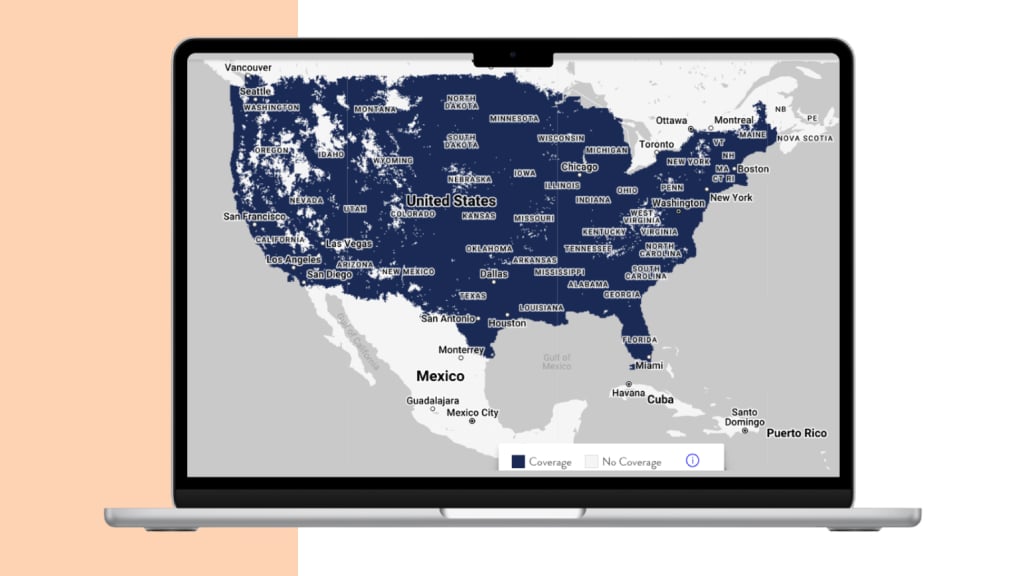
Boost Mobile has good coverage thanks to its partnership with T-Mobile and sells cheap prepaid and contract-free plans. They also have a pay-as-you-go option – that’s great for people who don’t want to tie themselves into long-term deals. Prices start at $25 per month (unlimited talk, text, and data).
U.S. Cellular
U.S. Cellular has excellent local support. The operator is actively developing a 5G network, but coverage is still limited compared to other leading networks. Nevertheless, in the coverage areas, the speed is very good. Packages start at $25 and include unlimited access to 5G/4G, HD video, and additional services for international calls.
Comparison of the best US mobile networks: T-Mobile, AT&T, Verizon
US mobile networks differ in their approach to customers and tariff packages. Still, the coverage quality is good for each company. The Opensignal report from January 2025 also proves this.
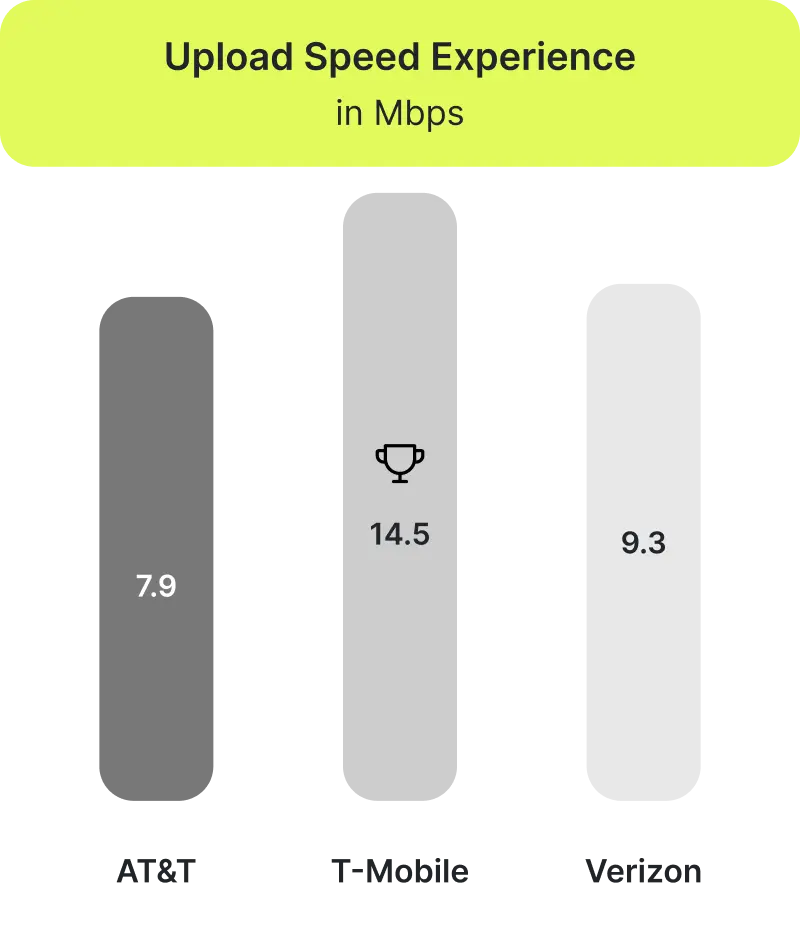
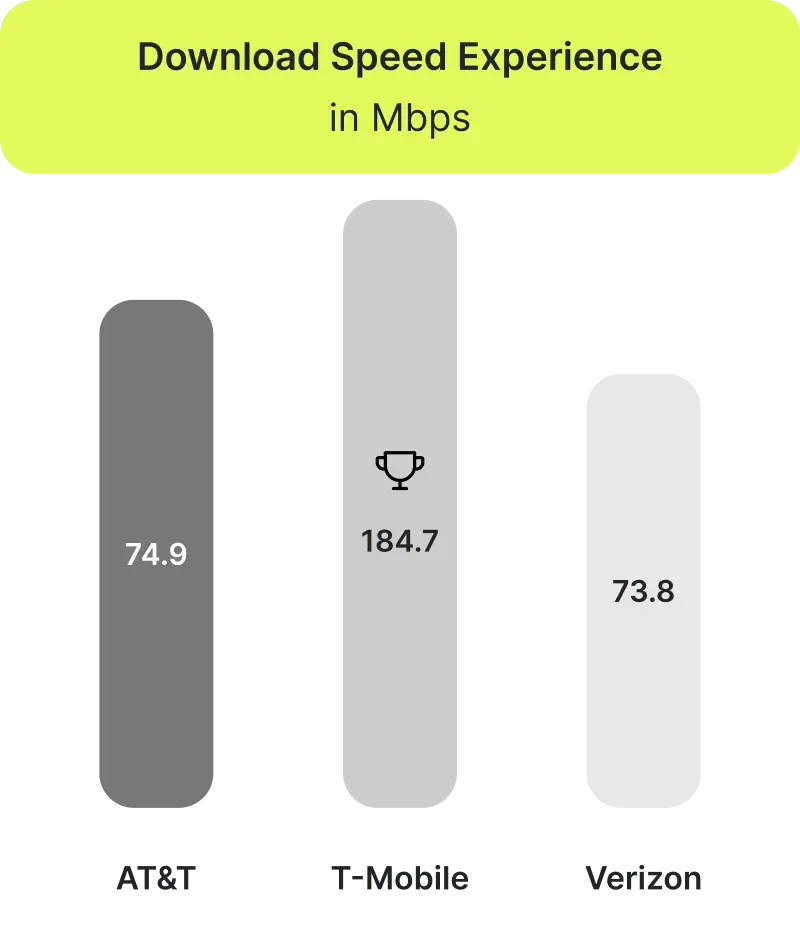
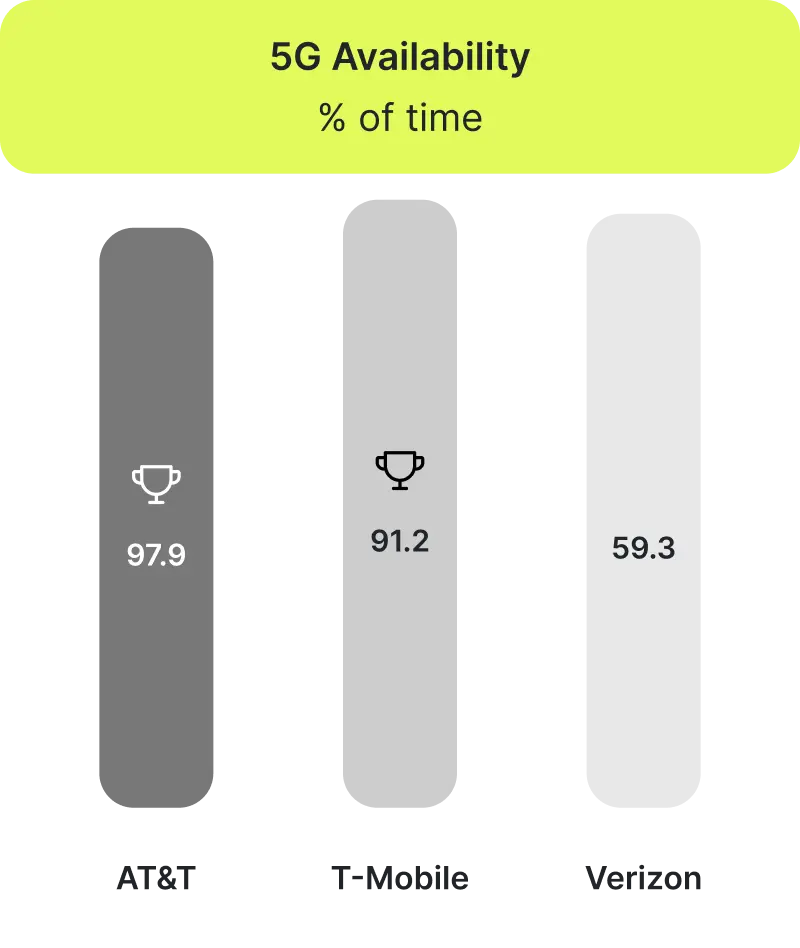
According to this data, T-Mobile has become the obvious leader in terms of overall experience among other mobile operators in the USA. It demonstrates almost equal performance in video and gaming experiences.
T-Mobile has the fastest mobile download and upload speeds. AT&T and T-Mobile are the best in 5G availability.
| Operator | Best for | Main limitation |
| Verizon | Rural coverage and reliability | Higher prices |
| T-Mobile | Fast 5G speeds | Rural coverage still varies in some regions |
| AT&T | Balanced nationwide service | Fewer aggressive pricing options |
| Boost Mobile | Budget prepaid plans | Lower priority during congestion |
| Google Fi | International travelers | More expensive for heavy data use |
Final thoughts
US mobile networks continue to improve rapidly in 2026. AT&T stands out for its extensive rural coverage and services for businesses. Verizon delivers the best overall coverage and high-quality voice calls and provides super-fast 5G in major cities. T-Mobile, on the other hand, has the fastest and most extensive 5G network and features favorable plans for families and travelers. It’s also worth keeping in mind that there are plenty of regional operators and MVNOs with low-cost solutions. However, they’re usually inferior to the big players in terms of coverage and speed.
For short-term visitors, prepaid SIM cards and travel eSIMs are usually simpler than long-term contracts. Most travelers mainly need stable mobile internet for navigation, transport apps, hotel bookings, messaging, and hotspot use, so a data-only eSIM like Ohayu is often enough. It helps to save time, money, and to use the powerful Internet comfortably from any corner of the world.