

When I travel to West Africa, one of the first things I check is the local mobile network situation. Reliable coverage is essential, whether it’s for navigation, staying in touch, or simply sharing the trip as it goes. I’d like to share my experience with you, starting with Ghana.
The major mobile networks in Ghana are MTN, Telecel (formerly Vodafone), and AT (formerly AirtelTigo). Each has its strengths, but together they dominate the market. In this guide, I’ll walk you through the available phone plans from local carriers, and I’ll also cover the more flexible eSIM option you can find at ohayu.com.
Ghana’s mobile market overview
The first Ghanaian mobile phone network was launched in 1992. It was by Mobitel, which we know today as AT (AirtelTigo).
Flash-forward to today, the cell phone industry is growing. At the beginning of 2026, there were 38.3 million active cell connections in the country. It is more than the population of Ghana. That’s because most people carry two or more SIMs and use them for various purposes (business and personal) or on separate networks.
As for the fixed broadband speed, the Speedtest Global Index in June of 2025 shows that Ghana has an average of 48.47 Mbps for a download and 18.71 Mbps for an upload, and was ranked 132 globally. The latency, or the speed at which a signal travels, was 22 milliseconds.
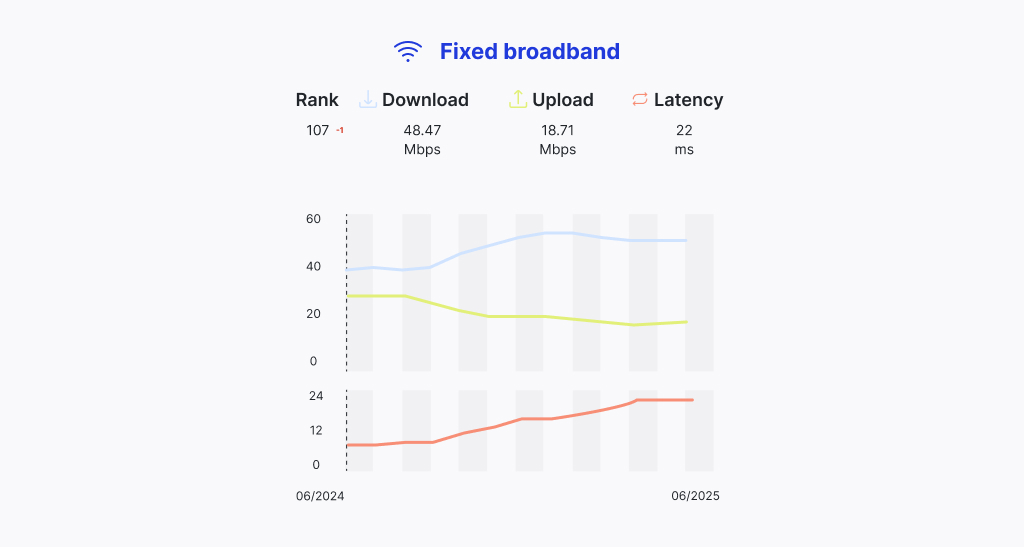
Ghana’s mobile speed data is limited. But based on fixed broadband, users can expect lower download and upload speeds compared to countries with more developed internet infrastructure. Here’s a comparison table for May 2026 to illustrate the difference.
| Country | Median fixed broadband download speed |
| France | 352.77 Mbps |
| United States | 306.86 Mbps |
| South Korea | 252.67 Mbps |
| Japan | 232.02 Mbps |
| Brazil | 227.66 Mbps |
| United Kingdom | 181.59 Mbps |
| Australia | 157.56 Mbps |
| Ghana | 48.72 Mbps |
The Ghanaian government has made internet access a priority, even in rural communities. The plan is ambitious – to extend 4G coverage from around 15% to 80% within three years. To make this happen, they are planning to build around 4,400 new 5G and 4G stations. The initiative is under the Next-Gen InfraCos (NGIC) program.
But for now, travelers still have to face limitations in both speed and coverage.
Ghana’s mobile quality rank
In the first half of 2026, Ghana ranked 127th on the Global Network Excellence Index. In terms of 4G/5G availability, it stood at around 69%. In practice, it means that about two out of three times your phone will be connected to a 4G network. You can only have 3G or even 2G in many rural locations.
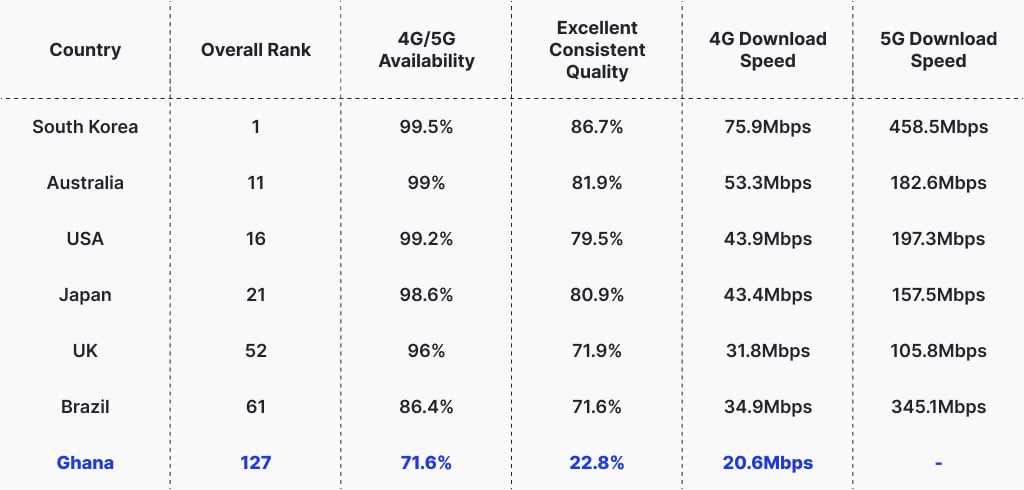
And there is an even bigger challenge related to connection stability. Consistent quality of the mobile internet is 17.2% max. It means that even if you’re lucky to see a 4G icon on your phone, the connection will not always be reliable and good enough for video calls or online streaming. This is something to note if you depend on high-quality internet for work or entertainment.
The good news is that 4G download speed in 2025 reached 18.3 Mbps. It is not blazing fast by global standards, but it’s enough for day-to-day use: browsing, checking social media, sending emails, and watching SD videos.
Realistically, Ghana has 4G, you just need to be ready for occasional signal drops, and note that broader 5G coverage is still in plans.
Top 4 mobile networks in Ghana
The best mobile operator in Ghana is MTN, with the widest 4G coverage. Telecel and AT offer more affordable mobile internet prices, while Glo has cheap packages for unlimited free calls within the network. Let’s review them in detail.
MTN
This carrier is popular not just in Ghana but across all of Africa. They provide standard services such as voice calls and data bundles, but what actually sets them apart is MTN Mobile Money, widely used for payments.
From my personal experience and 3rd-party reports, MTN has the widest 4G coverage. Ookla’s Speedtest has consistently named it the fastest network. Back in 2021, their average download speed was 8.24 Mbps, and now it’s improved to 12.84 Mbps.
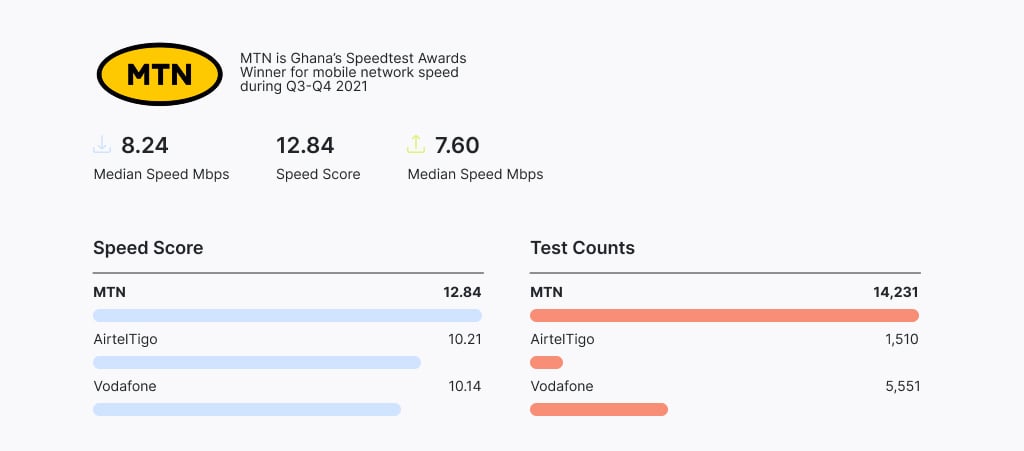
This mobile operator has put significant investment into building additional cell towers and increasing 4G coverage. Stand-alone tests by nPerf.com also confirm their strong coverage across all regions.
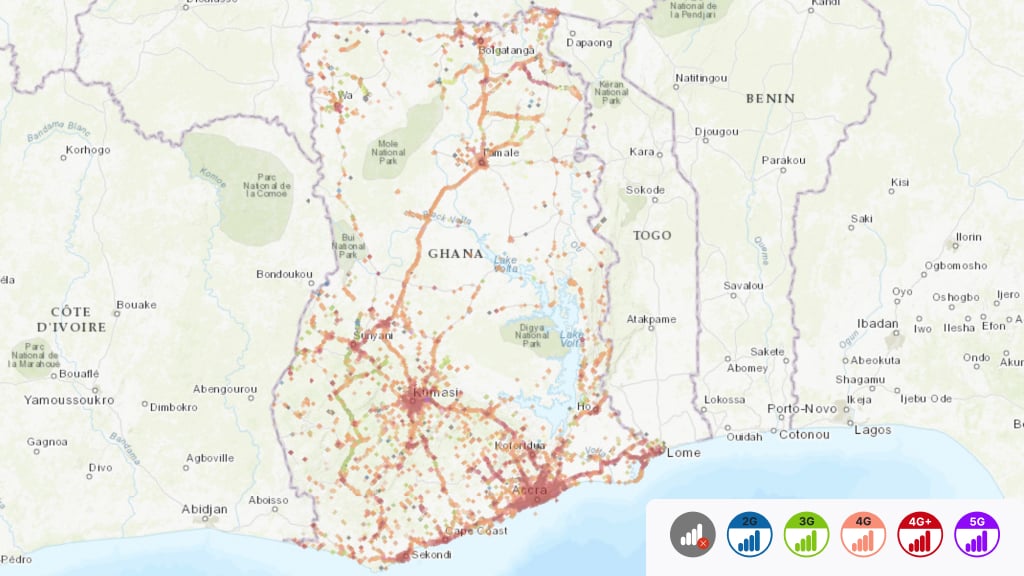
For travelers, MTN has plenty of data-only plans. You can grab a daily or weekly pack for a short visit, or buy larger bundles for a longer stay. Among all carriers, MTN has the strongest presence in Ghana. No other operator matches its coverage footprint.
Telecel (formerly Vodafone)
Telecel, previously known as Vodafone, is another strong mobile operator. They provide mobile phone services, home internet, and their own mobile payment platform, called Telecel Cash. But their 4G coverage is visibly worse vs. MTN, as it is available almost only in the biggest cities in Ghana.
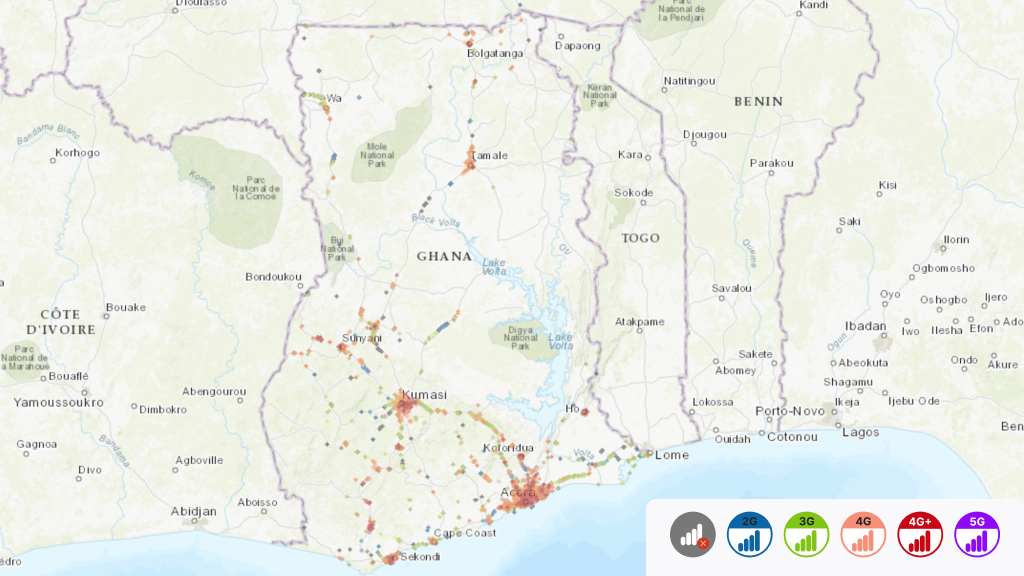
One of Telecel’s highlights is its bundles, including “Flexi No Expiry” options, which are very handy for travelers. For instance, you can get:
- 550 MB for GHS5 (about €0.41 / $0.48).
- 99 GB for GHS300 (about €24 / $28).
With these bundles, you can actively use mobile internet data for up to 6 months.
AT (formerly AirtelTigo)
AT was formed as AirtelTigo after Airtel and Tigo merged, combining their strengths into a single operator. One of its features is cheap data plans and unlimited voice calls in the network. But keep in mind that their speed is really poor – you will get only 3G connection, and almost only in Kumasi and Accra areas.
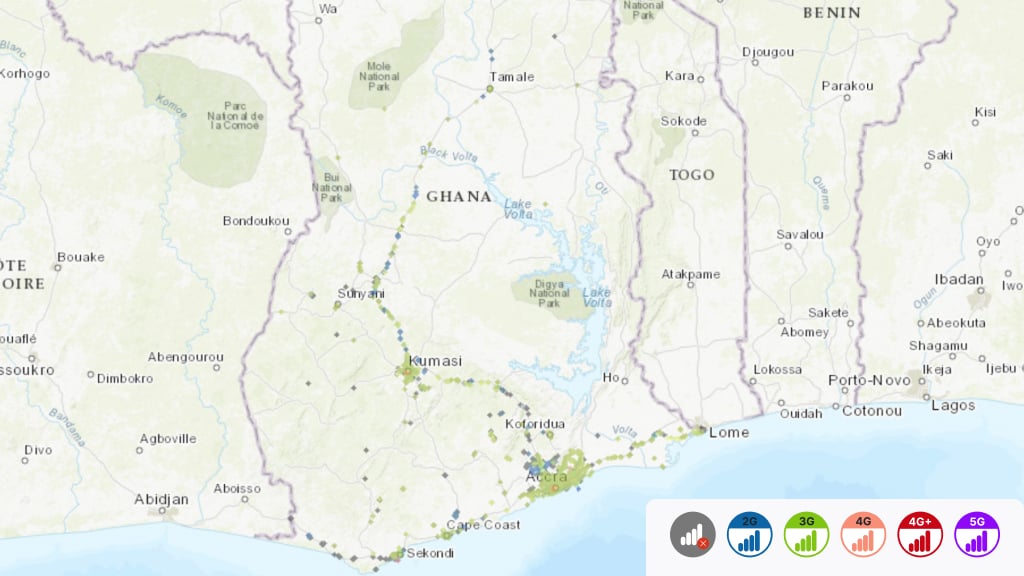
Like Telecel, AT also has “BigTime Data Bundles” with no expiry. In particular, you can buy:
- 550 MB for GHS5.
- 4.4 GB for GHS50 (about €4.10 / $4.81).
- Up to 250 GB for GHS400 (about €32 / $38).
These bundles work instantly after activation and are available to all prepaid users.
Glo
While perhaps not as widespread as its competitors, Glo is a viable option in certain regions if you need voice services. The carrier faced several challenges with network rollout in the past.
Glo’s approach is a bit different from the competitors. They offer “Glo Yakata” and “Glo Talk More” plans, which give you benefits when you recharge. For example, with “Glo Yakata”:
- Recharge GHS5 (€0.41 / $0.48) and get 1.25 GB (10 days) + free Glo-to-Glo calls.
- Recharge GHS20 (€1.60 / $1.92) and get 5 GB (40 days) + unlimited Glo-to-Glo calls.
This is a good value if you often call friends or family who are also on the same network, and you do not really need Internet access.
Ghana MVNOs
Beyond these big names, Ghana also has Mobile Virtual Network Operators (MVNOs). They don’t own their own infrastructure, but lease it from major mobile network carriers, and then offer special plans or lower pricing. Key MVNOs are Surfline Communications, Blu Telecoms, and Busy Internet.
While the MVNO market is still developing compared to some other countries, it is an area that could provide more choices in the future for savvy travelers looking for niche options.
Ghana eSIM – smart travel option
When you are hopping between countries, dealing with tiny physical SIM cards can be messy. I’ve lost a few myself. This is why eSIM has become my go-to solution.
- Ohayu connects through supported networks where coverage is available, so you can have better coverage than relying on a single local operator. With Ohayu, you get access to both MTN and Telcel networks.
- The convenience is unmatched. There is no physical SIM card to buy or swap. You do not have to find a local store and stand in a queue to buy it.
- It can be cost-effective. eSIM can reduce the use of home roaming if you set it as a mobile data line. Instead, you can pay something closer to local operators’ rates, instead of the usually high rates of your home carrier.
- Finally, eSIMs are easy to use. You install it in a few clicks after the purchase and activate it to connect to the network once you land.
How to buy a local SIM card in Ghana
To get a physical SIM card in Ghana, visitors and tourists need a passport plus proof of entry for SIM registration. Online travel eSIMs for Ghana, like Ohayu, don’t require ID registration. Here’s a quick summary table.
| Operator | How to Buy / Activate | Manage | Features |
| Ohayu eSIM | Purchase online at ohayu.com, install in the apps by clicking or scanning a QR code | Ohayu website or app | Instant connectivity upon arrival, no physical SIM needed, affordable plans |
| MTN | Buy at any MTN store or authorized vendor; activate via USSD *138# | MyMTN website | daily, weekly, monthly plans, MTN Mobile Money |
| Telecel (Vodafone) | Buy at Telecel stores; activate via USSD *700# or *110# | Telecel website | “No Expiry” bundles, Telecel Cash |
| AT (AirtelTigo) | Buy at AT outlets; activate via USSD *111# | AT | “BigTime” no-expiry bundles, prepaid only |
| Glo | Buy at Glo stores; activate via USSD *555# | Glo Café | “Glo Yakata” & “Talk More” plans, free in-network calls |
Most travelers find online eSIM the easiest to get and activate. For physical SIM cards, you will need to use USSD codes to see the available bundles and activate the one you need. If you prefer apps, Ohayu, MTN, Telecel, and AT all have user-friendly options for both Android and iOS.
To sum up
From my own travels, mobile networks in Ghana are challenging and may not always be reliable.
You will find diverse choices for tourists, but only MTN offers wide internet coverage. You may prioritize generous data bundles with no expiry or just basic connectivity for calls and messages – there is a carrier that fits.
Ultimately, the best advice is this: choose a service that best fits your needs for seamless communication. Think about where you will be traveling and how much data you genuinely need. A little research goes a long way to ensure you stay connected and enjoy your Ghanaian adventure without worries.