

Staying connected is essential in any situation, even during a flight. The Internet on an airplane allows you to send simple messages or browse an Instagram feed to overcome stress. However, in some cases, having a stable connection can be even more important when it comes to business travel. That’s why, before buying plane tickets, many passengers are concerned about the following questions: do airplanes have Wi-Fi, and how much will it cost?
In this article, we’ll look at how airplanes Wi-Fi works, which airlines provide paid and free Internet in the air, and figure out how to keep in touch anywhere in the world.
How do airplanes have WI-FI?
Modern airlines already provide Wi-Fi service on board. Now let’s see how it works in practice. As soon as the plane reaches an altitude of 3,000 meters, you can use the internet (at lower altitudes it is prohibited for security reasons). There are two technical options for making Wi-Fi work on airplanes.
‘Air-to-Ground’
It is an old method that was first implemented by the American provider Gogo. The company has covered almost the entire territory of North America and created more than 200 towers transmitting the Internet signal. These towers made it possible to connect passengers to the World Wide Web. So, this method involves ground-based mobile wide-area towers. The signal from them is picked up by antennas located on the plane near the fuselage. As the plane flies over different parts of the airspace, it automatically joins the signals from the nearest tower. However, the big disadvantage of this technology is that the Internet is not available in areas without human activity, such as oceans, seas, or deserts. The average speed is 20 Mbps.
Satellite antennas
This method is more modern and works using satellite technology. Airplanes connect to satellite Internet providers such as Starlink or Viasat, located in geostationary orbit. They send and receive signals to the ground via receivers/transmitters. The information is transmitted to the smartphone via an antenna at the top of the airplane. Further, the onboard router distributes the Wi-Fi signal to the passengers.
Of course, the speed of airplane Wi-Fi is much slower than what we are used to. The reason for this is simple: the airplane moves quickly in the air and may reach very high altitudes, which prevents it from connecting to a tower or satellite. However, it is enough to exchange messages, check email, or even watch videos on streaming platforms.
List of airlines that offer Wi-Fi
In most cases, passengers learn about the Wi-Fi on the plane after purchasing tickets. We understand this is not an option for those who are specifically looking for a flight with an Internet connection, so we have prepared this roundup post. Here you’ll find a list of US airlines that offer web access on their boards, as well as prices and terms and conditions.
American Airlines in-flight Wi-Fi
American Airlines offers its passengers high-speed and modern Wi-Fi internet on select domestic routes. The company reports on the possibility of streaming video services such as Netflix. Although the airline says Wi-Fi is available on almost all routes, we recommend checking the flight status for Internet availability.
If the connection is supported, you may easily pay for the service on the plane. The price is the same on almost all routes: $10. In addition, the company offers a monthly or annual subscription for AAdvantage® members who fly frequently. The subscription is active between the U.S. and Canada, Mexico, the Caribbean, and Central America, as coverage permits.
In general, the prices per flight look like this:
| Plan type | Cost | Monthly (1 device) | Monthly (2 devices) | Annual (1 device) | Annual (2 devices) |
| Pay-as-you-fly | from $10 | N/A | N/A | N/A | N/A |
| Subscription | N/A | $49.95 | $59.95 | $599 | $699 |
Do airplanes have Wi-Fi on Alaska Airlines?
Alaska offers airplane Wi-Fi on almost all routes. The cost starts at $8. However, there are a few nuances. First, the company notes that the Internet is not yet available on short-haul flights. It applies to aircraft such as the 737-9 Max or all Q400s: they do not yet have special equipment. The company also warns of possible satellite signal failures. In addition, the network will not be available at all when flying over the Arctic Circle, in certain regions of Mexico, Hawaii, and Costa Rica.
The company offers two types of connection: Streaming-fast satellite Wi-Fi and Basic. The first package allows you to watch streaming platforms at speeds almost as fast as on the ground. The Basic WI-FI is suitable for chatting in messengers, browsing the web, or shopping online. The availability of a particular connection and its price depend on the aircraft.
| Type | Price | Aircraft |
| Satellite Wi-Fi | $8 | All Boeing 737 MAX- All Boeing 737-900ERs- All but one Boeing 737-900- All Boeing 737-800s- All Embraer E175s |
| Basic Wi-Fi | $8 | All Embraer E175s |
| Basic Wi-Fi | Up to $24.99 | All Boeing 737-700s- One Boeing 737-900 |
If you need to send a few text messages, don’t rush to buy a tariff. Alaska Airlines has a cool perk in the form of free Internet for iMessage, Facebook Messenger, Telegram, Google Messages, and WhatsApp. Using these apps, you easily exchange messages (without pictures or videos). To use the service, turn on airplane mode and join the Alaskawifi.com network. Then, launch your web browser and go to AlaskaWiFi.com. Here, you can select the “free text messaging” option and proceed with it.
United Airlines airplanes Wi-Fi
United’s planes are equipped with “Air-to-Ground” systems for receiving the web. The Internet is available on almost all flights and costs $8 for MileagePlus members and $10 for other passengers. However, United warns that the price tag may be slightly higher on some international routes. It’s worth noting that the onboard Internet only supports messaging, without the ability to view streaming platforms.
United works with different providers for different zones. Below, you can see which zones each covers and where there will be no network at all.
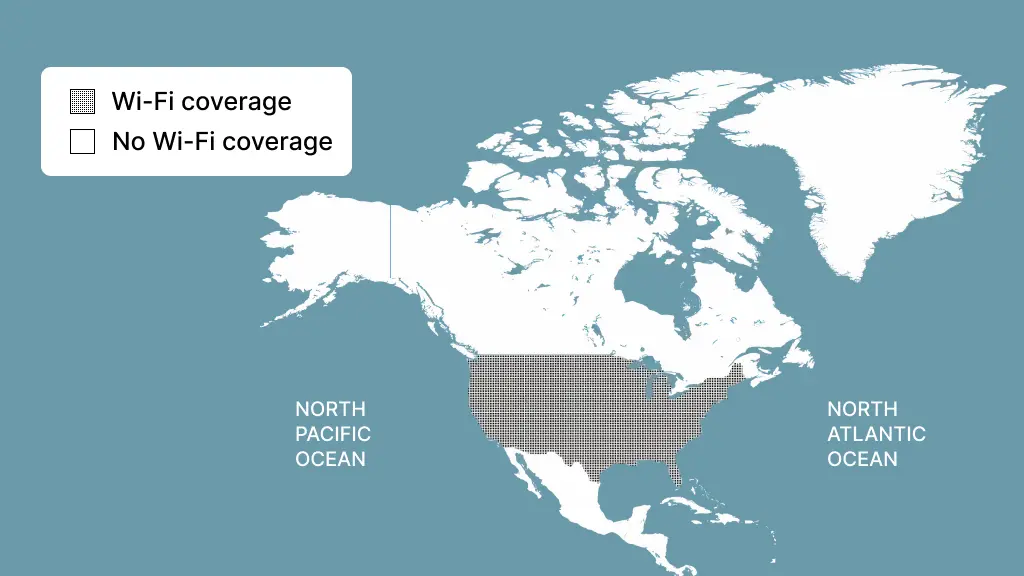
Gogo
Aircraft supported by the provider: Embraer 170, Embraer 175, Bombardier CRJ-700, and CRJ-550;
The zone under coverage: the continental US, parts of Alaska, and Canada.
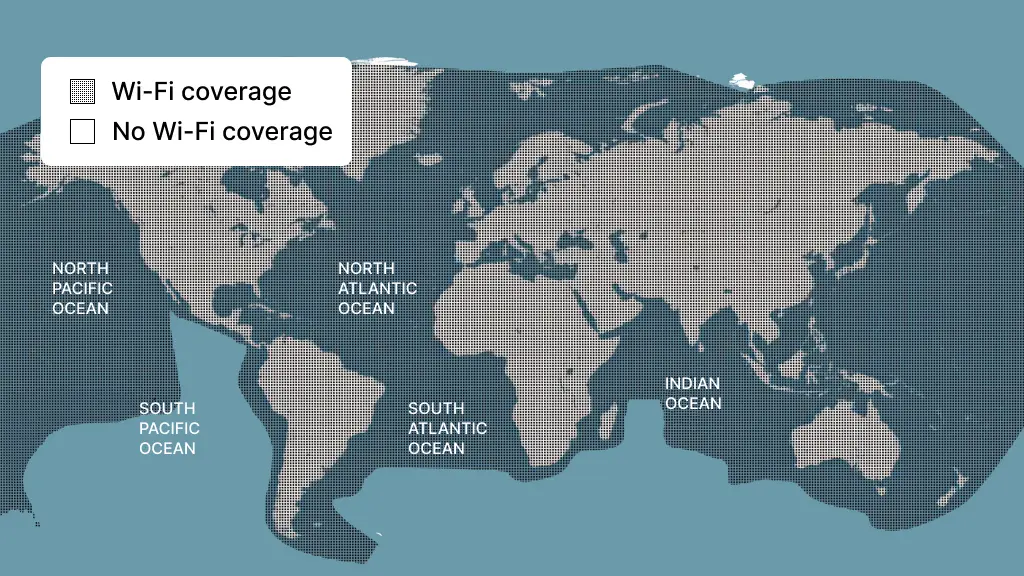
Panasonic
Aircraft supported by the provider: Select Airbus 319, Airbus 320, Boeing 757-2003, select 757-3003, 767-300ER, 767-400ER, 777-200, 777-200ER, 777-300ER, 787-8, 787-9 and 787-10;
The zone under coverage: global.
Thales
Aircraft supported by the provider: Boeing 737-7005, 737-8005, 737-9005, 737-900ER5 and select 757-300;
The zone under coverage: the continental US.
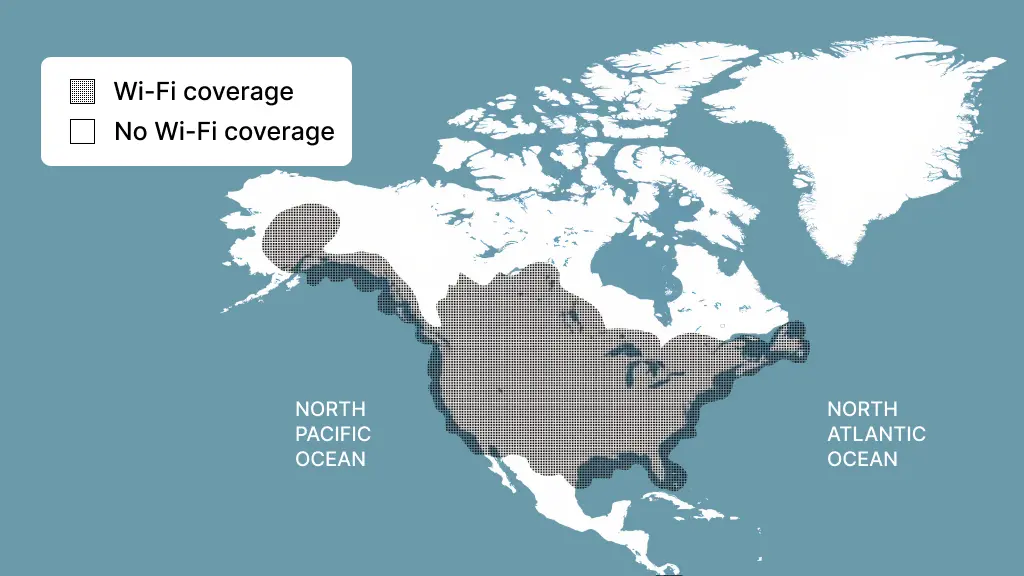
ViaSat
Aircraft supported by the provider: Select Airbus 319, A321neo, select Boeing 737-900, 737 MAX 8, and 737 MAX 9;
The zone under coverage: the continental US, Canada, Mexico, Central America, the Caribbean, and Europe.
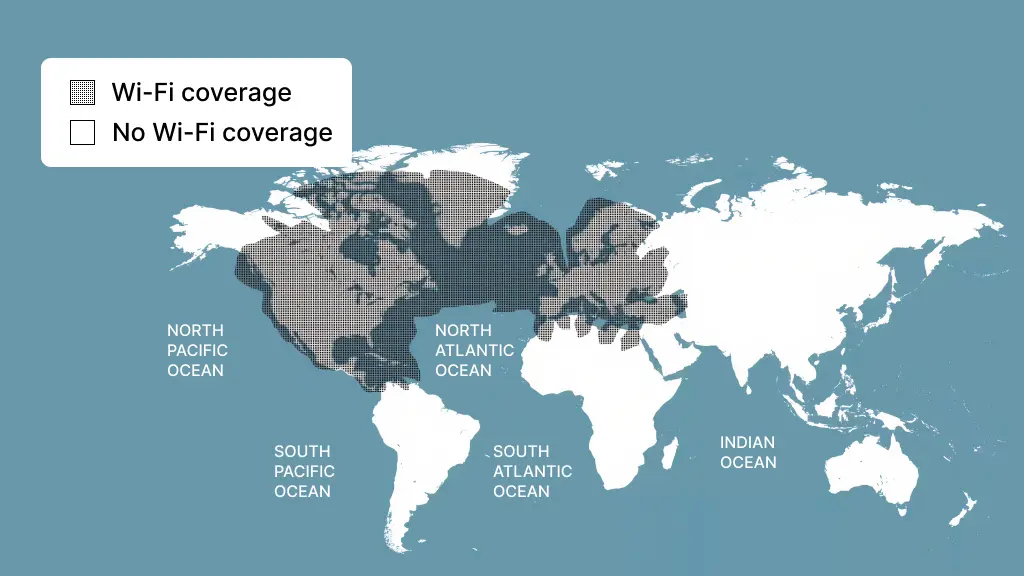
In 2025, United is expected to switch its planes to satellite Wi-Fi. Then, the connection will be much faster, cover more territories, and, of course, allow for the inclusion of streaming platforms.
Delta Airlines Wi-Fi
Delta offers airplane Wi-Fi and has several options. For example, about 600 aircraft have a satellite communication system from Viasat. It gives passengers quick access to messengers and streaming platforms. The connection is free of charge for SkyMiles members on some flights. Other passengers have to pay a $10 fee for using the Internet.
In general, the situation on board is as follows.
| Type | Provider | Aircraft |
| Free Wi-Fi | Viasat | A220-300, A319, A320, A321ceo, A321neo, 737-800, 737-900, 757-200H/D |
| Paid Wi-Fi | Viasat | A330-200, A330-300, A330-900, A350*, 757-300*, 767-300, 767-400 |
| Paid Wi-Fi | Wi-Fi Onboard | A330-300, A330-900, A350, 757-300, CRJ700, CRJ900, ERJ170 |
In general, a fast & free network is available on a range of smaller and mid-sized aircraft, while paid Wi-Fi is generally available on larger aircraft and regional jets.
Hawaiian Airlines in-flight Wi-Fi
Passengers love Hawaiian not only for its comfortable seats but also for its free Wi-Fi. The company recently signed an agreement with Elon Musk and receives Internet via modern Starlink satellite technology. Now, passengers can text, surf the web, scroll through social media, make online purchases, and watch videos for free! SMS, video, and voice calls are still not available, as they are on other airlines.
JetBlue Airplanes Wi-Fi
The next organization to offer free in-flight Internet is JetBlue. They have partnered with Viasat, which allows fast connections on all routes.
It won’t take you long to activate. Just go to FlyFi and follow the instructions to join with your device. Once the network is active, you’ll be able to send messages, watch streaming videos, and surf the web.
Airplanes Wi-Fi on airlines – summarizing terms & conditions
To summarize all of the above, we suggest using the table below. Here we have collected information on the availability of the network in each airline, prices, and connection functionality.
| Airlines | Cost | Texting | Streaming video | Aircraft support |
| American Airlines | $10 per flight; monthly plans at $49.95 (1 device) and $59.95 (2 devices); annual plans at $599 (1 device) and $699 (2 devices) | Yes | Yes | Available on almost all domestic and international routes |
| Delta Air Lines | Free for SkyMiles members on most domestic U.S. flights; $10 for non-members | Yes | Yes | Most domestic U.S. flights |
| United | $8 for MileagePlus members; $10 for others; free Wi-Fi expected starting in 2025 | Yes | No | Nearly all flights; full fleet to be equipped with Starlink by 2025 |
| Alaska Airlines | $8 per flight; free texting available | Yes | Yes | Most aircraft, except certain short-haul flights and specific models like 737-9 Max and Q400s |
| JetBlue | Free | Yes | Yes | The entire fleet is equipped with Viasat |
| Hawaiian Airlines | Free on select boards; expanding fleet-wide by the end of 2025 | Yes | Yes | Select aircraft currently; entire fleet by the end of 2025 |
How to get Wi-Fi when you arrive at your destination?
Mobile Internet is even more vital when you arrive at your destination. You need it to text your family about your safe arrival, use Google Maps to find a convenient route, stay in touch, and share your emotions live. And it is possible with an eSIM from Ohayu that can connect you to local networks in 170+ countries and regions.
All you need to get mobile internet is a compatible smartphone and an eSIM – a digital SIM card that is built directly into most modern devices. To install and activate an eSIM, you don’t need to go to a store; it can be downloaded online. Further steps are simple:
- First of all, check if your device supports eSIM. Ohayu has an autodetermine device compatibility feature, but you can also dial *#06# on your phone (it’s a free request to your phone settings, not a call). If after you tap the call button, an EID number appears on screen, your phone is eSIM-compatible.
- Next, choose the country where you need the service. After that, you will see the available plans with the price and data volume. For example, the options will look like this for the United States.
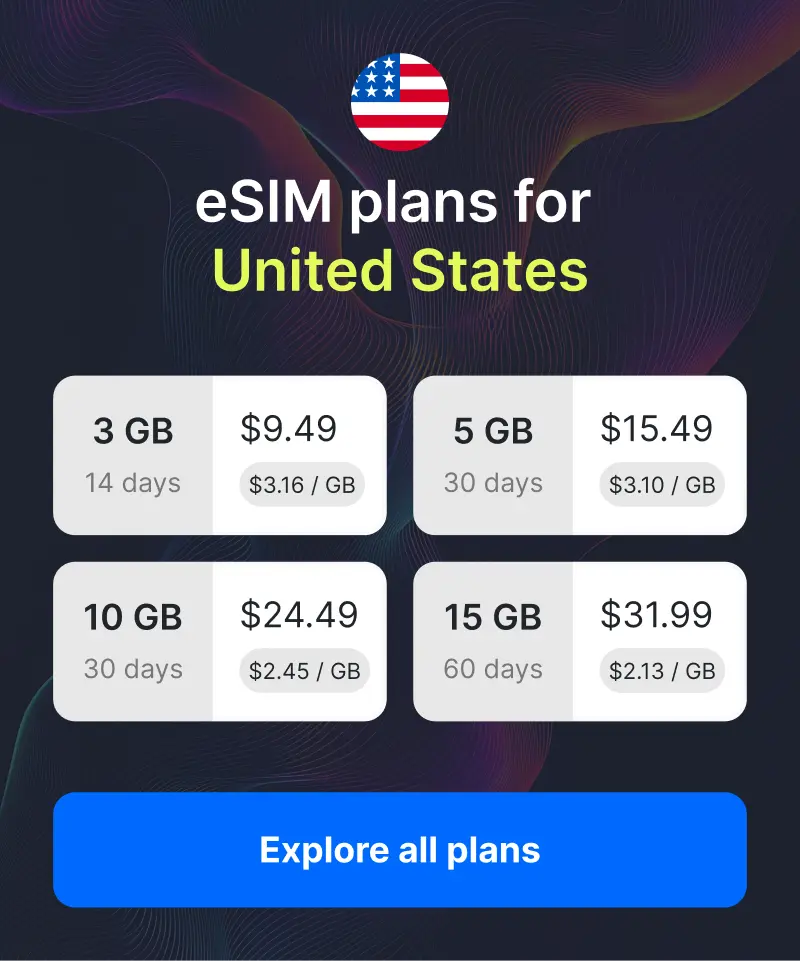
Ohayu works based on roaming agreements with local mobile carriers, so it can connect you to the local networks and help you get mobile internet while keeping your home phone number active for calls and SMS.
- After purchasing the package, follow the instructions to activate the SIM card and start using the mobile Internet.
Final words
To sum up, airplane Wi-Fi is an essential convenience for modern passengers. Most American Airlines have already implemented connectivity in their planes and offer satellite or ‘Air-to-Ground’ Internet. In most cases, on-board Wi-Fi service is paid and starts at $8. However, some companies, such as Hawaiian and JetBlue, offer free Internet access.
Being connected while traveling in a foreign country is equally important. That’s why we recommend taking care of it in advance to save money and precious time. Purchasing an eSIM can be a great addition to airplane Wi-Fi, which allows you to stay in touch as soon as you arrive and enjoy new travel emotions without connectivity obstacles.