

Germany’s mobile network operators are Deutsche Telekom, O2, Vodafone, and a new entrant, 1&1. Telekom served 69.8 million customers in Germany, according to its interim Q1 2025 report. O2 (Telefónica) reported 45 million mobile accesses in Q1 2024. 1&1, which launched its own 5G network in 2023, had 12.44 million mobile internet contracts as of June 30, 2025, and became the fourth German mobile network provider. Where its own network is unavailable, customers use Vodafone national roaming.
MVNOs (mobile virtual network operators) and international eSIM services like Ohayu, Yesim, Airalo, buy wholesale network access from local network operators. Even though none of them have physical networks in Germany, they can connect you to local carrier networks. This model is convenient for international travelers because travel eSIMs do not require language knowledge, and users do not need to look for local stores.
In this article, we compare the coverage and performance of German mobile operators, and discuss when it makes sense to use an international travel eSIM instead of a physical SIM card during your trip.
German mobile market overview
Germany is a large country with a diverse infrastructure and demanding consumer expectations for mobile internet quality. No single operator consistently satisfies all use cases. All major networks perform well in urban centres, but users notice differences in coverage and network stability on highways, in rural areas, and on rail routes.
High-speed 4G reaches nearly the entire population, 5G capacity is increasing, and regulatory oversight is intensifying to ensure coverage expansion.

According to Ookla Speedtest, in September 2025, Germany ranked 56th in the global index for mobile internet. It had a median mobile download speed of 72.30 Mbps with a 23 ms latency.
| Place | Country | Median mobile download speed |
| 4 | Brazil | 243.62 Mbps |
| 7 | South Korea | 227.07 Mbps |
| 10 | Denmark | 178.51 Mbps |
| 12 | Netherlands | 163.72 Mbps |
| 14 | United States | 158.49 Mbps |
| 26 | France | 131.62 Mbps |
| 33 | Australia | 124.99 Mbps |
| 56 | Germany | 72.30 Mbps |
| 59 | United Kingdom | 68.46 Mbps |
| 66 | Japan | 60.72 Mbps |
This table contains data from Speedtest Global Index for September 2025, retrieved in November 2025.
The Federal Government has tied future spectrum licences to specific coverage commitments in its 5G Strategy for Germany. For instance, new contracts require operators to achieve certain coverage thresholds in rural and corridor areas. This way, the regulator, Bundesnetzagentur, is pressuring operators to fill in the “white spots,” especially in villages, on highways, and along railways.
In 2025, the state extended frequency licenses with the condition of serious commitments. According to this plan, by 2030, 99.5% of the country’s territory should have at least 50 Mbps mobile download speed (statement of Klaus Müller, President of the Bundesnetzagentur).
5G technology development
3G was switched off in Germany back in 2021. 2G (GSM) is being kept for IoT, M2M, and legacy devices. Telekom has already announced the date for switching off 2G: June 30, 2028.
Today, 4G and 5G form the core of mobile connectivity across all major networks. 5G is available on all 4 mobile networks in Germany. Telekom, Vodafone and O2 offer nationwide 5G. 1&1 has its own standalone 5G (SA) network with limited coverage. For users, network quality depends on the availability of 4G and 5G where they live and travel, which can be checked easily through operator coverage maps before a trip.
eSIM in Germany
eSIM is already commonplace in Germany. New supported iPhones, Pixels, and most Samsung models can install an embedded SIM profile without any physical card.
For travelers, this saves time, because you don’t need to look for a SIM card store, or register with your passport (ID is required in Germany for local prepaid SIM cards), or swap SIM cards manually. More than that, with eSIM you can keep your home number for calls and messaging, and use the eSIM data profile to get mobile internet.
Key features of Ohayu eSIM for Germany:
- Connects to a local mobile network in Germany.
- It’s data-only and does not include a German phone number or SMS. Calls and messages work over data in apps like WhatsApp, and you can keep your main SIM for calls and texts.
- Activate within 30 days of purchase. The validity period starts on activation, so you can buy a plan before your trip and start using it when you arrive.
- Hotspot sharing is supported, so you can share your mobile data with friends and family from one device with an active eSIM.
- Many plans can be topped up in the app if you need more data.
- For multi-country travel, the Global plan is one eSIM for 120+ countries, so you do not need to install a new eSIM for each country.
To use an eSIM, first check whether your device is compatible. Dial *#06# (this is a free device request, not a call). If you see an EID number, it means that your phone supports eSIM. Once confirmed, you can install the eSIM via QR code or, on supported phones, with one-click installation in the Ohayu app.
German mobile network operators
Germany has four mobile network carriers: Telekom, Vodafone, O2 (Telefónica Germany), and the newer entrant 1&1. Telekom, Vodafone, and O2 have wide-area networks and mature 4G/5G infrastructure. 1&1 is building its own 5G network, which covers limited areas, and relies on national roaming elsewhere.
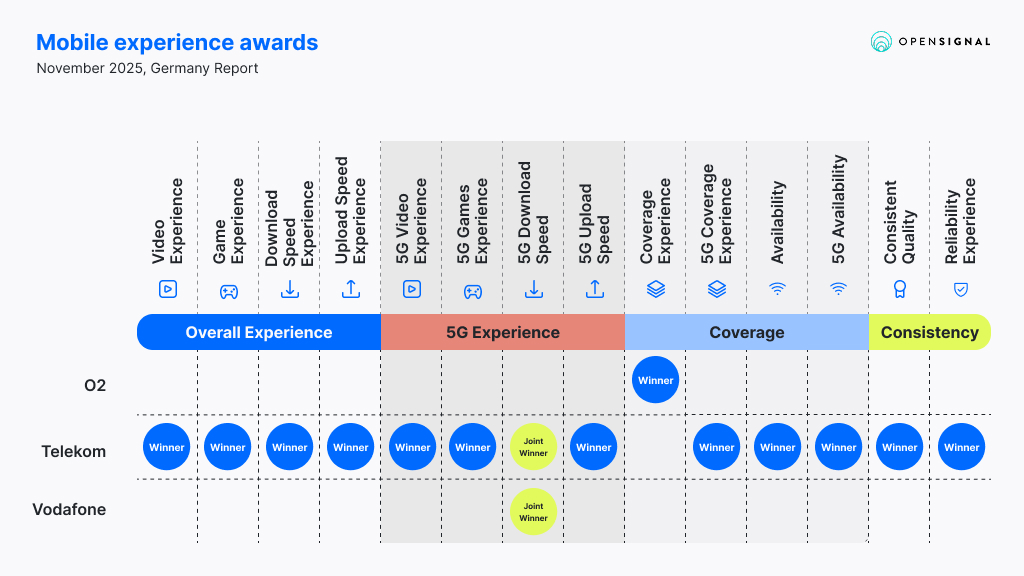
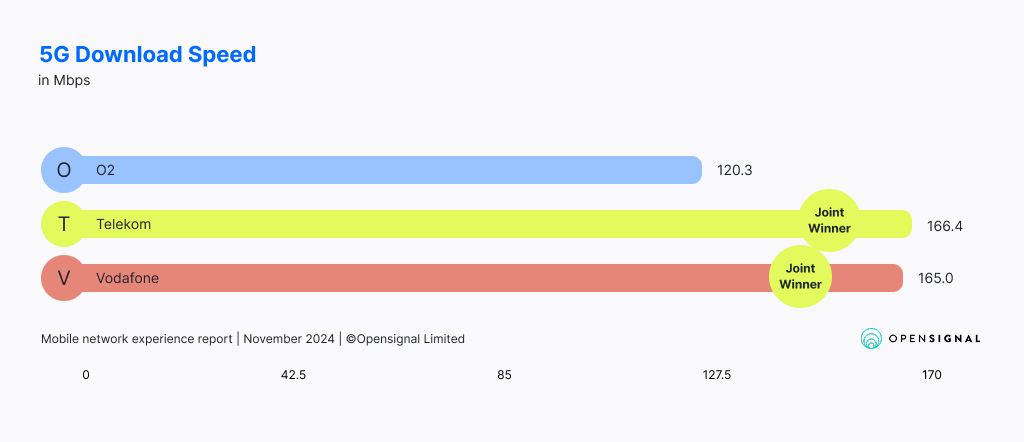
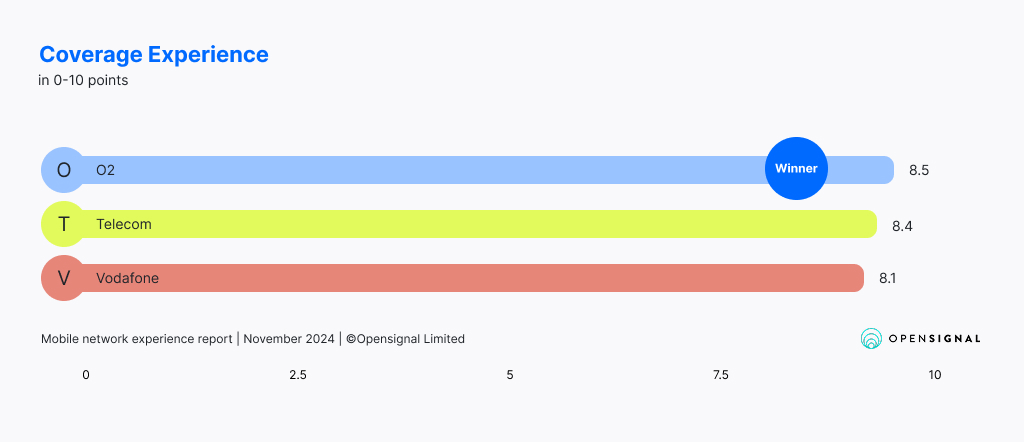
According to Opensignal’s November 2025 report, Telekom won the most awards, Vodafone shared the 5G Download Speed award with Telekom, and O2 won the Coverage Experience award.
| German mobile operators | Average download speed (Opensignal) | Key strengths |
| Telekom | 68.9 Mbps | Won the most Opensignal awards, including Download and Upload Speed Experience |
| Vodafone | 56.3 Mbps | Shared the 5G Download Speed award with Telekom |
| O2 (Telefónica Germany) | 47.7 Mbps | Won the Coverage Experience award |
| 1&1 | Standalone 5G only (limited footprint) | New entrant, 5G SA network in rollout phase, relies on national roaming |
| MVNOs (e.g., Aldi Talk, Lidl Connect, Blau), eSIM providers (Ohayu, Airalo) | Varies by host network | Use Telekom, Vodafone, or O2 networks, no own infrastructure |
Download speed values are based on Opensignal’s Mobile Network Experience Report – Germany, November 2025.
Telekom
Telekom has long had a strong reputation in Germany. In Opensignal’s November 2025 report, it led on speed and experience, while O2 won the Coverage Experience award. The map below shows Telekom’s coverage.
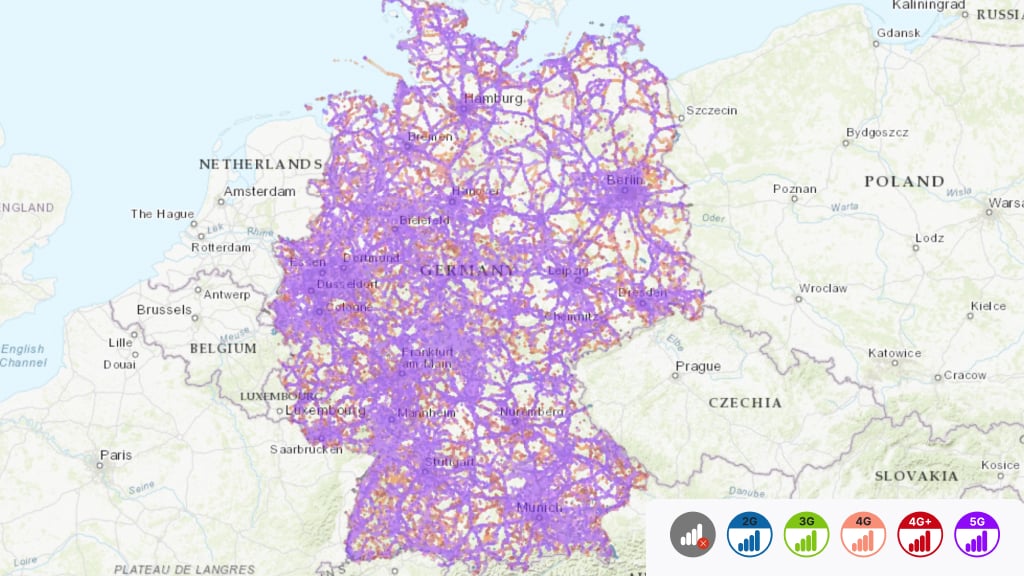
Telekom has announced that it will switch off 2G in 2028. In Opensignal’s November 2025 report, it won the Download Speed Experience award with an average download speed of 68.9 Mbps.
Vodafone Germany
Vodafone is one of Germany’s three established network operators, alongside Telekom and O2. It runs a nationwide 4G and 5G network, and in Opensignal’s November 2025 report it shared the 5G Download Speed award with Telekom.
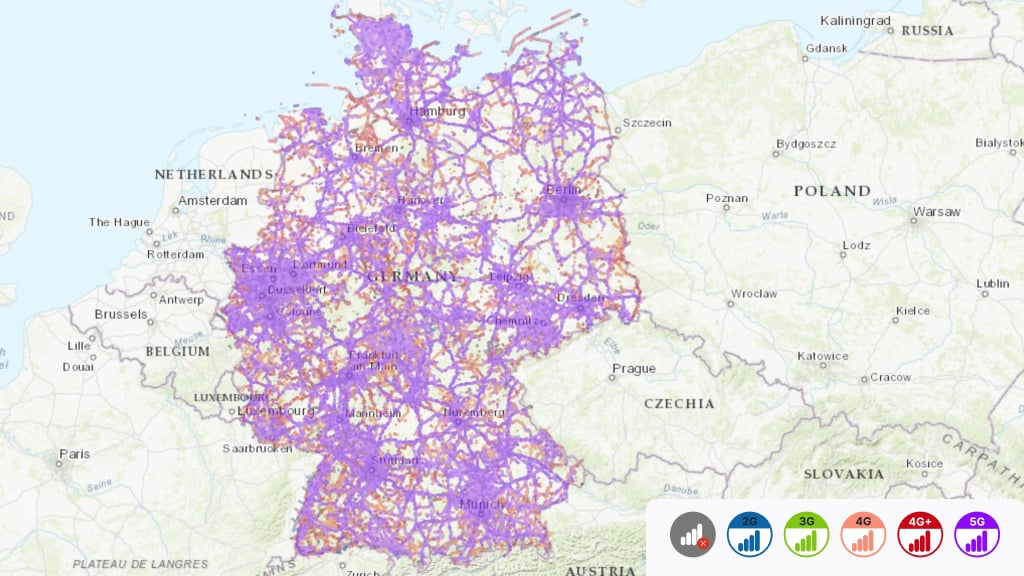
In Opensignal’s November 2025 report, Vodafone’s average download speed was 56.3 Mbps.
O2
O2 (Telefónica Germany) has invested heavily in its network in recent years. In Opensignal’s November 2025 report, it won the Coverage Experience award.
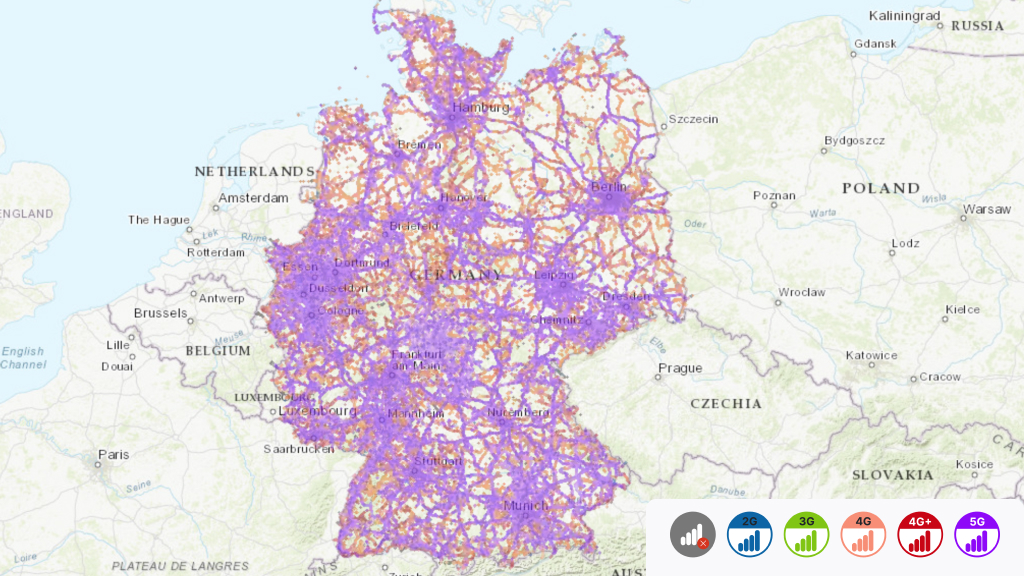
In Opensignal’s November 2025 report, O2’s average download speed was 47.7 Mbps.
1&1
1&1 is the fourth mobile network operator in Germany and is rolling out its own 5G standalone (SA) network. Coverage remains limited, so customers rely on national roaming where the 1&1 network is not available.
Comparison of German mobile operators
Opensignal’s November 2025 report (data collected from July to September 2025) provides a detailed comparison of main mobile networks in Germany across key performance categories. The analysis focuses on Telekom, Vodafone, and O2, highlighting the strengths of each operator and the overall distribution of network quality across the country.
Video and games experience
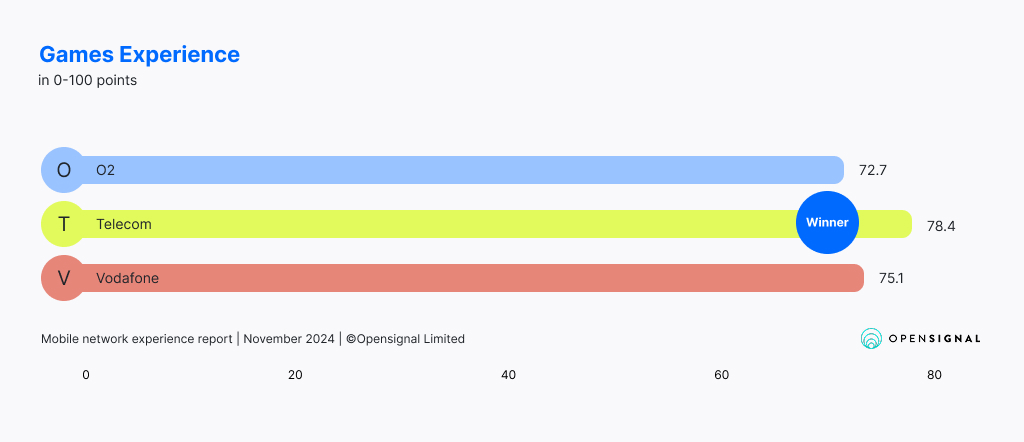
Telekom led in the video and games experience categories, sharing the Video Experience award with O2. These categories cover video streaming and online gaming quality, which matter for users who rely on streaming and latency-sensitive applications.
Download and upload speed
Telekom also won the Download Speed Experience and Upload Speed Experience awards. In the 5G Download Speed category, Vodafone shared the award with Telekom.
Coverage
O2 won the Coverage Experience award. This category reflects service availability across a wide range of regions, including less urbanised areas. For many users, especially outside major cities, consistent network availability is more important than peak download speeds.
5G performance
The 5G categories show close competition between Telekom and Vodafone: Vodafone’s gains in 5G download speed let it share that award with Telekom in the November 2025 report.
Conclusion
In Opensignal’s November 2025 report, Telekom won the most awards, including download and upload speed. Vodafone shared the 5G Download Speed award with Telekom, and O2 won the Coverage Experience award. The fourth operator, 1&1, is still rolling out its own 5G network and relies on national roaming where it has no coverage.
For travellers, an eSIM can be a practical way to stay connected without visiting a store or handling physical SIM cards. International providers such as Ohayu offer data-only eSIM plans for Germany, and the Ohayu Global plan covers 120+ countries for multi-country trips. Choosing between a local prepaid SIM and an eSIM depends on data needs, travel duration, and whether immediate activation is important.