

The biggest mobile networks in Germany are Deutsche Telekom, O2, Vodafone, and a new entrant, 1&1. Telekom has the highest-speed 5G and serves 69.8 million customers in Germany, according to its interim Q1 2025 report. O2 (Telefónica) followed the leader with 45 million mobile accesses in Q1 2024. Vodafone serves 31.2 million mobile contracts and prepaid customers. 1&1, which started developing its own 5G network in 2023, gained 10 million contracts by 2025, and became the fourth German mobile network provider. Where its own network is unavailable, customers use Vodafone national roaming.
MVNOs (mobile virtual network operators) and international eSIM services like Ohayu, Yesim, Airalo, buy wholesale network access from the top 3 local networks. Even though none of them have physical networks in Germany, they can connect you to local carrier networks. This model is beneficial for international travelers because it is often cheaper than home roaming, does not require ID or language knowledge, and users do not need to look for local stores.
In this article, we compare coverage, performance, and pricing plans that German operators offer to permanent residents, and discuss when it makes sense to use an international travel eSIM instead of a physical SIM card during your trip.
German mobile market overview
Germany is a large country with a diverse infrastructure and demanding consumer expectations for mobile internet quality. No single operator consistently satisfies all use cases. All major networks perform well in urban centres, but users notice differences in coverage and network stability on highways, in rural areas, and on rail routes.
High-speed 4G now reaches nearly the entire population, 5G capacity is increasing, and regulatory oversight is intensifying to ensure coverage expansion. According to Opensignal’s November 2025 report, Germany still lacks some of the international top-tier speeds.

According to Ookla Speedtest, in September 2025, Germany ranks 56th in the global index, compared to other countries. It has a download speed of 72.30 Mbps with a 23 ms latency.
| Place | Country | Median mobile download speed |
| 4 | Brazil | 243.62 Mbps |
| 7 | South Korea | 227.07 Mbps |
| 10 | Denmark | 178.51 Mbps |
| 12 | Netherlands | 163.72 Mbps |
| 14 | United States | 158.49 Mbps |
| 26 | France | 131.62 Mbps |
| 33 | Australia | 124.99 Mbps |
| 56 | Germany | 72.30 Mbps |
| 59 | United Kingdom | 68.46 Mbps |
| 66 | Japan | 60.72 Mbps |
This table contains data from Speedtest Global Index, retrieved in November 2025.
The Federal Government has tied future spectrum licences to specific coverage commitments in its 5G Strategy for Germany. For instance, new contracts require operators to achieve certain coverage thresholds in rural and corridor areas. This way, the regulator, Bundesnetzagentur, is pressuring operators to fill in the “white spots,” especially in villages, on highways, and along railways.
In 2025, the state extended frequency licenses with the condition of serious commitments. According to this plan, by 2030, 99.5% of the country’s territory should have at least 50 Mbps mobile download speed (statement of Klaus Müller, President of the Bundesnetzagentur).
5G technology development
3G was switched off in Germany back in 2021. 2G (GSM) is being kept for IoT, M2M, and legacy devices. Telekom has already announced the date for switching off 2G — June 30, 2028. Vodafone plans to switch off regular 2G services in September 2028, while keeping 2G for critical IoT applications until the end of 2030, and O2 plans to switch off 2G in the second half of 2028.
Today, 4G and 5G form the core of mobile connectivity across all major networks. 5G is available on all 4 mobile networks in Germany. Telekom, Vodafone, O2 serve nationwide 5G. 1&1 has standalone 5G (SA) only with extremely limited coverage. For users, network quality depends on the availability of 4G and 5G where they live and travel, which can be checked easily through operator coverage maps before a trip.
eSIM in Germany
eSIM is already commonplace in Germany. New supported iPhones, Pixels, and most Samsung models can install an embedded SIM profile without any physical card.
For travelers, this saves time, because you don’t need to look for a SIM card store, or register with your passport (ID is required in Germany for physical SIM cards with phone numbers), or swap SIM cards manually. More than that, with eSIM you can keep your home number for calls and messaging, and use the eSIM data profile to get mobile internet.
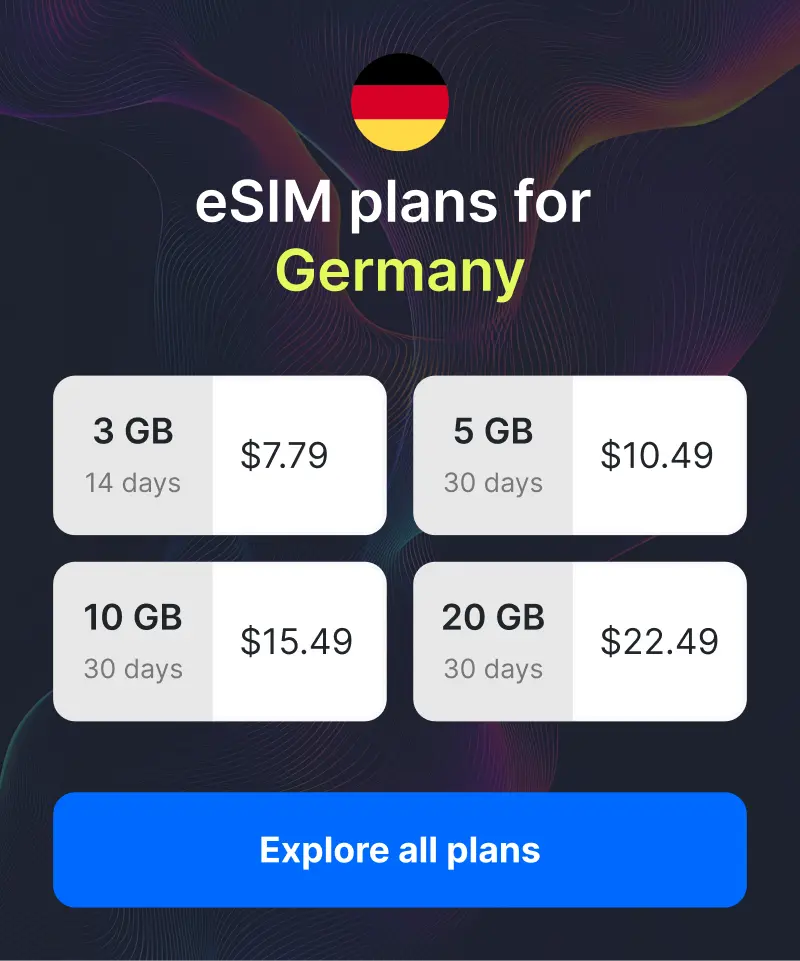
Key features of Ohayu eSIM for Germany:
- Works on O2, Vodafone, and T-Mobile networks, automatically connects you to one of the supported networks.
- It’s data-only and does not include a German phone number, SMS; you pay only for the amount of GB you need.
- Activation window is 30 days. It means that you can buy a plan before your trip and activate it immediately after arrival using the airport Wi-Fi.
- Hotspot sharing is supported, so you can share Wi-Fi with your friends and family using one active eSIM device.
- Easy to top up if you need more data.
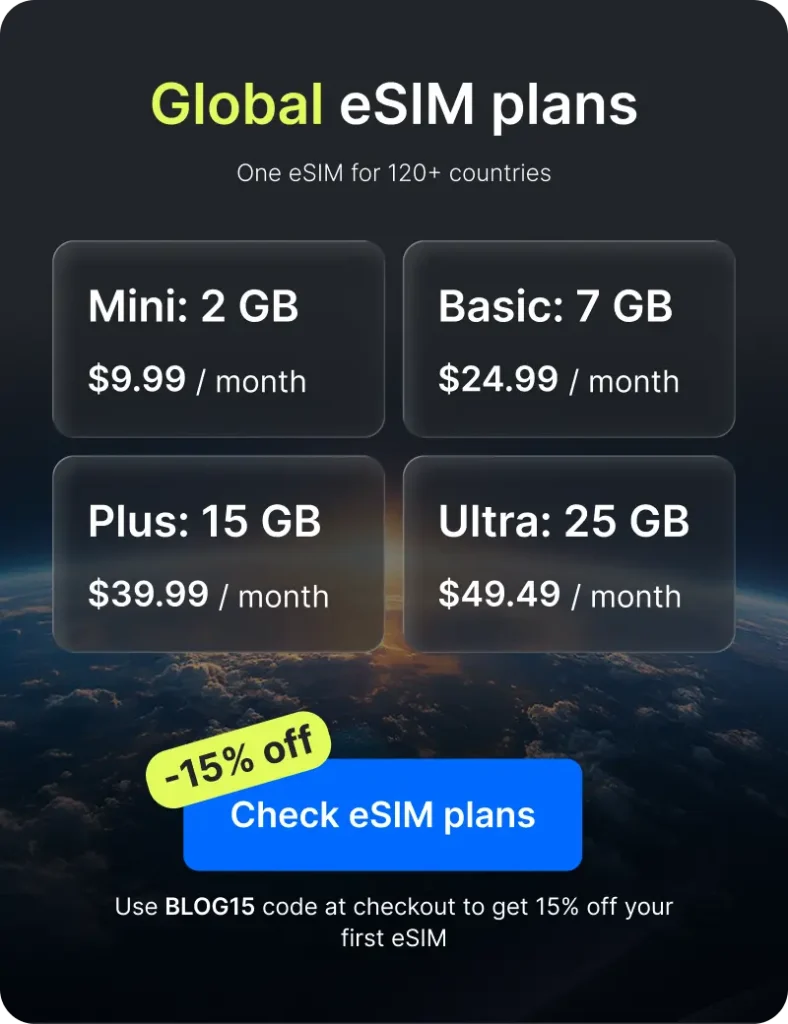
- You can use the Global plan for multi-country travel in 120+ countries, it automatically switches between supported networks without additional installations.
To use an eSIM, first check whether your device is compatible. Dial *#06# (this is a free device request, not a call). If you see an EID number, it means that your phone supports eSIM. Once confirmed, you can install the eSIM via QR code or direct installation inside the Ohayu app.
Top 4 German mobile operators
Germany has four mobile network carriers: Telekom, Vodafone, O2 (Telefónica Germany), and the newer entrant 1&1. Telekom, Vodafone, and O2 have wide-area networks and mature 4G/5G infrastructure. 1&1 is building a separate 5G network that currently covers limited areas and relies on national roaming.
According to independent measurements from Opensignal, Telekom is leading in overall quality and experience on highways and railways, Vodafone also has a well-balanced performance, and O2 continues to improve coverage quality on main transport corridors.
| German mobile operators | Median mobile download speed | Key strengths |
| Telekom (T-Mobile) | 68.9 Mbps | Fastest mobile experience, strongest 4G/5G; best performance on highways |
| Vodafone | 56.3 Mbps | Balanced country-wide network, good 5G, strong reliability in suburban areas |
| O2 (Telefónica Germany) | 47.7 Mbps | Good urban performance, competitive pricing, strong progress in transport-route coverage |
| 1&1 | Standalone 5G only (limited footprint) | New entrant, 5G SA network in rollout phase, relies on other networks (roaming), has cheaper plans from €9,99/mo |
| MVNOs (e.g., Aldi Talk, Lidl Connect, Blau, Drillisch brands), eSIM providers (Ohayu, Airalo) | Varies by host network | Use Telekom, Vodafone, or O2 networks; offer lower-cost prepaid plans, no independent infrastructure |
Download speed values are based on Opensignal’s Mobile Network Experience Report – Germany, November 2025.
Telekom (T-Mobile Deutschland)
Telekom has long been considered the gold standard of mobile communications in Germany. Its main strength is coverage. This network has the best signal in distant areas. You can see this on the coverage map, which extends to different parts of the country. If other providers may still show EDGE or lose connection in the mountains or in the northern part of the country, Telekom users have much better chances to stay online. This makes it the number one choice for those who are constantly on the move.
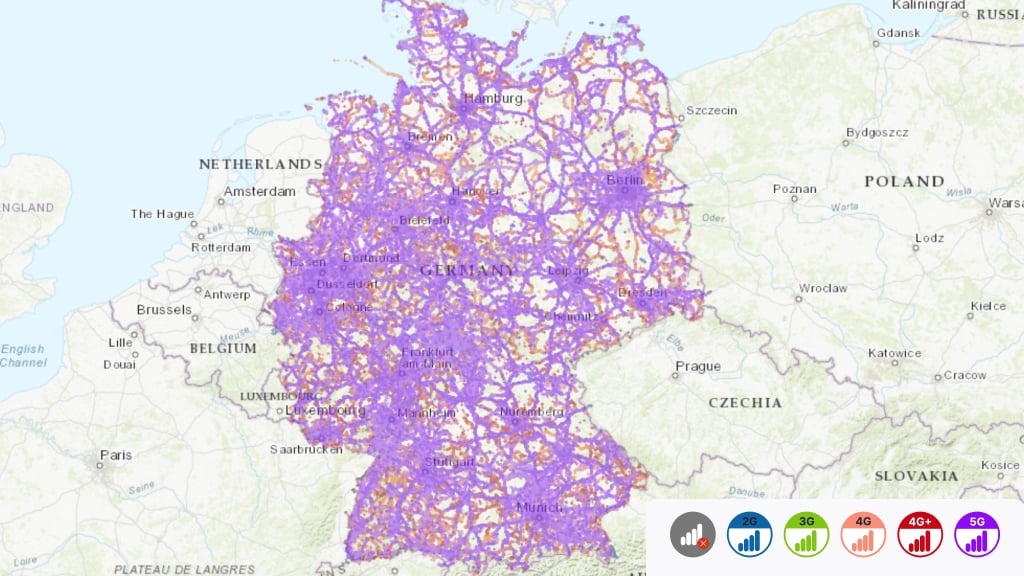
Telekom is also consistently ahead in terms of speed. The network is actively developing 5G, using not only the 3.6 GHz band but also wider frequencies for true “deep” coverage. The company has already announced that it will switch off 2G by 2028, which indicates its commitment to a fully modern infrastructure. According to Opensignal, the download speed is 68.9 Mbps.
Prices are typically the highest among the major operators, but users often choose Telekom for its reliability and quality.
- MagentaEINS prepaid plan for 4 weeks costs €9.95 (13 GB of data).
- The cheapest contract package costs €29.95. It includes 20 GB of data (with LTE Max/5G).
- The most expensive package costs €84.95. It includes unlimited data, 5 GB of roaming, and support for 2 multi-SIM cards.
Vodafone Germany
Vodafone ranks second in the market, and many consider it to offer the best balance between price and quality. It has very good coverage in cities and most suburbs, 4G works reliably, and 5G is expanding to smaller towns. On highways, the carrier usually performs slightly worse than Telekom, but for daily commutes and business trips, it is more than enough.
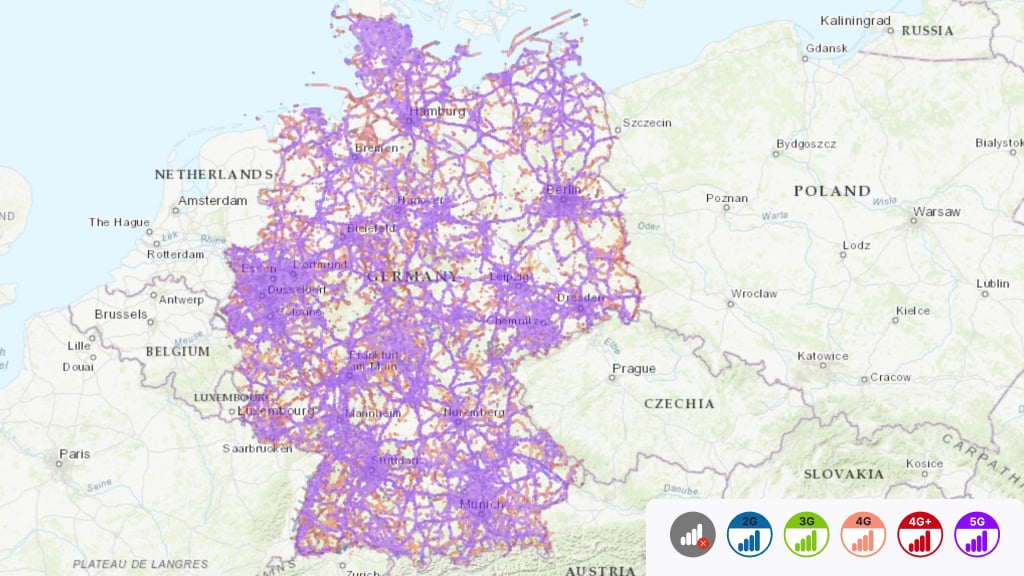
Vodafone is known for quickly integrating new technologies. For example, it is actively implementing its own IoT solutions and gives businesses smart packages for device management. This makes it popular among private users and companies looking for a comprehensive approach.
The pricing policy is more flexible than Telekom’s. Tariffs are cheaper, and bonuses in the form of larger data packages or special options often make the deal attractive.
- CallYa plans with flat-rate calls/SMS and data, no long-term contract.
- Plans start from €9.99/4 weeks for 10 GB, €19.99/4 weeks for 30 GB, €79.99 for the unlimited plan.
- Additional data top-up options: 500 MB for €2.99 (7 days).
- All prepaid tariffs include EU roaming, 5G access (where available).
Vodafone’s main advantage is stability. The download speed is 56.3 Mbps with a 37 ms delay.
O2
O2 has long had a reputation as the third network operator, but the situation has changed in recent years. The company has invested heavily in its network. In cities, 4G and 5G speeds have become significantly faster, and along railways, O2 has been praised for its sharp increase in reliability.
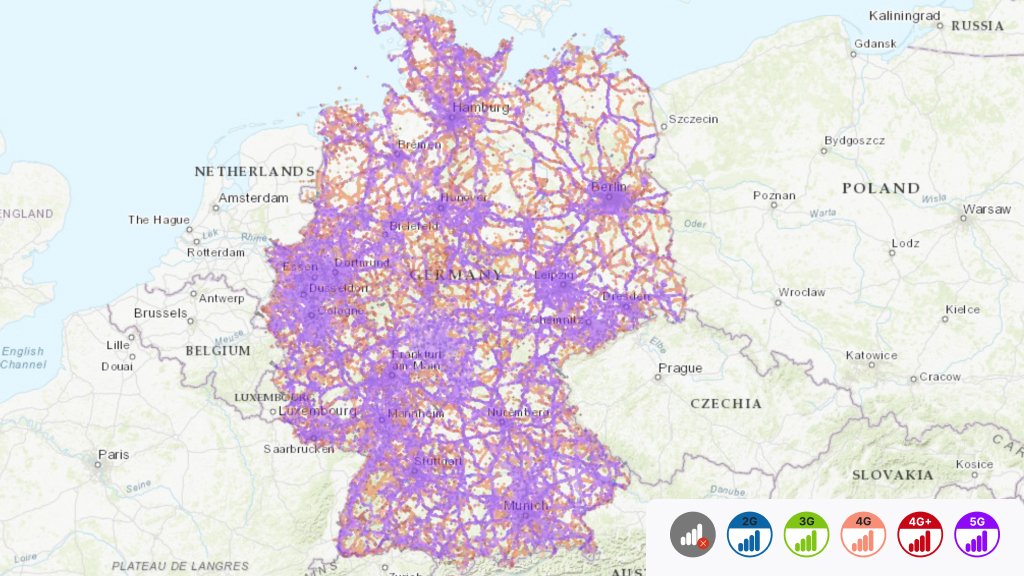
The main advantage of O2 is its price and gigabytes. It has the most affordable data packages. If you need a lot of traffic for video, social networks, or working with cloud services, O2 gives you more for less money. O2 offers a practical option for those who need generous data allowances without higher-tier pricing.
- Flexible prepaid tariffs, no contract binding.
- Prepaid S: 12 GB for €9.99/4 weeks, M: 25 GB for €14.99, and L: 50 GB for €19.99.
- Prices decreased recently; data volumes increased across S/M/L segments.
- Includes EU roaming in many tariffs.
The network’s download speed is 47.7 Mbps with a 36 ms latency.
1&1
1&1 is the fourth mobile network operator in Germany and is currently rolling out its own 5G standalone (SA) network. Coverage remains limited, so most customers rely on national roaming while the infrastructure expands. The main appeal of 1&1 is its lower monthly pricing and high data allowances.
Here are the 1&1 mobile plan examples:
- €9.99 / month (permanently) for 10 GB, which also includes national roaming.
- €14.99 / month for 30 GB.
- €19.99 / month for 60 GB.
- €24.99 / month with 120 GB data.
Comparison of German mobile operators
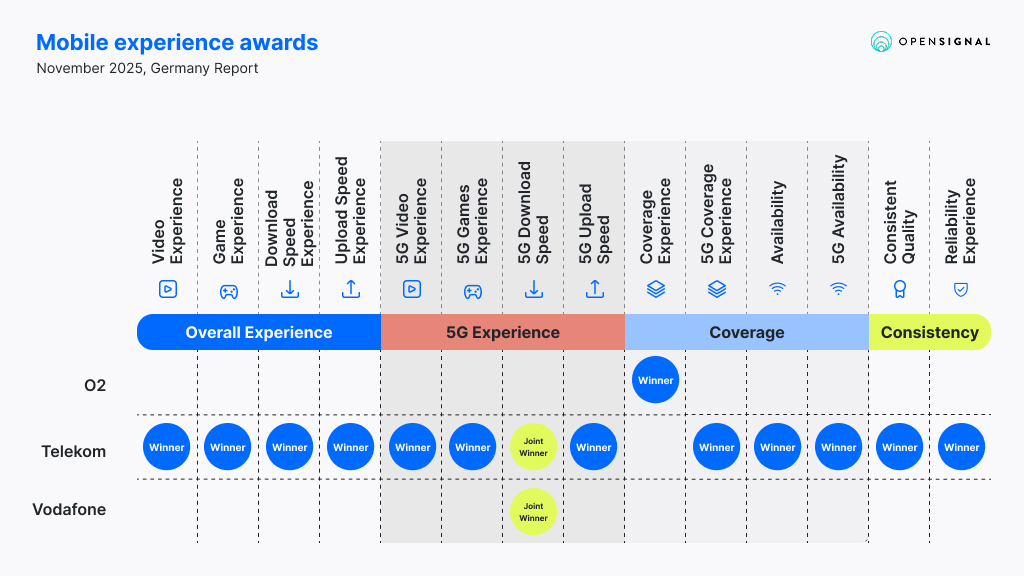
The Opensignal November report 2025 provides a detailed comparison of main mobile networks in Germany across key performance categories. The analysis focuses on Telekom, Vodafone, and O2, highlighting the strengths of each operator and the overall distribution of network quality across the country.
Video and games experience
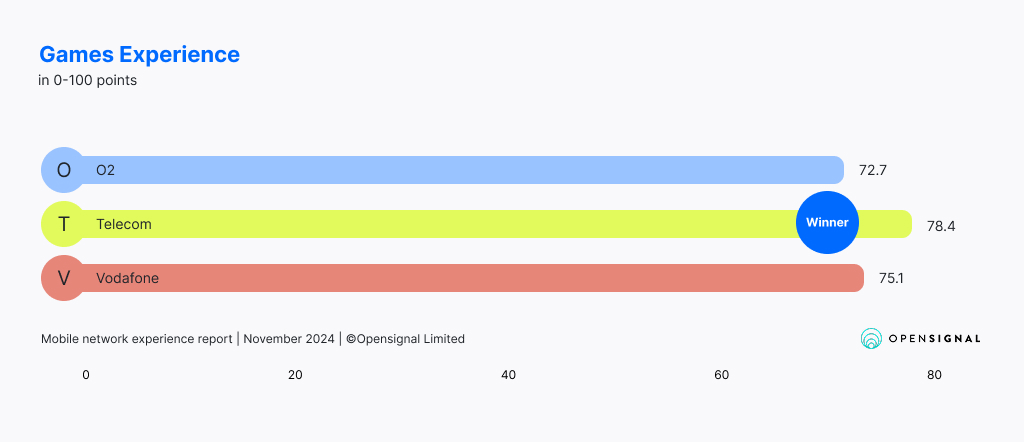
Telekom is the leader in the video and games experience. This means that users get the smoothest possible video playback in high quality and stable performance for online gaming. These categories are relevant for users who rely on streaming and latency-sensitive applications.
Download and upload speed
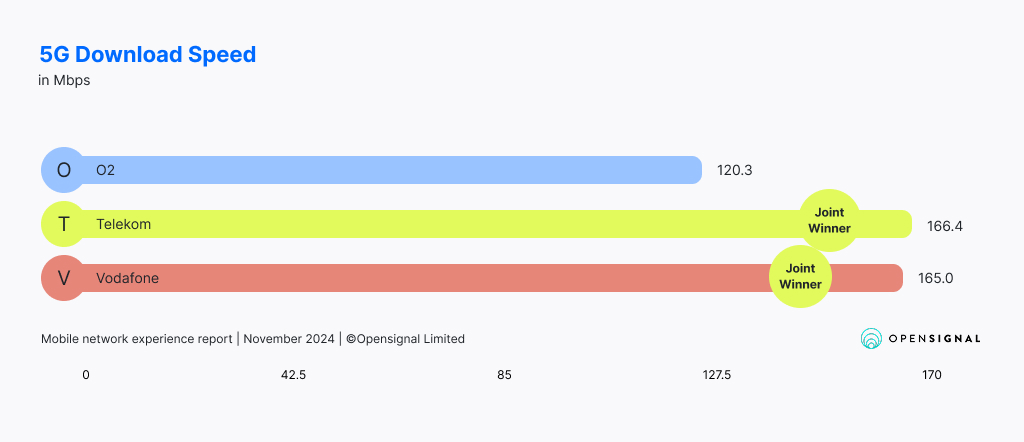
Telekom also leads in download and upload speed. This confirms the highest average speed for both file downloads and data transfer over the network. Interestingly, in the 5G download speed category, Vodafone performs on par with Telekom, making them joint winners. This indicates that Vodafone is actively improving quality in the latest standard.
Coverage
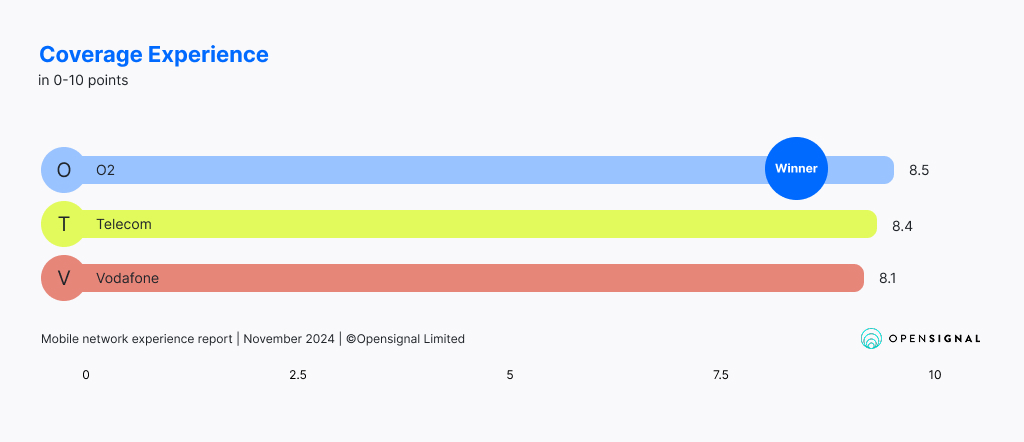
O2 ranks first in the coverage experience category. This reflects improvements in service availability across a wide range of regions, including less urbanised areas. For many users, especially outside major cities, consistent network availability is more important than peak download speeds.
5G performance
The categories related to 5G show significant competition. The differences between Telekom and Vodafone are narrower than in previous years. This means that the 5G market in Germany is becoming more balanced, and users can expect rapid development of this technology in the coming years.
Conclusion
Telekom confirms its status as the leader in the German market, giving users the best service across cities, rural areas, and major transport routes. Vodafone is growing fast and is becoming a strong competitor in modern tech. O2 is focusing on wider coverage and availability, and remains an attractive option for those looking for larger data allowances at a lower cost. The fourth operator, 1&1, is still in the early stages of rolling out its 5G. While coverage is currently limited, its contract plans offer large data allowances at lower monthly prices.
For travellers, an eSIM can be a practical way to stay connected without visiting a store or handling physical SIM cards. International providers such as Ohayu offer data-only eSIM plans that work on Germany’s major networks and can be activated online, which is useful for short visits or multi-country trips within the EU. Choosing between a local prepaid SIM and an eSIM depends on data needs, travel duration, and whether immediate activation is important.