



Planning your next trip to Australia? Vodafone, Optus and Telstra are the main providers of connectivity, 5G and mobile data. So, to simplify your connection experience, we present the overview of mobile networks in Australia to help you choose.
What are the special features of mobile networks in Australia?
Australia has a developed but uneven mobile network. The main operators provide coverage in cities, but in remote areas, Telstra operates mainly. The speed and quality of communication depends on the location: 5G and fast LTE networks are available in metropolitan regions, while in regional areas you may only get 4G, and in remote outback areas coverage can disappear entirely.
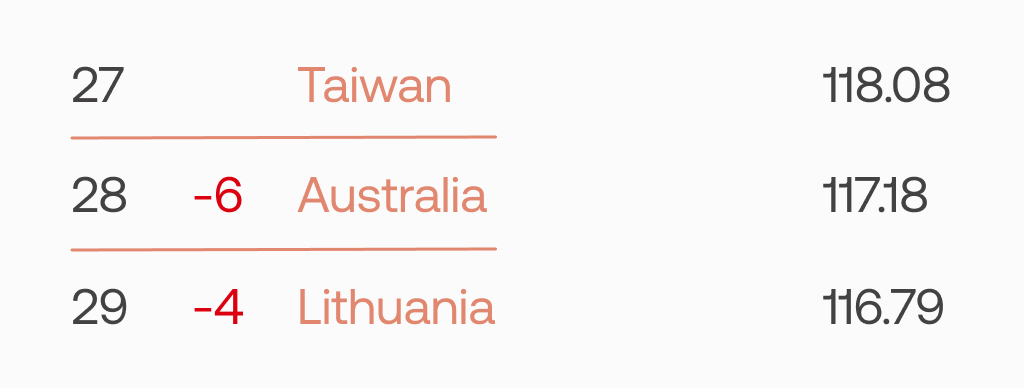
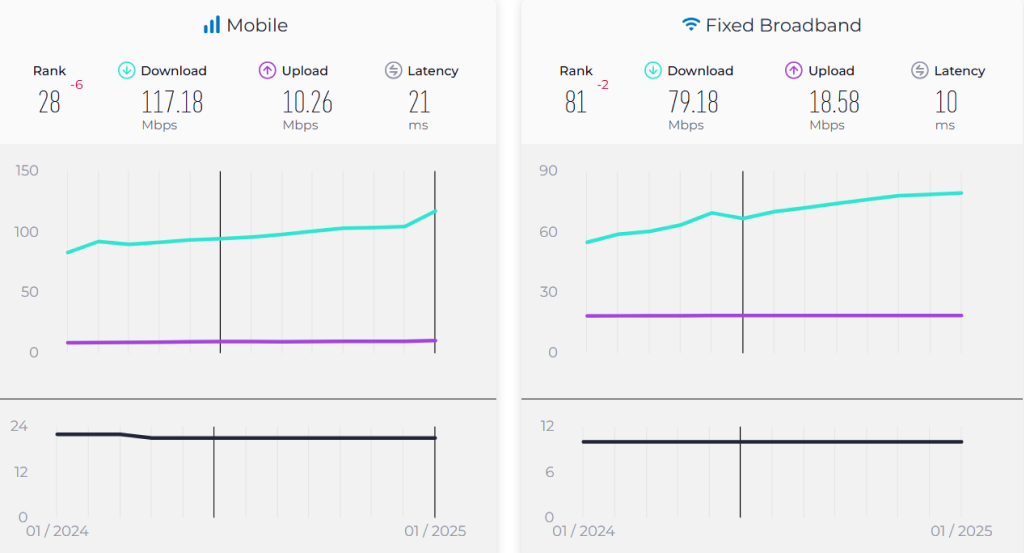
According to the Speedtest Global Index, in January 2025 the country ranked 28th in the world for mobile internet speed.
In January 2025, the median mobile download speed was 117.18 Mbps and the median upload speed was 10.26 Mbps, with a latency of 21 ms.
The infrastructure deployment is expensive due to the country’s large territory. This affects tariffs. However, MVNO operators (which rent capacity from large companies) often provide cheaper options and more flexible terms.
Innovations, such as the expansion of 5G and satellite technologies, are intended to improve the communication quality, especially in remote areas. According to the Australian Telecoms Market Report, Telstra and Optus have signed a contract with SpaceX to provide mobile satellite communications services via Starlink satellites where traditional mobile infrastructure is down or coverage is weak. Telstra launched its Starlink-based satellite messaging service in mid-2025: text messages only, on compatible phones. Satellite services like this can provide:
- Connectivity in remote areas;
- Better emergency communication – a way to send messages in the case of natural disasters or interruptions in the operation of land-based networks.
Australia has vast sparsely populated areas where coverage is weak. Satellite services can help to reduce communication “dead zones” in these areas.
3 main mobile networks in Australia
There are only a few large mobile operators in Australia – Telstra, Optus, and Vodafone. This is due to high infrastructure costs and the demand for large capital to cover the vast territory.
It is a challenging task for operators to reach all areas with mobile coverage. It imposes extra costs on new entrants. This is a barrier for new operators.
Vodafone
This operator delivers mobile and fixed-line internet services. The company continues to develop its infrastructure, especially in the area of 5G. As a part of TPG Telecom Group, Vodafone serves millions of customers, offering international roaming and Internet backup for home users. Customer service is an important business component – the operator has its own stores and a contact center for support.

Vodafone’s 4G coverage is available in most cities across the country. The operator is most active in Victoria, New South Wales, and Queensland. In the Southern and Western parts, 4G coverage is available mainly on the coasts.
Here are some key features of Vodafone:
- The provider offers International Roaming Packages for calls and Internet abroad.

This is convenient for people who often travel or work abroad.
- Vodafone allows its users to share data between multiple devices through the Data Sharing option. This works well for users who have multiple gadgets. You can collect data on one main account and distribute it to tablets or other phones.
- Vodafone is actively developing its 5G network in cities where it has coverage.
Optus
This Australian telecom company is a part of Singapore’s Singtel. They serve millions of customers. Optus operates a variety of services: mobile communications, internet, and even satellite communications.

However, in 2022, the company faced a serious problem – a large-scale cyberattack that exposed the personal data of almost 10 million current and former customers. This led to a class action lawsuit. Despite these challenges, the operator continues to develop and introduce new technologies to improve its services for Australians.
Optus is also actively developing a 5G network, bringing high-speed Internet access to major cities in Australia.
Telstra Australia
Telstra is one of the largest operators in Australia. Its coverage extends across most of the country’s population – South, East, West, and most of Northern Australia are connected to Telstra.
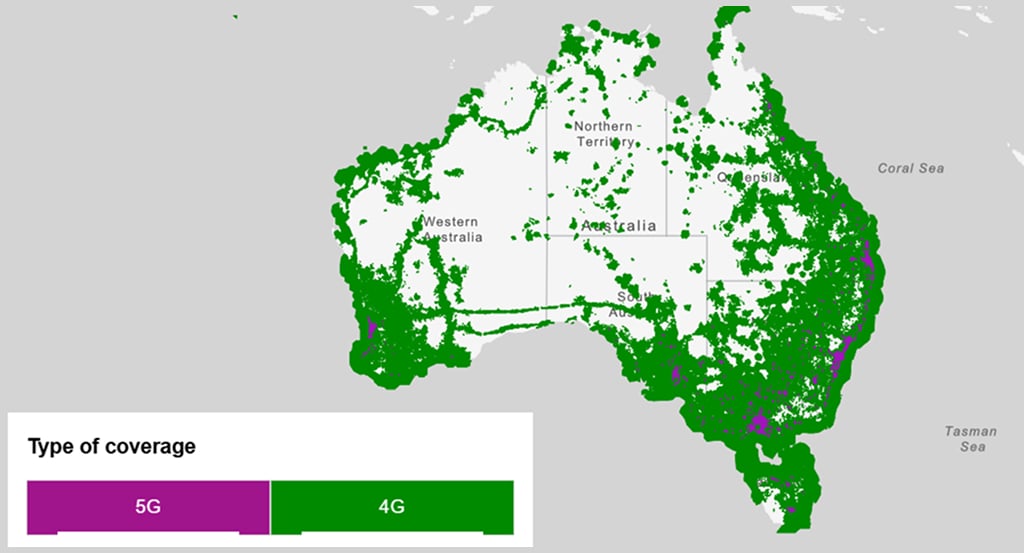
Here are some key features of Telstra:
- Telstra is the leader in remote areas of Australia. Their coverage is the widest of the three mobile operators. This is an important aspect for users staying in rural areas or traveling around the country. Telstra is also actively working to improve coverage in regions where competitors may not have access. These are, for example, the Northern regions.
- The company has separate plans for small and medium-sized businesses, with options such as advanced security, round-the-clock technical support, and 4G backup in case of an outage.
Mobile virtual network operators in Australia
MVNOs are virtual mobile operators that don’t possess their own network but rent infrastructure from large companies. This allows them to reduce the cost of launching services. MVNOs are known for flexible tariffs. They often present narrowly targeted packages: for tourists, gamers, or budget-oriented consumers. Prices are often lower than those of traditional operators. Another advantage is digital orientation.
Many virtual mobile networks in Australia operate only online, simplifying connection and maintenance. Clients save time by avoiding offices. Among the disadvantages is dependence on the main operator. The communication quality can suffer when the network is overloaded.
Vodafone, Optus and Telstra – a detailed overview
Here is how the three operators compared in the Opensignal report for October 2024. Optus was the most awarded carrier, winning five awards on its own and three more jointly.

In that report, Vodafone won the 5G Availability award, as network users had a 5G connection 53.3% of the time, up from 47.3% in the April 2024 report.

Vodafone also led in download speeds, at 84.3 Mbps.
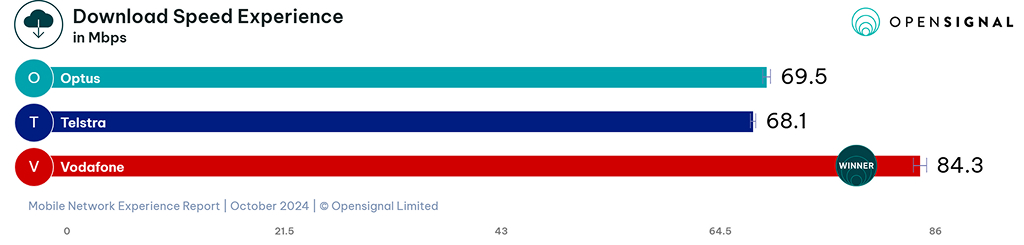
Telstra took the top spot in the coverage categories, receiving 9.5 points out of 10 for coverage in populated areas.

To sum up
The mobile networks in Australia are trying to deliver as many useful plans, data, and benefits as possible for locals and tourists. Telstra has the widest coverage, especially in remote areas, and packages for businesses and entrepreneurs. Optus won the most awards in the October 2024 Opensignal report. Vodafone offers international roaming packages and led download speeds in the same report.
An eSIM is a convenient choice for traveling to Australia. It allows you to connect to local operators without a physical SIM card. It saves time and eliminates the problem of losing or damaging a physical SIM card.
You can get an Australian eSIM online with Ohayu, install it before your trip (you need an internet connection, Wi-Fi is fine), and activate it after you arrive in the country.