


Japan Digital Nomad Visa is a Japanese visa, introduced in 2024, that allows remote workers employed by companies outside Japan to stay in the country for six months. Nationals of 51 countries and regions can apply for the visa (official list of the Immigration Services Agency of Japan, checked October 2026). An important condition is that employment in Japanese companies is prohibited, so applicants must already be engaged in remote work for foreign companies or freelancing for clients abroad.
The permit can be an attractive option for freelancers and IT professionals, as it allows them to stay in the country for a fairly long period. It’s a great opportunity to explore the culture and flavor of the nation and find a new community of like-minded people.
In this article, we’ll look at the benefits of a Japan Digital Nomad Visa, what documents you need to apply for, and the requirements for getting a permit.
Key details about Japan Digital Nomad Visa
- Who can apply? Remote workers who are nationals of countries and regions that are both visa-exempt for Japan and have a tax treaty with Japan.
- Term of stay: 6 months from the date of entry.
- Processing time: from 5 working days to several weeks after you apply at the embassy or consulate.
- Validity of Visa: single entry, 3 months from the date of issue.
The Digital Nomad Visa, also known as a freelancer visa or a remote work pass, allows individuals to live and work in Japan without a job offer from national firms. It allows a stay of up to 6 months, longer than a visa-free short-term stay. The visa is aimed at remote workers from around the world.
However, there are restrictions. Only nationals of countries and regions that are both visa-exempt for Japan and have a tax treaty with Japan may apply. These include most EU countries, the USA, the UK, Canada, Australia, New Zealand, Singapore and others. Check the current official list before applying.
Note that the digital nomad permit cannot be renewed. However, according to the Immigration Services Agency of Japan (Q&A as of July 2024), you can use this status again once six months have passed since you left Japan.
Japan Digital Nomad Visa requirements
The Japan Digital Nomad Visa has several mandatory criteria for applicants:
- Be a national of an eligible country or region. You may see the full list of eligible countries in the file.
- Have a valid passport for at least six months.
- Be employed by a foreign company, have your own business, or work as a freelancer and have supporting documents. The company must be registered outside of Japan.
- Have an annual income of at least 10 million JPY.
- Have private health insurance in case of accident, illness, or death.
What documents do you need to apply?
To get a permit, you should prepare a package of documents. Here is a list of what you and your family require.
Application form
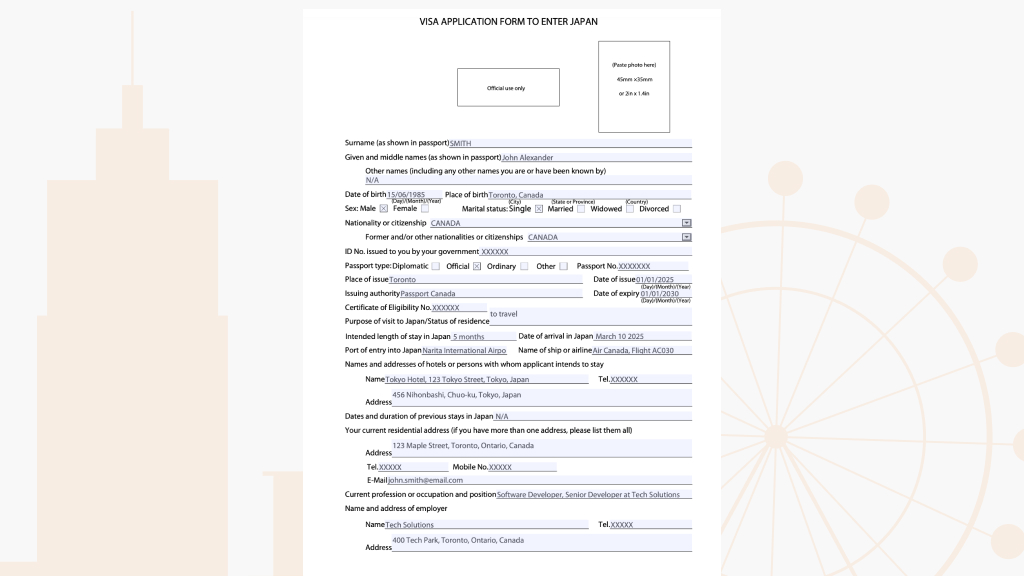
The first document you need is a completed application form. It should be filled out by hand with a wet-ink pen or typed. The signature must be handwritten, so don’t use an e-signature. You may download the application form example here. If a field does not apply to you, mark it “N/A”.
Valid passport
As for your passport, it should be valid for 6 months (the duration of your intended stay in Japan).
Passport-size photo
You need to prepare one color photo, taken within the last 6 months. Size is 45 x 35 mm (about 1.8 x 1.4 in). Your photo should be clear and without filters. The background of the image should be white without shadows or patterns. If you are wearing glasses or hats, remove them when taking the photo. Also, note that selfies and self-printed pictures may be rejected due to their low quality.
It is necessary to write your name on the backside of the photograph in print.
Planned activities & stay period
Describe your planned activities while living in Japan and the timeframe of your stay. One tip for this point: be detailed and accurate to support your application.
Proof of annual income
As we discussed, your annual income should be at least JPY 10 million to obtain the Digital Nomad Visa. So, you need to prove your financial capability with documents such as the following (check the exact list with your embassy):
- copy of your employment contract;
- copy of a contract with a business or client (must show contracted prices);
- letter from your bank that includes your name and information about annual revenue.
Insurance coverage
Provide your private health insurance. It must cover death, injury, and illness during your stay in Japan, with at least JPY 10 million for medical expenses. An insurance certificate or policy summary can serve as proof.
Japan Digital Nomad Visa for spouses and children
Digital nomads can stay in Japan with their legal spouses and children if the family members also have private health insurance and are nationals of a country or region on the official list for spouses and children (in the same official file; this list is longer than the main one). Each family member needs their own application form, passport, photo and insurance documents; proof of income is needed only from the main applicant. The package will also include documents confirming your legal relationship.
| Document | Details |
| Proof of relationship | Marriage certificate (for spouse) or birth certificate (for child) |
| Copy of sponsor’s passport | Digital Nomad visa holder’s passport copy |
How to apply for the Japan Digital Nomad Visa?
If you meet all the criteria and plan to try life in Japan, it’s time to apply for a pass. The process consists of several steps:
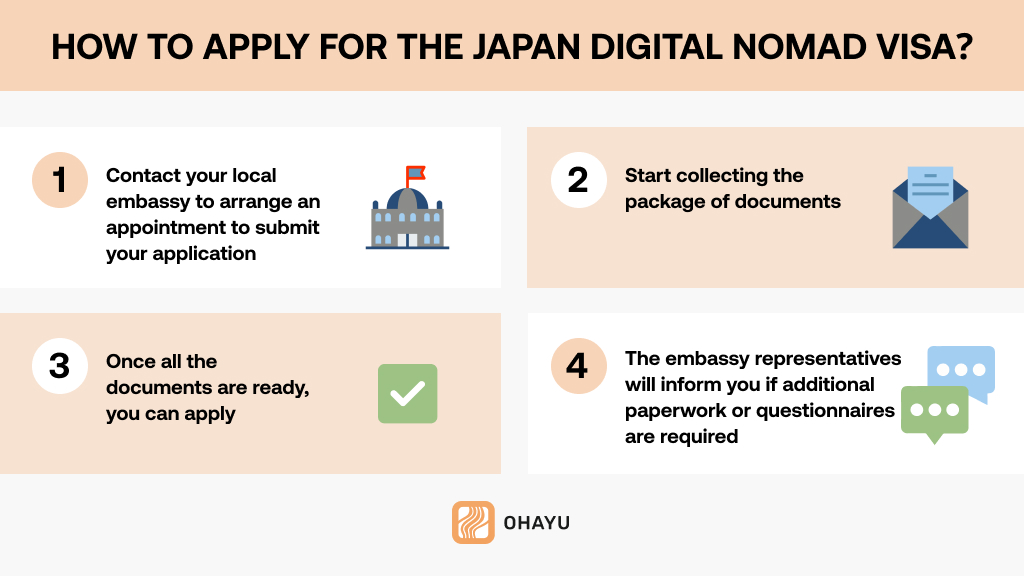
- First, contact the Japanese embassy or consulate in the country where you are staying to arrange an appointment to submit your application. If you are outside Japan, you apply for the visa directly there; no Certificate of Eligibility is needed. The embassy can tell you which documents it requires.
- Next, start collecting the package of documents. The list is quite extensive, so this stage may take some time.
- Once all the documents are ready, you can apply.
- The processing time for a Japanese Nomad Visa application starts from 5 working days and can take several weeks. The embassy representatives will inform you if additional paperwork or questionnaires are required.
Japan Digital Nomad Visa fee & taxes
According to the Immigration Services Agency of Japan (Q&A as of July 2024), income that digital nomads earn for work done in Japan can be exempt from Japanese income tax if it meets the conditions of the tax treaty between Japan and their home country. In most treaties, these conditions include staying in Japan for 183 days or less in the relevant period and not being paid by an employer resident in Japan. The exact requirements depend on the treaty, so check your situation with a tax adviser.
You will also have to pay the visa fee. According to Japan’s Ministry of Foreign Affairs (checked October 2026), for applications accepted from 1 July 2026 the fee is about 15,000 JPY for a single-entry visa and about 30,000 JPY for a multiple-entry visa. You pay it at the embassy or consulate when applying, in the currency of the country you are in. Some nationalities pay a different fee, so confirm the exact amount with your embassy or consulate.
Why are Japan Digital Nomad Visa applications rejected?
Of course, there are cases when applicants are denied a visa. Reasons can include missing or illegible documents or missing certificates. A photo of poor quality or the wrong size can also cause problems. Keep in mind that the accuracy of the main application form and the description of the activities you plan to carry out within the country also matter. Include a detailed explanation and, if your embassy asks for them, the itinerary of both flights (to and from Japan) and your place of stay.
Also note that your legal history is checked when a visa is approved. Criminal convictions, previous deportations from Japan or other countries, and drug-related or other offenses can lead to a refusal. The application form asks about these matters, and your answers must be truthful.
How to stay in touch on your trip to Japan?
If you’re about to travel to Japan, it’s time to ensure you have a reliable mobile connection. It is essential if you need to stay in touch with your family, build routes with your navigator, and respond to work issues. If you haven’t chosen your operator yet, we recommend you pay attention to Ohayu.
Ohayu provides mobile data in many countries via eSIM, an embedded SIM card that is already built into many modern devices (check your phone compatibility here). It means that you can purchase a plan before your trip, install the eSIM, and activate it after arrival to get mobile Internet without searching for local stores to buy a SIM card. Here is how eSIM setup works:
- First, you need to choose the country where you need the service. Let’s say it’s Japan.
- Pick your data plan by selecting how much data you will need on your trip. You can choose a fixed-data plan or, in selected countries, an unlimited plan for a fixed number of days, or opt for a monthly Global eSIM plan if you plan to visit several covered countries.
- Follow the steps to install and activate your eSIM to start using data.
Final words
To sum up, the Japan Digital Nomad Visa is an opportunity for eligible remote workers to try life in Asia. It allows you to stay in this picturesque country for up to 6 months and enjoy the national culture to the fullest.
If you have already received your nomadic or tourist permit and are preparing to travel abroad, don’t forget to take care of your mobile connection. Book an eSIM package in advance to stay connected right after your arrival!