


A good travel agency business plan should explain how your agency will make money, the target customers you are going to serve, and how your competitors do it, and have an estimation of revenue and margin for the upcoming months and years. You need it before you spend money on supplier agreements, a host agency, ads, tools, or an office.
If you already run a travel agency or plan to start one, mobile internet should be part of your trip planning checklist. Most clients will need data abroad for maps, WhatsApp, hotel messages, mobile tickets, ride apps, and online payments.
You can also turn this into ancillary revenue. Ohayu works with travel agencies through partner and affiliate options. Agencies can earn 20-50% from new customer eSIM sales, buy eSIMs in bulk for clients, or share a personal discount link before departure.
See the Ohayu affiliate program or email us with a link to your site or Instagram page and the subject line “Travel agency”, and we will send the partnership details.
In this guide, I’ll give you an example of how to write a business plan and add a template you can reuse for your agency. For convenience, I created a sample of a fictional US agency called EasyTravel. It will contain all basic things like packages, Instagram-led sales, hotel partnerships, Booking.com, GDS tools, and also Ohayu eSIM services, and travel insurance as ancillary revenue. But before we proceed to the template, let’s start with the basics.
What is a travel agency business plan?
A travel agency business plan is a written plan for starting, running, and growing your business. It covers the agency model, target customers, services, competitors, marketing channels, operations, team, startup costs, and financial projections.
New agencies need it before launch. Existing agencies also use it when changing niche, adding corporate travel, hiring staff, joining a host agency, or applying for financing.
Travel agency business plan template
You can use this travel agency business plan template as a working file. While reading this article, this way you can have the plan draft ready when we finish. This template has all 9 sections from this guide, plus a startup cost table, competitor table, and three-year projection table. I prepared an editable Google Doc / DOCX version, so you can download and start editing it right away.
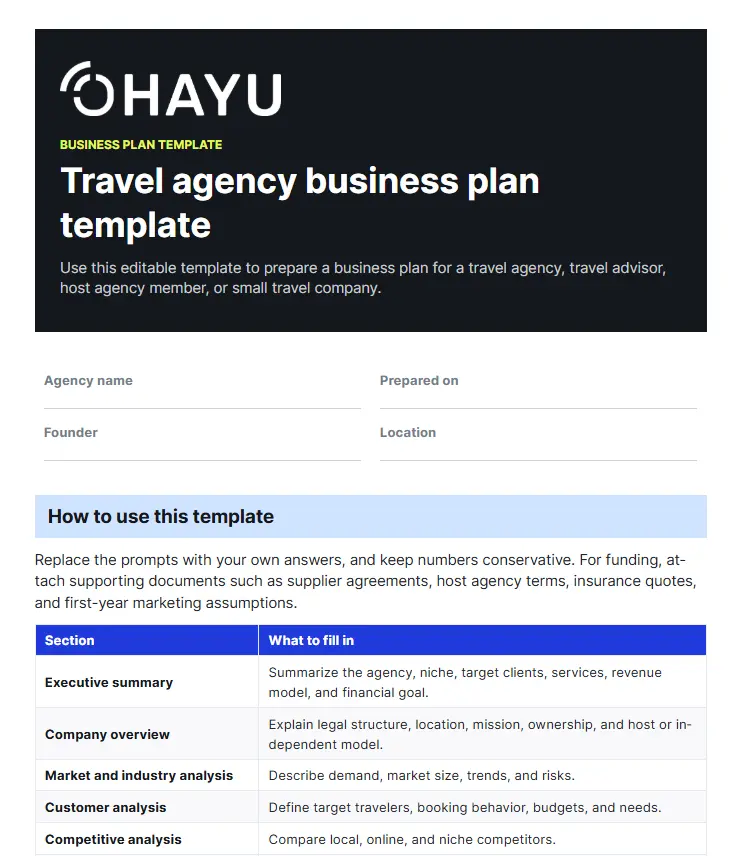
Do not copy the example numbers exactly. Replace them with your own niche, state, supplier model, fees, launch budget, and realistic booking assumptions.
9 sections of a travel agency business plan
A good travel agency business plan does not need to be long, but it should be specific. The U.S. Small Business Administration says it should guide the business through each stage of starting and managing the company. Here are the exact 9 sections we are going to cover.
| Section | What it should explain |
| Executive summary | Short version of the agency, niche, model, financial goal |
| Company overview | Legal structure, location, mission, ownership, agency model |
| Market and industry analysis | Market demand, industry size, travel trends, risks |
| Customer analysis | Target travelers, budgets, booking behavior, pain points |
| Competitive analysis | Сompetitors and USP (unique selling point, how your agency will be different) |
| Services and operations | Booking workflow, tools, suppliers, daily work |
| Marketing and sales | Lead channels, sales funnel, referrals, partnerships |
| Management team | Founder, support, advisors |
| Financial plan | Costs, revenue model, projections |
Executive summary
The executive summary comes first, but imo it is easier to write last. Keep it short. The reader should understand what the agency sells, who buys it, financial target, and how you earn that money. Include the following points.
- Business name
- Your agency niche
- Target customer
- Main services
- Revenue model
- Launch budget
- 12-mo goal
Example summary: EasyTravel (It’s a fictional agency name, so any resemblance to actual businesses is purely coincidental) is a US-registered travel agency focused on all-inclusive packages for couples, families, honeymooners, and small friend groups. The agency will sell flights, resorts, transfers, activities, insurance, and travel eSIM recommendations. Revenue will come from package commissions, service fees, selected itinerary markups, travel insurance, and Ohayu eSIM referrals. The year-one target is $1.4M in gross travel sales, $185K in net profit, and 450 booked trips.
Company overview
This section explains what the company is and how it will operate legally. For a travel company business plan, “online travel agency” is not specific enough. It can mean a solo advisor, host agency member, franchise owner, storefront agency, corporate travel agency, tour planner, or niche itinerary consultant.
- Legal structure, such as LLC or sole proprietorship.
- State or country of registration.
- Founder and ownership.
- Home-based, storefront, online-only, host agency, or franchise model.
- Mission statement.
- Short founding story.
- Supplier and booking model.
The independent vs. host agency decision matters. A fully independent agency has more control, but it may need more supplier relationships, booking systems, insurance, and compliance work. A host agency can provide supplier access, technology, training, and commission processing, usually in exchange for fees or a commission split.
Market and industry analysis
This section shows whether there is enough demand for your agency. Use it to explain the market, not to write broad claims about travel “booming.”
In the US, travel agencies are classified under NAICS 561510, which covers businesses that act as agents in selling travel, tour, and accommodation services to the general public and commercial clients.
The demand case should use real travel behavior. The National Travel and Tourism Office reported that US resident outbound travelers reached 107.7 million in 2024, up 9.2% from 2023. Mexico received 39.9 million US visits, Canada 14.1 million, and overseas countries 53.8 million. For a US agency, those numbers show that outbound leisure travel is large enough to support niche planning services.
NTTO also reported that the average US overseas outbound air traveler in 2024 had a household income of $163,000, planned 109 days before departure, stayed 15.3 nights, and spent $1,907 outside the United States. That matters for agency planning because it gives you useful assumptions for budget, lead time, and pre-trip support.
For 2026 planning, I would focus on these demand signals:
- Personalized travel planning. Simple trips can be booked alone, but multi-city routes, group trips, all-inclusive packages, cruises, destination weddings, and higher-budget itineraries still create work for advisors.
- AI-assisted planning. AI tools help with research and first drafts. Advisors still compete on supplier judgment, problem solving, and client trust.
- Niche travel. All-inclusive resorts, cruises, family trips, warm-weather packages, and destination-specific planning are easier to sell than “we book everything.”
Do not just list trends unless they change what you sell, how you market, or how you price.
Customer analysis
Customer analysis is where many plans become too vague. “People who like travel” is not a customer segment, use the following details instead.
- Age range
- Household income
- Location
- Travel budget
- Trip type
- Booking lead time
- Main concerns
- Preferred communication channel
- Decision maker
- Repeat booking potential
Example: EasyTravel targets US couples and families aged 30-55 with a typical trip budget between $3,000 and $8,000. These customers want clear package pricing, a resort that fits their group, and fewer last-minute questions before departure. The secondary audience includes honeymooners, celebration travelers, and friend groups of 4-8 people. These clients need more coordination because the trip involves multiple rooms, deposits, room types, and schedule preferences.
Competitive analysis
Competitive analysis should cover both direct competitors and online alternatives. Your customer is not only choosing between two travel agencies. They may also choose Expedia, Booking.com, Google Flights, direct hotel booking, a credit card concierge, a destination management company, or doing everything alone.
| Competitor | Strength | Weakness | EasyTravel position |
| Expedia and OTAs | Fast search and visible prices | Mostly self-service | Add concierge help and trip preparation |
| Costco Travel | Strong value and trust | Less flexible for niche support | Tailor all-inclusive packages |
| Local agencies | Personal service | May have limited add-ons | Bundle package, insurance, and eSIM guidance |
| Booking.com | Large hotel supply | No complete package planning | One-price trip support with human help |
Good positioning is specific. “Better service” is weak. “All-inclusive packages for US couples and families, with insurance and mobile data handled before departure” is clear.
Services and operations
This section explains what the agency sells and how the work gets done.
- All-inclusive package curation.
- Resort and hotel comparison.
- Flight and transfer coordination.
- Activity recommendations.
- Travel insurance.
- Visa and entry requirement guidance.
- Pre-trip documents.
- Post-trip review requests.
- Ohayu eSIM recommendations for international trips.
A travel agency does not need to sell eSIM as its core product, but many travelers ask how they will use maps, ride apps, hotel messages, mobile tickets, and email abroad. For single-destination trips, agencies can point travelers to country eSIM plans. For multi-country trips, the Ohayu Global eSIM can be easier to explain because the traveler does not need a different mobile data setup for every border crossing.
Before recommending an eSIM, the agency should ask travelers to check compatibility. Ohayu has a compatible devices guide. Dialing *#06# is not a call and does not charge the user. It is a device request that shows identifiers such as IMEI or EID. If the phone shows an EID, it usually supports eSIM.
Your operational plan should explain the daily workflow:
- Lead comes from referral, search, Instagram, or partner.
- Agency qualifies budget, dates, destination, and trip type.
- Client pays planning fee or confirms service terms.
- Advisor prepares itinerary and quote.
- Client approves booking.
- Agency processes payment and confirmations.
- Agency sends insurance and eSIM recommendations.
- Agency sends final travel documents.
- Agency checks in before departure.
- Agency follows up after the trip for review and referral.
Marketing and sales strategy
Marketing for a travel agency usually starts slowly. Referrals matter, but they are not a full strategy if the agency is new.
- Search-optimized destination articles and planning guides.
- Google Business Profile for local trust.
- Instagram and short video for package examples.
- Referral partnerships with photographers, wedding planners, hotels, schools, clubs, and local businesses.
- Email follow-ups for past travelers.
- Past client reviews.
A travel agency can also use practical destination content to support pre-trip planning. The Ohayu travel connectivity blog covers mobile networks, eSIM setup, and destination-specific internet questions that often come up before an international trip.
A basic sales funnel can look like this:
- Lead discovers the agency through Instagram, search, referral, or partner.
- Lead submits an inquiry or sends a DM.
- Agency offers a short consultation.
- Client accepts planning terms.
- Agency sends proposal.
- Client pays deposit and books.
- Agency recommends insurance and eSIM where relevant.
- Agency follows up after travel.
The marketing section should include numbers. For example:
- 30 qualified inquiries per month by month 12.
- 35% consultation booking rate.
- 50% consultation-to-client conversion rate.
- Average planning fee of $250.
- Average gross trip value of $3,100 for EasyTravel or $7,500 for a higher-end custom agency.
Management team
For a solo agency, the management team section can feel strange. Still write it. Lenders, partners, and host agencies want to know who handles sales, planning, finance, and support.
- Founder background.
- Travel industry experience.
- Sales or customer service experience.
- Destination knowledge.
- Certifications.
- Host agency affiliation.
- Contractors or part-time roles.
- Bookkeeper, accountant, or legal advisor.
Credentials should match the niche. ASTA or IATA Travel Advisor training can support trust for general agency work; CLIA certification is more relevant if cruises become a meaningful part of sales. CLIA says more than 29,000 certifications have been awarded in North America.
Financial plan
The financial plan is where the idea becomes testable. Keep it conservative.
Startup costs vary by model. A lean home-based agency can start with a few hundred to a few thousand dollars, especially under a host agency. A storefront model can require more because of rent, deposits, furniture, signage, insurance, local marketing, and staff.
For planning purposes, use separate one-time costs and monthly costs. This prevents the first-year profit estimate from looking cleaner than it really is.
| Cost item | Lean home-based estimate | Small structured agency estimate |
| Business registration and legal | $150-$800 | $1,000-$3,000 |
| Host agency or franchise setup | $300-$2,500 | $1,000-$10,000 |
| Website, email, brand basics | $300-$2,000 | $1,500-$6,000 |
| CRM, itinerary, accounting tools | $50-$300/mo | $150-$700/mo |
| Training and certifications | $200-$1,500 | $500-$3,000 |
| Insurance | $300-$1,500 | $1,000-$5,000 |
| Launch marketing | $500-$3,000 | $3,000-$15,000 |
| Office setup | $0-$1,500 | $5,000-$25,000 |
Revenue usually comes from:
- Supplier commissions.
- Planning fees.
- Service fees.
- Group trip markups.
- Corporate management fees.
- Travel insurance commissions.
- Affiliate or partner revenue.
Travel agent commission rates vary by supplier, sales volume, host agency, consortium, destination, and booking type. For basic projections, many new agencies model supplier commissions around 8%-15%, then add planning fees or service fees where the market allows.
Travel agency business plan example
Here is a filled-in example for a fictional small travel agency called EasyTravel.
| Field | Example |
| Agency name | EasyTravel |
| Business model | US-registered independent travel agency under a host agency. |
| Niche | All-inclusive warm-weather travel packages. |
| Main customers | US couples, families, honeymooners, and friend groups. |
| Team | 6 people. |
| Main channels | Instagram now, direct-book website later. |
| Supplier and tool stack | Hotels, Booking.com, Amadeus, Sabre, Travelport, Ohayu eSIM. |
| Ancillary revenue | Ohayu eSIM recommendations and travel insurance. |
| Year-one target | $1.4M gross sales and 450 trips booked. |
EasyTravel executive summary
EasyTravel is a small US-based travel agency that sells all-inclusive travel packages for couples, families, honeymooners, and small friend groups. The agency focuses on warm-weather destinations where travelers want one clear package price that covers flights, resorts, transfers, and activities.
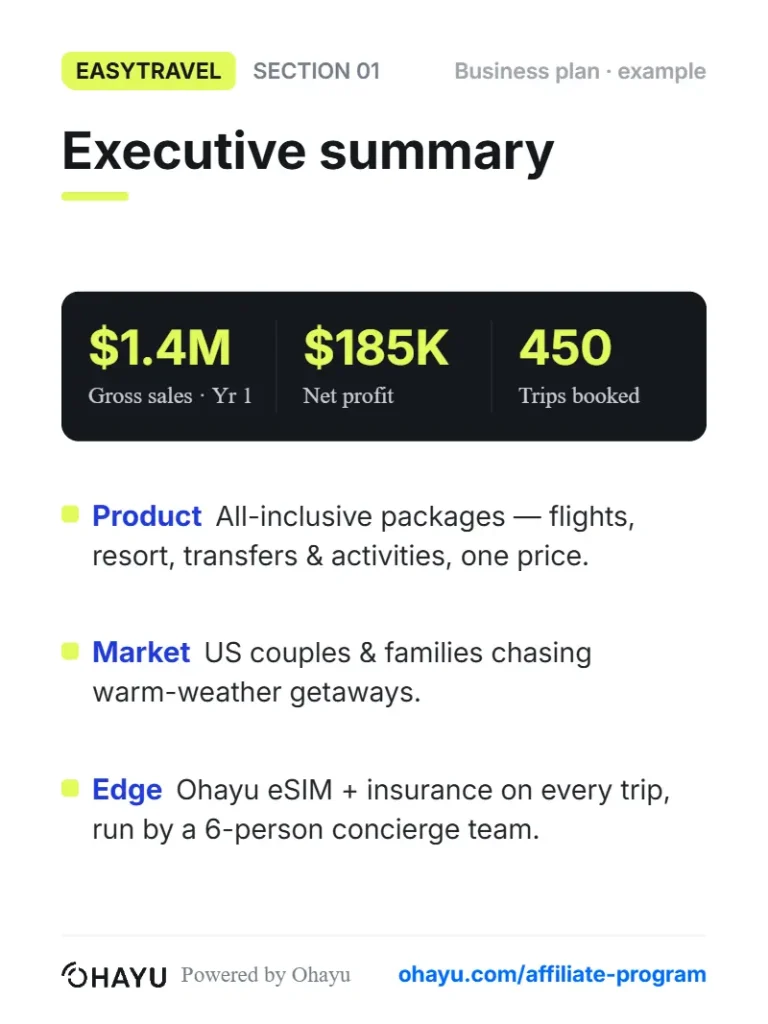
The business will start with Instagram as the main acquisition channel and later add a small direct-book website. The agency will use a host agency for supplier access and booking support, while building partnerships with hotels, Booking.com, Ohayu eSIM services, and travel insurance providers.
EasyTravel plans to earn revenue from package commissions, service fees, selected itinerary markups, travel insurance, and Ohayu eSIM referrals. The year-one target is $1.4M in gross travel sales, $185K in net profit, and 450 booked trips.
EasyTravel company overview
EasyTravel LLC will be a founder-owned, US-registered travel agency. The business will operate independently but under a host agency to access supplier rates, booking systems, training, commission processing, and back-office support.
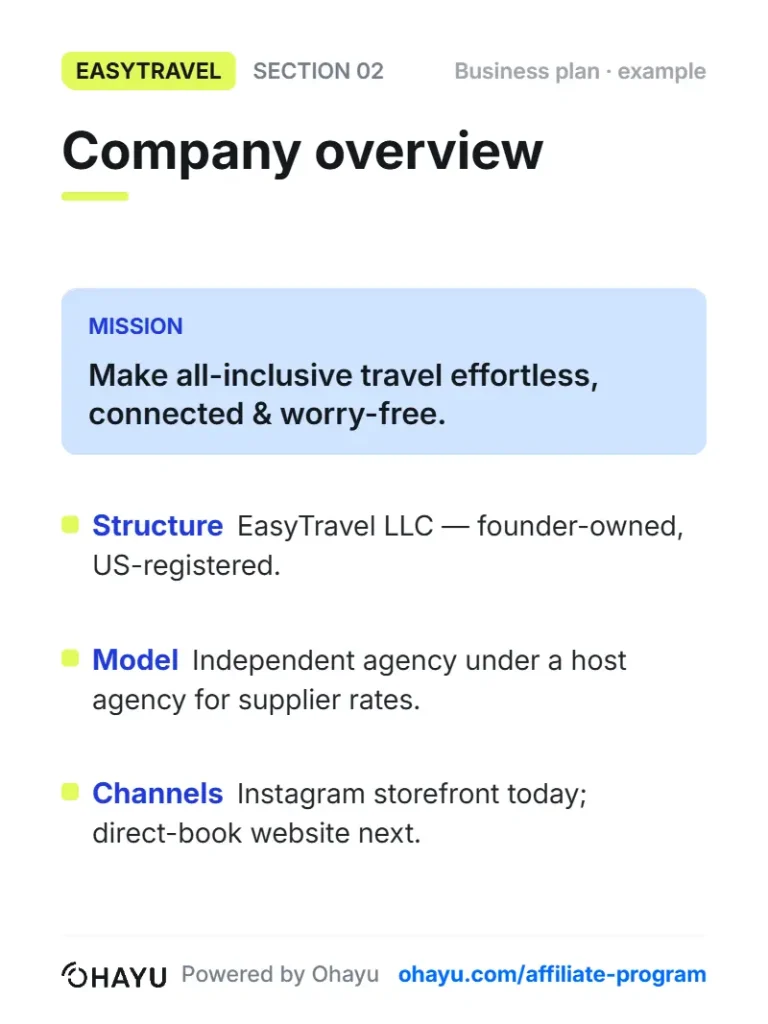
The agency will not open a storefront in the first year. It will start as a digital-first agency, using Instagram for demand generation and direct messages, then move qualified leads into consultations, quotes, deposits, and final bookings.
The mission is simple: make all-inclusive travel easier to buy, easier to understand, and easier to manage before departure. That includes the trip package, insurance, transfers, and mobile connectivity abroad.
EasyTravel market and industry analysis
EasyTravel will focus on US outbound leisure travelers who prefer packaged, warm-weather trips instead of building every part of the journey alone. The main destinations will include Mexico, the Caribbean, and selected resort areas in Europe.
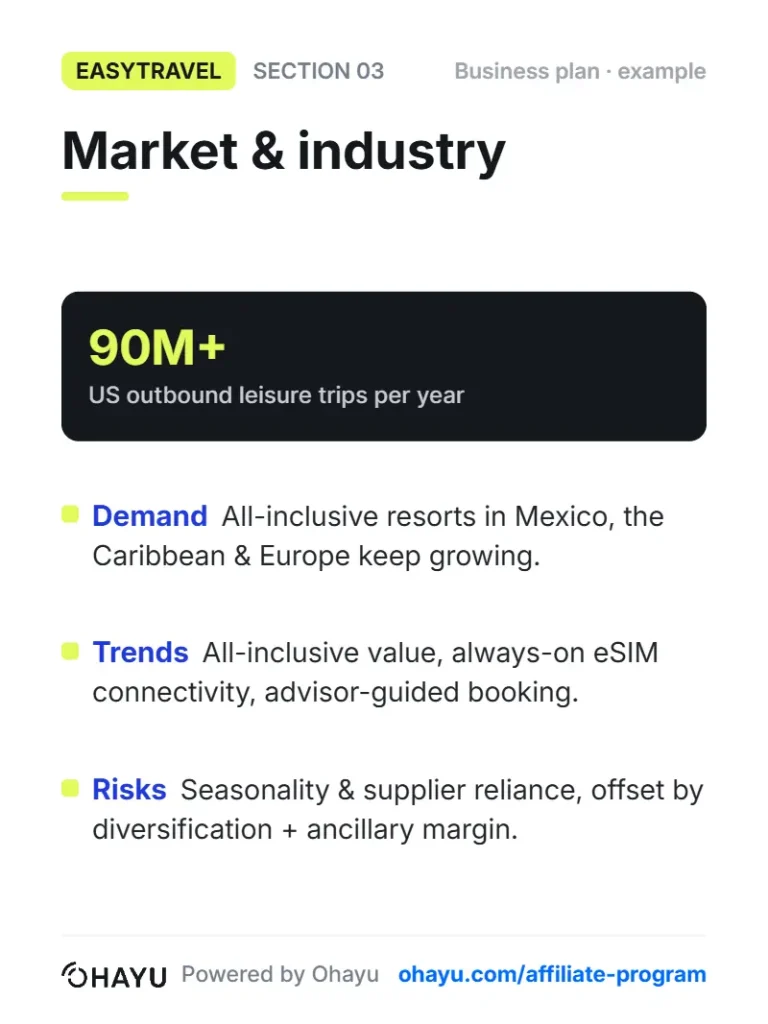
The demand case is realistic because US outbound travel is large. NTTO reported 107.7 million US resident outbound travelers in 2024. It also reported that Mexico was the largest outbound market, with 39.9 million US visits. That fits EasyTravel’s all-inclusive beach package focus.
- Travelers want clear pricing for flights, resorts, transfers, and activities.
- Many customers research on Instagram and Google but want a person to finalize the booking.
- Connectivity, insurance, and pre-trip support are now part of the planning conversation.
- All-inclusive packages are easier to explain than fully custom trips for first-time agency clients.
The main risks are seasonality, dependence on supplier rates, and price competition from online travel agencies. The agency will reduce this risk by selling ancillary products, including travel insurance and Ohayu eSIM plans, and by building repeat bookings through client referrals.
EasyTravel customer analysis
EasyTravel will target US couples and families aged 30-55 with a typical trip budget between $3,000 and $8,000. These customers usually want a warm-weather break, but they do not want to compare dozens of resort options, transfer rules, baggage policies, and activity add-ons alone.
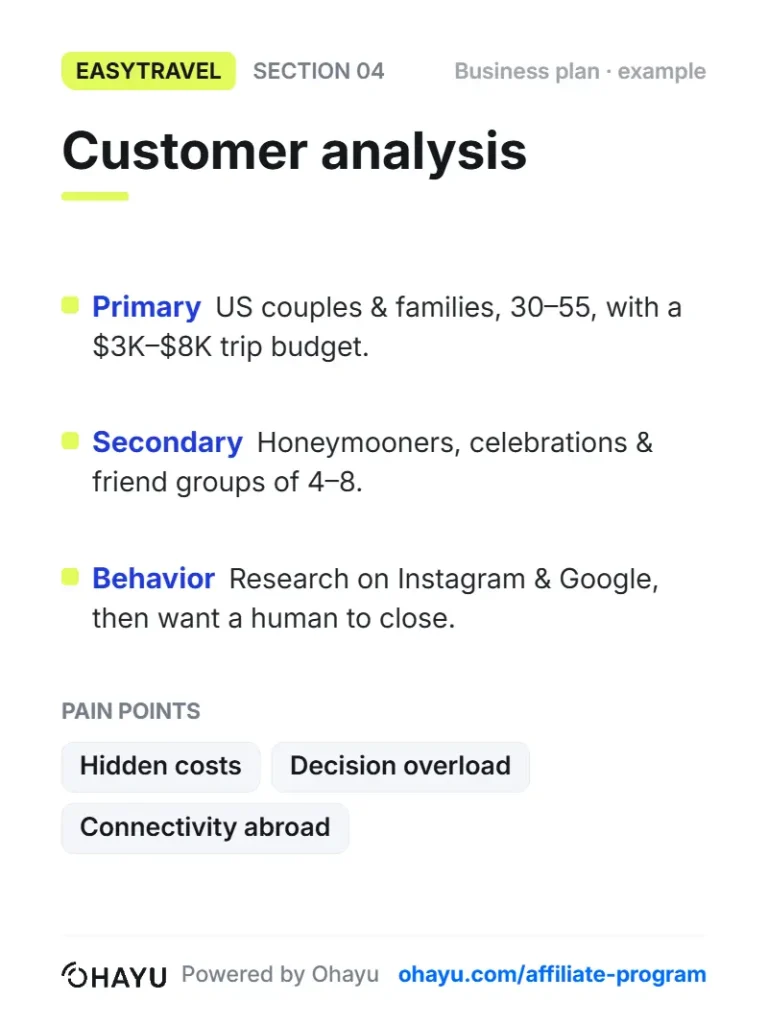
The secondary audience includes honeymooners, celebration travelers, and friend groups of 4-8 people. These clients usually need more coordination because the trip involves multiple people, deposits, room types, and schedule preferences.
- Hidden costs.
- Too many package options.
- Unclear resort quality.
- Transfer and arrival logistics.
- Mobile data abroad.
- Insurance questions.
- Group decision delays.
This is why EasyTravel will sell the package and also support the practical parts of the trip, including insurance and eSIM guidance.
EasyTravel competitive analysis
The agency will compete with OTAs, Costco Travel, Booking.com, local travel agencies, and DIY planning.
| Competitor | Strength | Weakness | EasyTravel position |
| Expedia and OTAs | Cheap visible prices. | Self-service. | Add human concierge help and connectivity support. |
| Costco Travel | Trusted value. | Less tailored for niche support. | Tailor all-inclusive trips. |
| Local agencies | Personal relationship. | Few practical add-ons. | Bundle eSIM and insurance guidance. |
| Booking.com | Large supply. | No full package planning. | Deliver one-price, supported trips. |
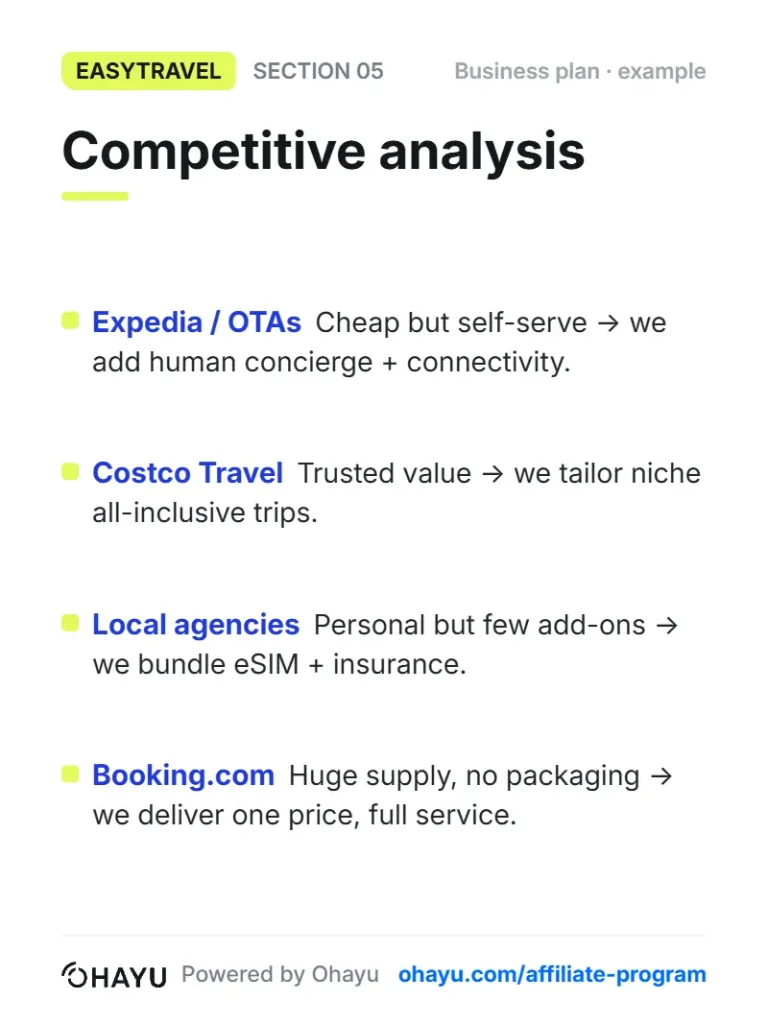
EasyTravel should not claim it is cheaper than every competitor. The stronger position is that it reduces friction. The client gets one package, one planning contact, and help with the parts that usually create last-minute questions.
EasyTravel services and operations
EasyTravel will sell all-inclusive travel packages as the core product. A standard package can include flights, resort stay, airport transfers, activities, travel insurance, and mobile data guidance.
- All-inclusive package curation.
- Resort and hotel comparison.
- Flight and transfer coordination.
- Activity recommendations.
- Travel insurance.
- Ohayu eSIM recommendations for international trips.
- Pre-trip support documents.
- Post-trip review requests.
The workflow will stay simple: inquiry, consultation, quote, deposit, booking, insurance and eSIM recommendation, final documents, pre-trip check-in, and post-trip follow-up.
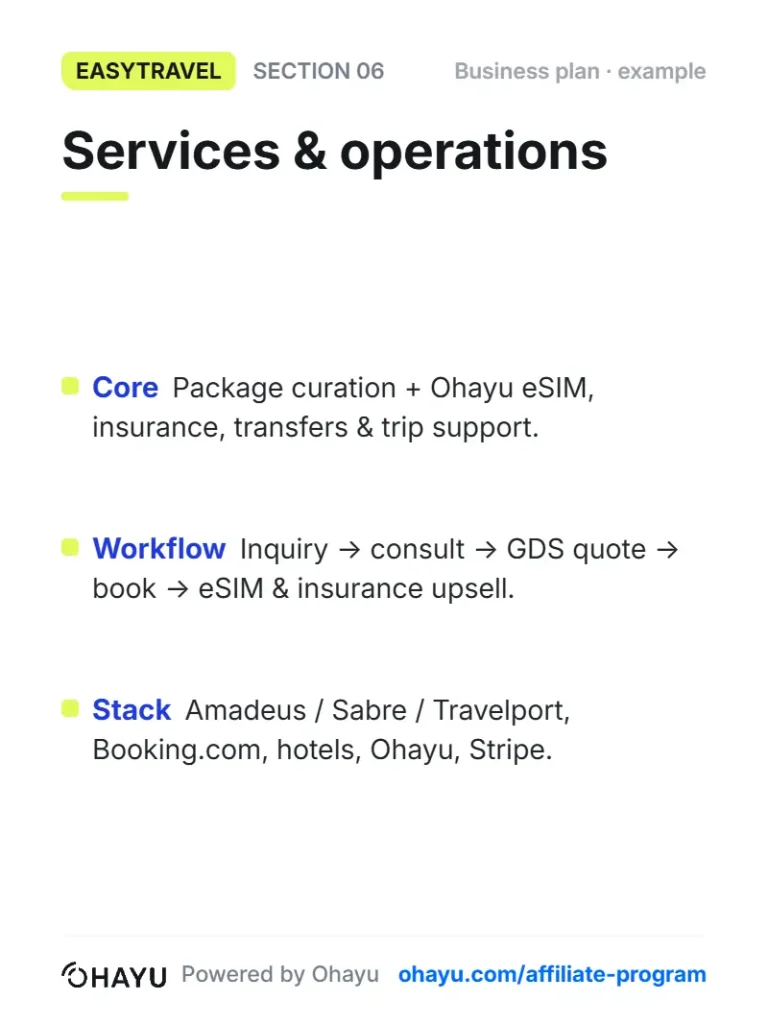
EasyTravel will use supplier and booking tools such as Amadeus, Sabre, or Travelport through a host agency setup, plus Booking.com and hotel partners where suitable. Stripe can support payments, while CRM and itinerary tools should track leads, deposits, confirmations, and follow-up tasks.
EasyTravel marketing and sales strategy
EasyTravel will start with Instagram because it fits warm-weather, all-inclusive travel well. The first content format should be simple: resort comparisons, package examples, honeymoon ideas, family-friendly destination posts, and short videos explaining what is included in each trip.
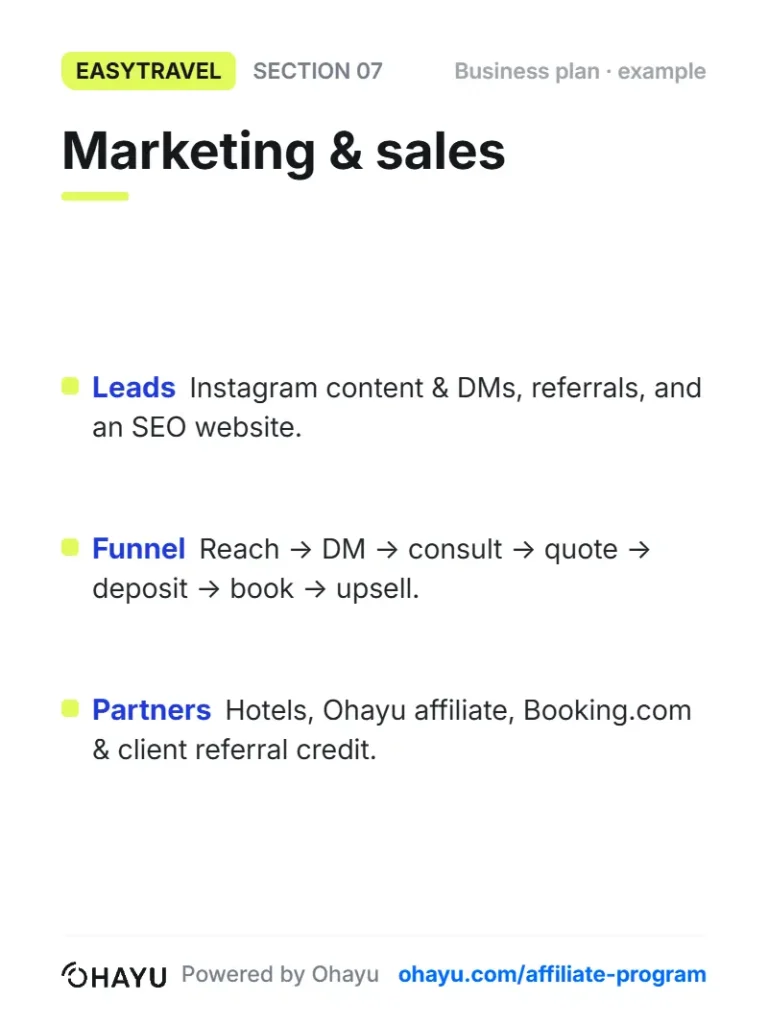
The agency should not depend only on social media. The second stage is a small SEO website with destination pages, package inquiry forms, customer reviews, and practical travel guides.
- Instagram content and DMs.
- Client referrals.
- SEO website.
- Hotel and partner referrals.
- Booking.com affiliate opportunities.
- Ohayu affiliate partnership for travel eSIMs.
- Email follow-ups for past clients.
The Ohayu affiliate program can be used as an ancillary partner channel if EasyTravel wants to recommend travel eSIMs inside pre-trip documents or itinerary checklists.
EasyTravel management team
EasyTravel will operate with a 6-person team.
| Role | Responsibility |
| Two co-founders | Sales, supplier relationships, product direction. |
| Two travel advisors | Consultations, quotes, bookings, client support. |
| Marketing lead | Instagram, website content, email, referral campaigns. |
| Operations coordinator | Documents, payment tracking, supplier follow-up, support tasks. |
Books and design can be outsourced in the first year. This keeps fixed payroll lighter while the agency tests demand and builds repeatable lead channels.
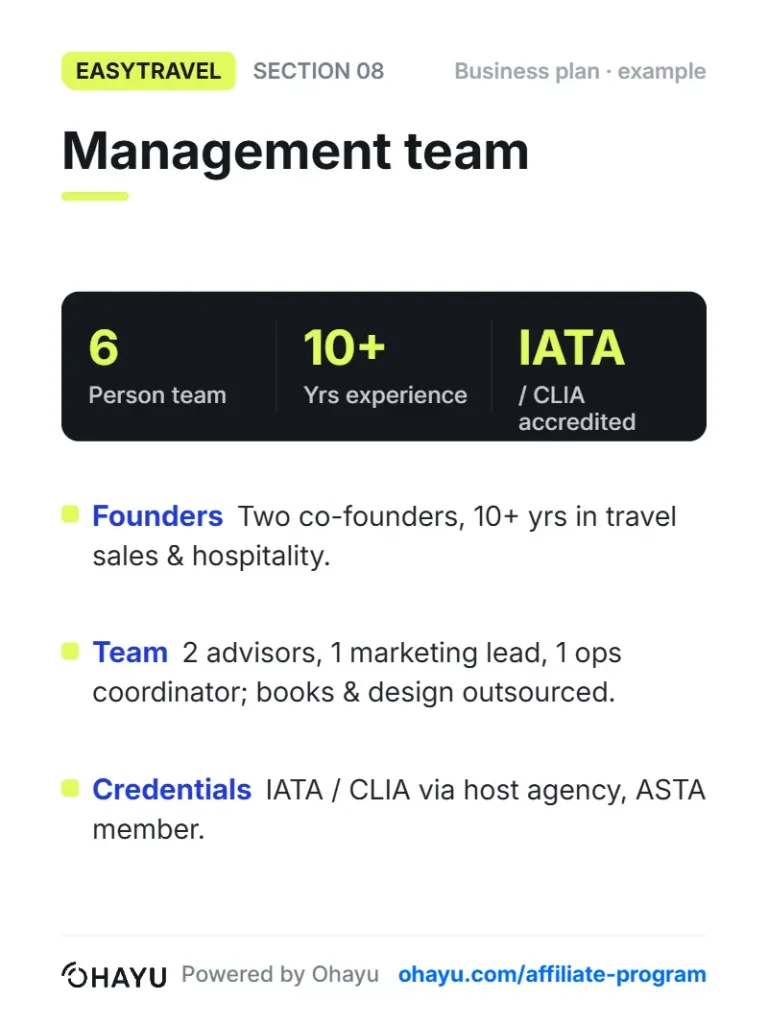
The agency can use IATA or CLIA access through the host agency where applicable. ASTA membership can also support trust, especially if EasyTravel wants to work with higher-budget clients or formal partnerships.
EasyTravel financial plan
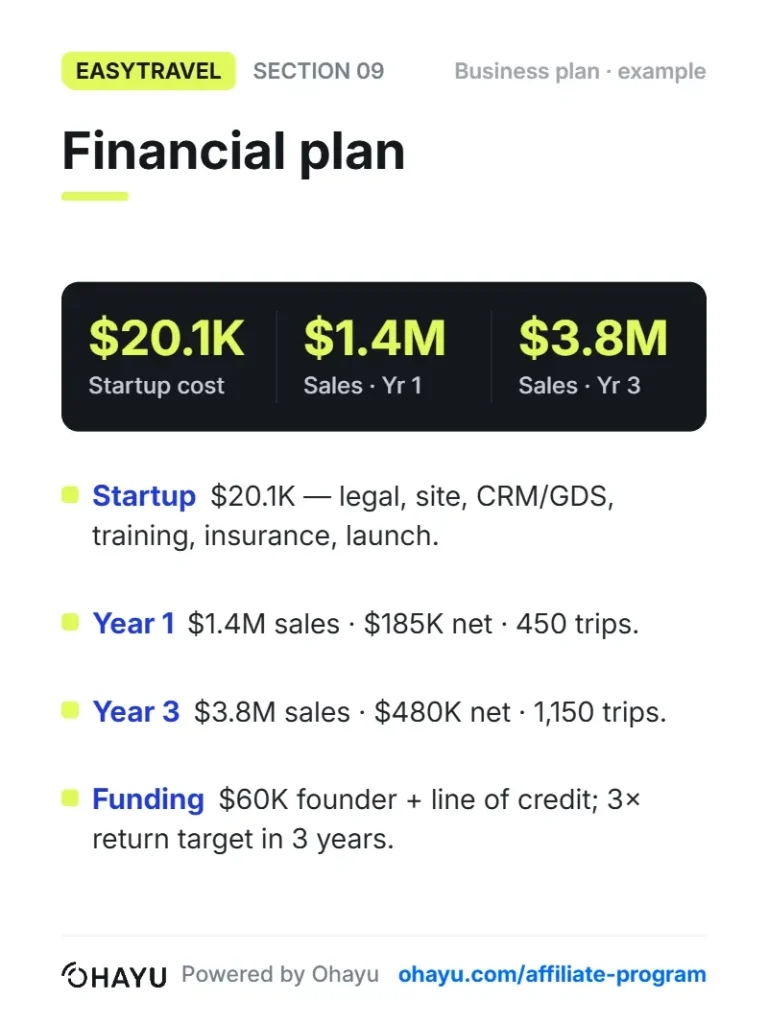
EasyTravel estimates $20,100 in startup costs. The highest early costs are legal setup, website basics, CRM or booking tools, training, insurance, and launch marketing.
| Cost item | Estimate |
| Business registration and legal | $1,500 |
| Host agency setup and training | $3,000 |
| Website and email setup | $2,500 |
| Brand basics and templates | $1,200 |
| CRM, booking, and operations tools | $2,400 |
| Insurance | $2,000 |
| Launch marketing | $5,500 |
| Accounting setup | $2,000 |
| Total | $20,100 |
| Metric | Estimate |
| Gross travel sales | $1.4M |
| Trips booked | 450 |
| Net profit | $185K |
| Average gross trip value | About $3,100 |
| Main revenue sources | Package commissions, service fees, insurance, Ohayu eSIM referrals. |
| Metric | Year 1 | Year 3 |
| Gross travel sales | $1.4M | $3.8M |
| Trips booked | 450 | 1,150 |
| Net profit | $185K | $480K |
Funding will come from $60K in founder capital plus a line of credit. The target is to return 3x founder capital within three years, but this depends on keeping acquisition costs controlled and converting Instagram demand into booked trips.
Common mistakes to avoid in your travel business plan
Do not write the plan like a travel brochure. A lender, partner, or host agency wants numbers, positioning, and operations.
- Using a broad niche such as “everyone who travels.”
- Ignoring startup costs because the agency is home-based.
- Assuming commissions arrive immediately after booking.
- Leaving out planning fees.
- Copying supplier commission rates without checking actual host agency terms.
- Skipping insurance, legal, and accounting costs.
- Treating Instagram as the whole marketing plan.
- Making three-year projections with no inquiry or conversion assumptions.
- Forgetting customer support after booking.
Trust also matters. The FTC travel consumer resources and USAGov travel complaints pages are useful references when you write policies for refunds, complaints, travel scams, and customer support workflows.
A travel business plan should show how the agency survives the first year, not only how it will look when it is already successful.
Frequently asked questions
A practical travel agency business plan is usually 10-20 pages. A one-page plan can help with early thinking, but it is too short for funding, partners, or serious launch planning. If you are applying for a loan, write the full version with financial projections.
Not always. Many host agencies do not require a full formal business plan. Still, having one helps you choose the right host, estimate costs, and avoid signing up before you know your niche, fees, and sales targets.
A business plan for travel agent work focuses on one advisor, often home-based or under a host agency. A travel agency business plan may include a larger company structure, employees, storefront costs, corporate clients, or multiple advisors.
A home-based agency can start around $500-$5,000, depending on registration, host agency fees, tools, training, insurance, and marketing. A storefront or more structured agency can require $10,000-$50,000 or more because of rent, setup, signage, insurance, staff, and local marketing.
Yes, if the eSIM is presented as a practical travel add-on, not as the main reason to book. It fits best in pre-trip documents for international travelers who need maps, ride apps, email, and hotel messages abroad.