

The best Norway mobile operators are Telenor (the widest 5G network), Telia (the second largest), and Ice (cheaper plans but limited coverage). They offer mobile plans for data and calls from $20/mo for permanent residents.
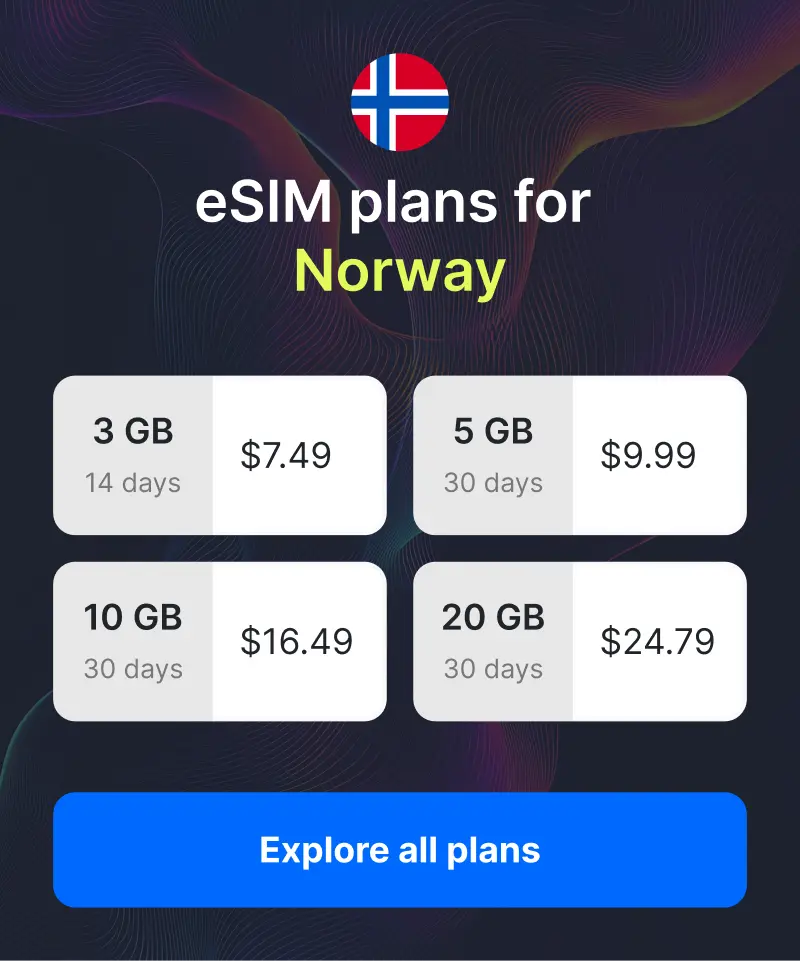
International providers such as Ohayu.com can use the network capacities of Telia and Telenor and sell data-only eSIM plans for travelers from $7.59. This is a more convenient option compared to buying a SIM directly from local carriers. Users can purchase a travel eSIM online even before the trip starts, using Euro or USD currency, and activate it right after landing in Norway to get connected to local networks.
In this article, we’ll analyze and compare the network coverage, performance, and costs for each of these providers so that you can decide on the best one for your next visit.
Norwegian mobile market overview
Norway has a solid mobile network performance due to the significant investments in 5G networks by leading mobile operators. As of mid-2025, it is one of the world’s leaders in cellular performance due to Opensignal reports.
Average download and upload speeds are at 158.59 and 22.67 Mbps, respectively. This makes the country rank 17th for mobile performance in the Speedtest Global Index.
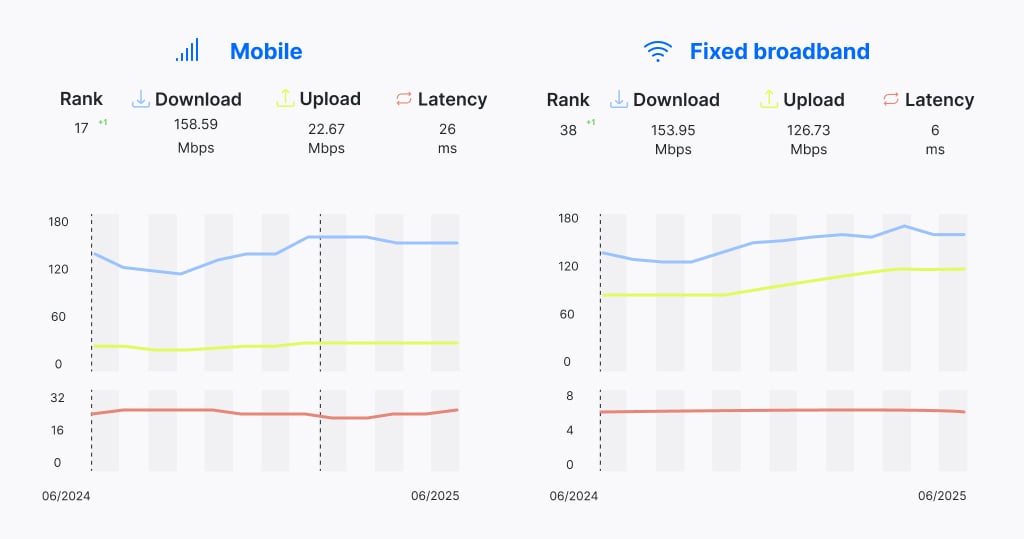
This table shows how Norway compares to other countries on mobile download speeds.
| Place | Country | Median mobile download speed |
| 4 | Brazil | 243.62 Mbps |
| 7 | South Korea | 227.07 Mbps |
| 10 | Denmark | 178.51 Mbps |
| 12 | Netherlands | 163.72 Mbps |
| 14 | United States | 158.49 Mbps |
| 17 | Norway | 151.75 Mbps |
| 26 | France | 131.62 Mbps |
| 33 | Australia | 124.99 Mbps |
| 59 | United Kingdom | 68.46 Mbps |
| 66 | Japan | 60.72 Mbps |
This table contains data from Speedtest Global Index, November 2025.
In major cities, average mobile speeds are higher: Oslo has around 231 Mbps, Bergen – 187 Mbps. These high numbers are achieved due to an extensive 5G high-frequency network mixing big towers with multiple small cell sites and signal boosters located around the cities. In smaller towns, even 4G connections often give more than 100 Mbps mobile speed.
Overall, the majority of mobile connections are currently 4G or 5G. 5G is widely deployed, reducing the need to fall back to 4G. The older generations, 2G and 3G, are being phased out and scheduled to fully close by 2025.
The government has highly ambitious plans for the telecommunications sector. Their Digital Norway – ICT Strategy 2030 is to ensure that the country becomes one of the most digitally advanced nations by 2030. This focuses on improving online services and extending internet connectivity even to the most rural and remote areas across the country.
eSIM in Norway
A simple and modern solution to get connected in Norway is an eSIM. It is an embedded SIM card located inside most modern smartphones. International travel eSIMs connect user devices to one of Norway’s local networks (Telenor, Telia, or Ice), depending on the provider’s agreements. In particular, Ohayu can switch between Telenor and Telia.
Here are some unobvious eSIM advantages for travelers.
- No need to go to a shop and swap physical SIM cards. All setup takes place online; you don’t need to look for kiosks, stay in queues, or know the local language to buy a plan.
- Keep your phone number. Use eSIM as a data profile for mobile internet only, and keep your home SIM active to make calls, reply in messengers, etc.
- Automatic access to a local network. This prevents the costly roaming fees of your home carrier.
- International travel eSIMs like Ohayu activate online without ID. Local Norwegian eSIMs may require ID registration.
- Store several eSIMs on a single phone. It is very convenient when traveling in several countries – you can get a Global plan that automatically switches networks when you cross borders. Global subscription is very useful if you plan to visit the nearest countries as well, because it covers Sweden and Finland, as well as 120+ other locations.
To install an eSIM for Norway, you need to check your device compatibility. Dial *#06# to make a free request to your phone system. If you see an EID number, it means that your device supports eSIM.
Ohayu has a range of plans for trips of different durations and data requirements: there are 3-50 GB plans, which can be used within 14-90 days.
How eSIM works
- Buy an eSIM plan
- Scan a QR code or tap the Install button in your Ohayu app, which will download the eSIM profile to your phone.
- Activate it using Wi-Fi when you arrive in Norway and get connected to the local network. Main international airports, including Oslo (OSL), Bergen (BGO), Stavanger (SVG), and Trondheim (TRD), have free Wi-Fi access, so you can start the activation right after landing.
Top 3 Norway mobile operators
Norway’s mobile market has three major providers — Telenor, Telia, and Ice — supported by several smaller MVNOs (Mobile Virtual Network Operators) that use the infrastructure of the main operators.
| Norwegian mobile operators | Mobile download speed | Key strengths |
| Telenor | 172.47 Mbps | Widest 4G and 5G coverage, strong rural reach, highest number of subscribers nationwide |
| Telia | 139.08 Mbps | Extensive 4G/5G network in cities and populated areas, rapid 5G expansion |
| Ice | 76.86 Mbps | Cost-effective plans, good stability, but a smaller coverage footprint in remote regions, and slower speeds |
| MVNOs (Talkmore, Chilimobil, OneCall, MyCall) | Niche providers | Lease major networks, offer prepaid plans at lower prices |
Mobile download speed is based on the Ookla Speedtest Intelligence report, July-December 2024.
Telenor
The operator has its roots back in 1855, when it started operating as a telegraph company. Today, it operates as a global telecommunications leader with millions of customers worldwide.
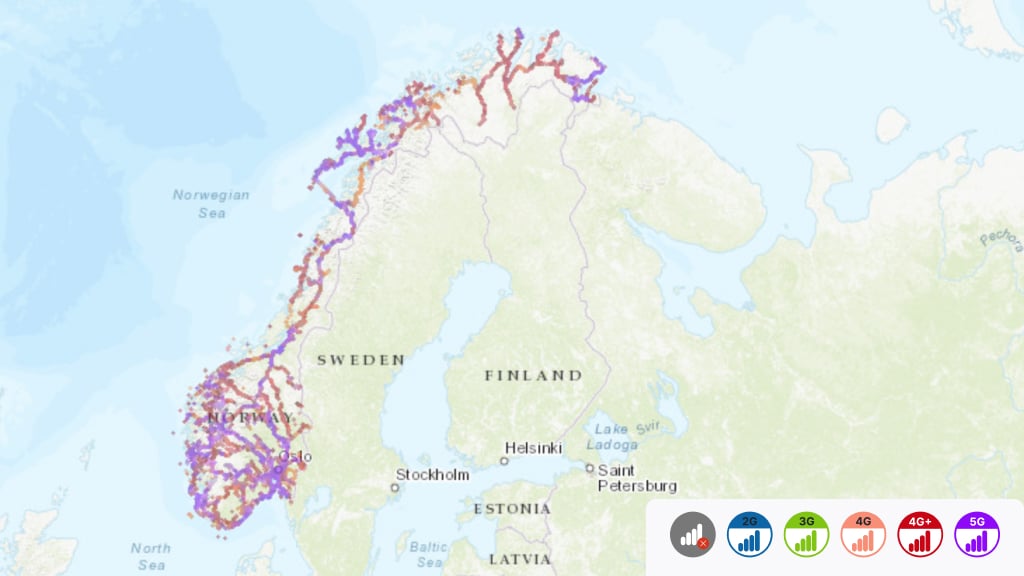
The company earns recognition for its fast download speeds. In 2024, users experienced an average of 170.72 Mbps 4G and 255.57 Mbps 5G download speeds. The upload speeds are 21.60 Mbps for 4G and 32.78 Mbps for 5G, respectively.
Its service boasts the widest 4G reach across Norway. As of early 2023, 99.8 % of the population had access to 4G service.
The operator’s prepaid plans for fast 5G include different amounts of data. You could, for example, receive:
- 5 GB for 379 NOK (approximately $37.5 USD) monthly.
- 10 GB for 459 NOK (approximately $45.4 USD) monthly.
Some plans provide unlimited data, starting from 549 NOK (about $54.3 USD) with EU roaming included.
Telia
It is the second biggest telecommunications company in Norway. It originated from Telia Company, a Swedish multinational telecommunications company, which operates in Sweden, Finland, Norway, Estonia, Latvia, and Lithuania.
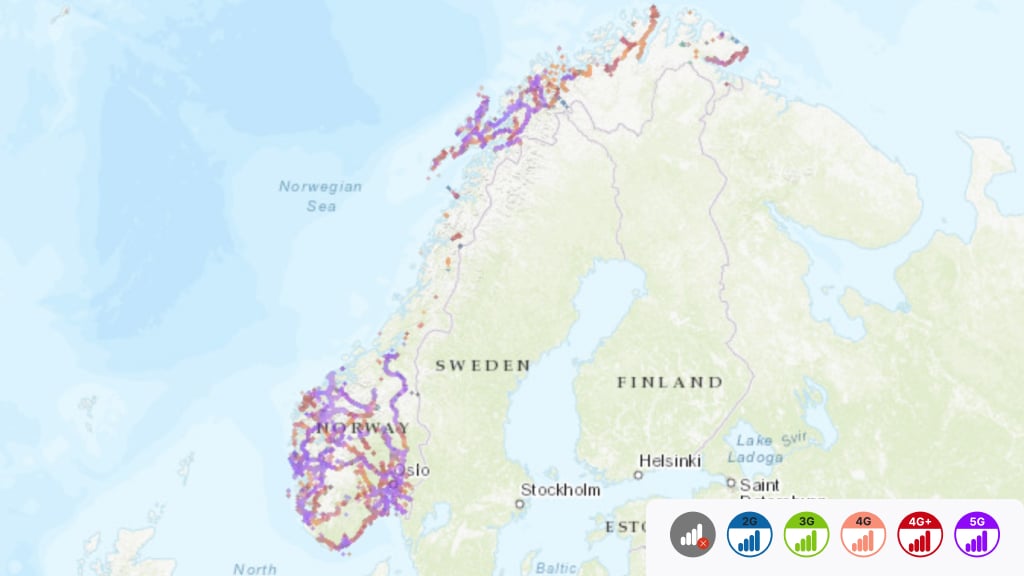
One of its great achievements is that this operator launched the first 4G LTE network in Scandinavia in 2009. They also pioneered nationwide 5G in Norway. By December 2024, the company had achieved 99% coverage. The operator has also substantially upgraded its 5G infrastructure.
The combination of upgraded 4G and 5G has considerably boosted average network performance. For instance, in the Arctic city of Tromso, download speeds have improved by 375% since 2019. Mobile data usage also increased by 900% over the same period.
Packages offered by Telia include:
- 5 GB for 329 NOK ($32.5 USD).
- 10 GB for 379 NOK ($37.5 USD).
- “X Start” (unlimited GB) for 429 NOK ($42.4 USD).
- “X Max” (unlimited GB) for 549 NOK ($54.3 USD).
These prepaid plans also include free calls/texts to the EU and Great Britain.
Ice
It is the country’s third-largest carrier. It was launched in 2003 as Ice Norge, as a broadband-first provider. In 2015, the operator rolled out its own network.
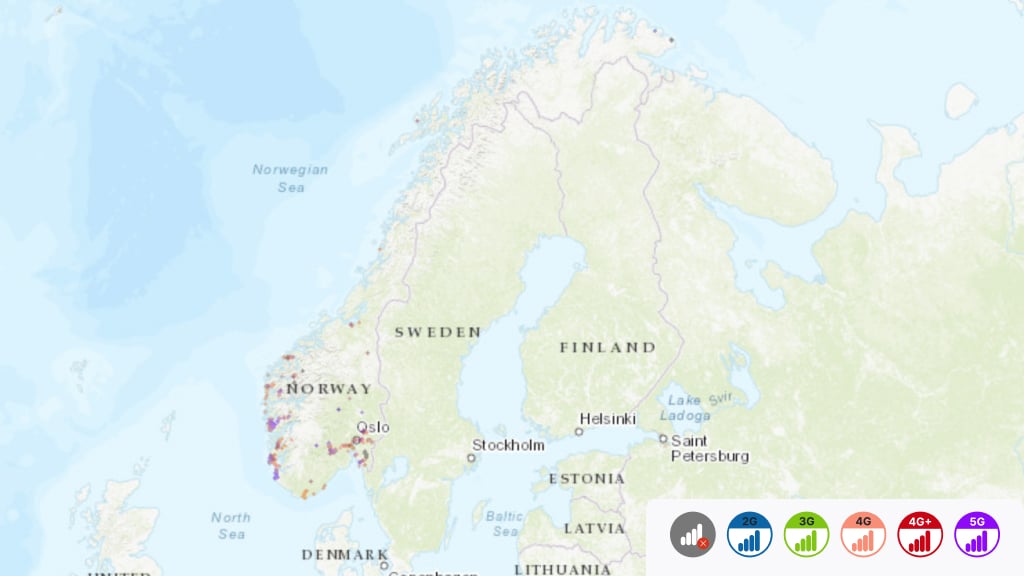
Today, it combines its infrastructure with roaming arrangements to access another carrier’s service and provide national coverage. The provider generally rates well on availability (time with a 3G or better connection). In June 2023, it reported 99.3% availability.
Even though Ice has strong network stability, its overall speeds remain lower than Telenor and Telia. During the 2nd half of 2024, its average median download speed was around 76.86 Mbps. For 5G, it was around 88.76, which is still behind compared to the other two top Norway mobile operators.
The company is working on 5G infrastructure. It ranks third for overall coverage experience.
Ice’s mobile plans are cheaper than the competitors. Some of these are as follows:
- 2, 6, 12, 60 GB plans for around 179-299 NOK ($17.7-30 USD) per month.
- Plans with unlimited data, like “iceMax,” cost from 399 NOK ($39.4 USD).
Other Providers (MVNOs)
Mobile Virtual Network Operators use the services of the MNOs. Some examples of MVNOs are Talkmore, Chilimobil, OneCall, and Mycall.
- Their biggest advantage: they are cost-cutters.
- The significant disadvantage: not all of them are as fast and stable as the MNOs.
Comparison of Norway mobile operators
This section provides a comparison of Norway’s mobile operators based on the Opensignal Mobile Network Experience Report for 2024. It is a comparison of the core MNOs’ performance indicators, like download and upload speed, 5G experience, network coverage, and consistency of the connection.
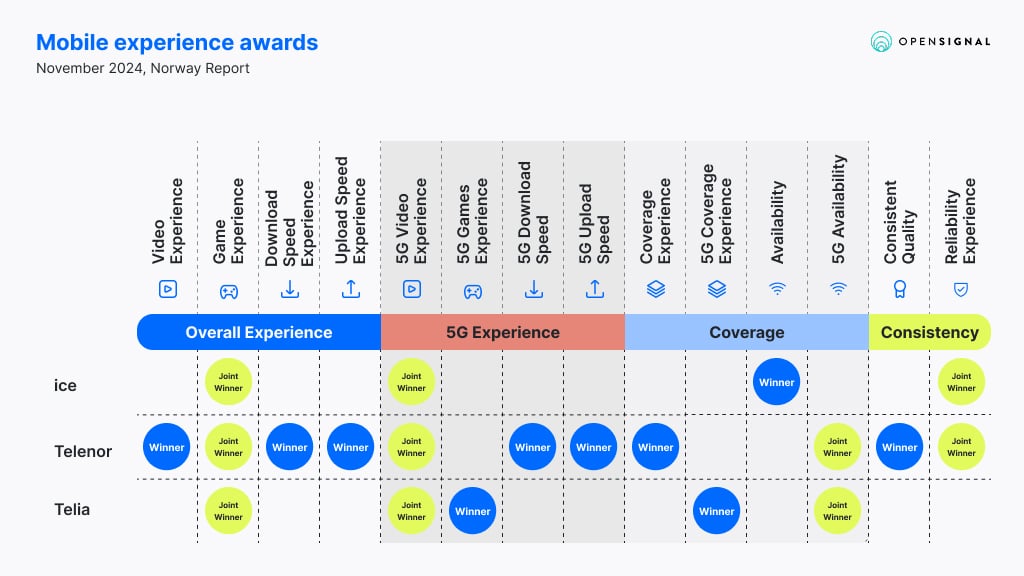
Telenor is best in most of the categories, with the strongest performance and widest coverage. Ice is outstanding in network stability. Telia wins in 5G coverage and gaming experience.
Download speed
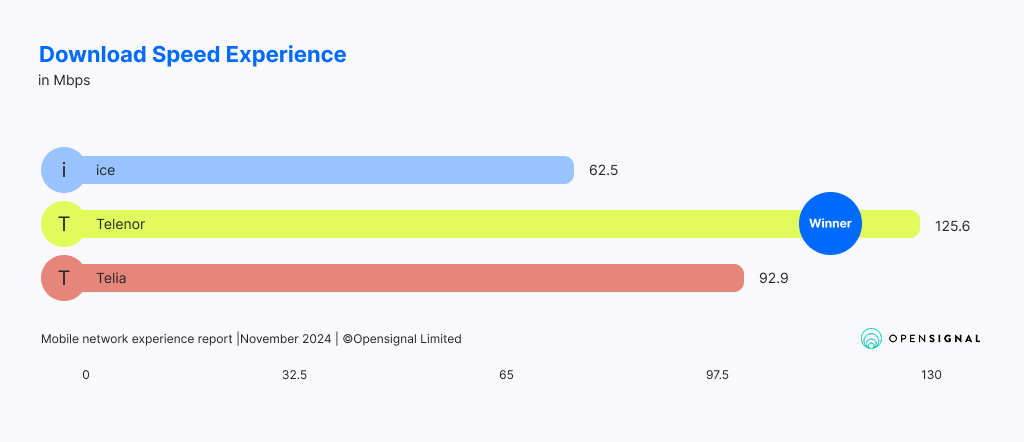
The fastest download speeds category winner is Telenor. Telenor has 125.6 Mbps, Telia – 92.9 Mbps, and Ice – 62.5 Mbps (which is two times slower than Telenor).
Upload speed
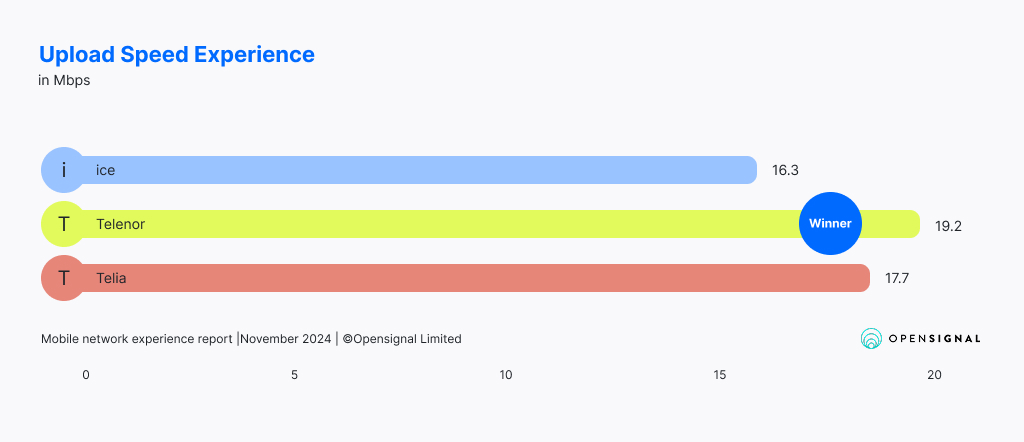
Telenor wins in upload speeds as well. Its upload rate is 19.2 Mbps. The second one is Telia with 17.7 Mbps. Ice has 16.3 Mbps.
Coverage experience
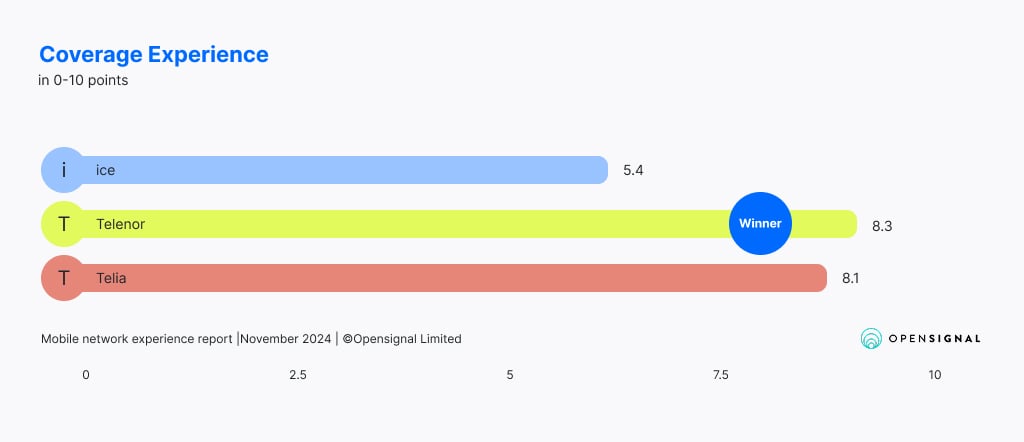
Telenor is the best rated with 8.3 points out of 10 for mobile coverage. Telia is very close to the winner with 8.1 points and hence also has a good signal in most of the country. Ice receives 5.4 for a worse 4G/5G coverage; its customers might experience poor signal in remote areas.
Network reliability
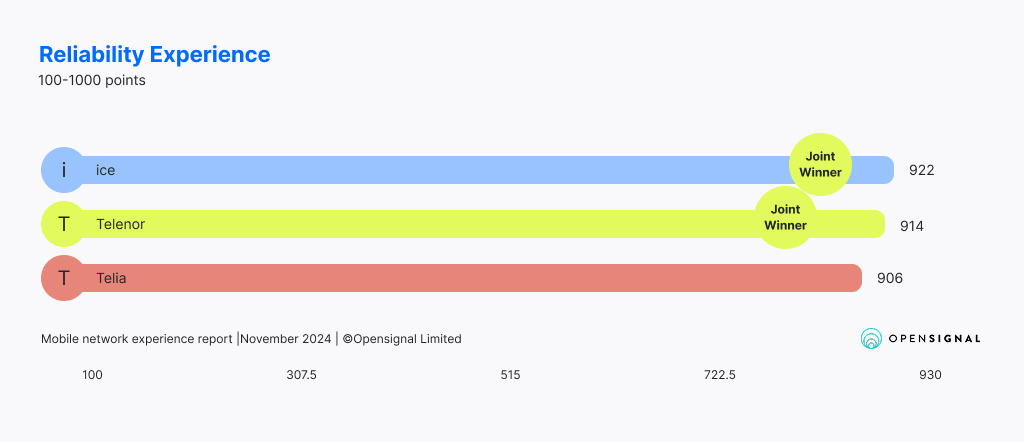
The most reliable network is Ice. This shows that where covered, its network is quite stable. All three networks rank very close in this category with a few points difference.
How to buy a SIM card in Norway
eSIM is the most convenient way to get online fast and connect to the local networks. However, if you still prefer to buy a physical Norwegian SIM card due to an older phone model, here are some helpful recommendations on where to get it.
Where to Buy
- Airports: Oslo Airport (OSL), Bergen Airport (BGO), and Trondheim Airport (TRD) have kiosks or stores. As soon as you land, you may purchase a SIM card.
- Mobile Carrier Stores: In bigger towns and cities, there are official cell phone operator stores. The multilingual staff can assist you in selecting a package.
- Convenience Stores: Prepaid SIM cards are usually sold in convenience stores such as Narvesen and 7-Eleven. A fast way of instant use.
- Electronics Retailers: Cell bundles are also sold in stores such as Elkjop and Power.
With a physical SIM card that is bought at a store, expect to show your passport during registration. That is a normal procedure. The store will enroll your name on the SIM.
Activation is normally fast. At times, it enables automatically, or you get a welcome SMS that your service is ready.
| Operator | How to buy / Features | Google Play | App Store |
| Ohayu eSIM | Buy online, activate with QR code. Works on Telenor and Telia networks. Tourist plans from $7.49. | Android | iOS |
| Telenor | Available at airports (OSL, BGO, TRD) and Telenor stores. Activate with USSD 132#. Prepaid 5-10 GB from 379 NOK ($37.5 USD). | Android | iOS |
| Telia | Sold in Telia stores and 7-Eleven/Narvesen kiosks. Activate with USSD 133#. Prepaid 5-10 GB from 329 NOK ($32.5 USD) | Android | iOS |
| Ice | Buy at Ice shops, Elkjøp, or Power stores. Activate with USSD 134#. 2-60 GB plans from 179 NOK ($17.7 USD) | Android | iOS |
| MVNOs (Talkmore, Chilimobil, OneCall, MyCall) | Sold online or in partner stores. Use major networks at lower prices. Simple prepaid bundles. | – | – |
Prepaid vs postpaid SIM
Prepaid:
- Pay in advance.
- Recharge your account when you need.
- No long-term contracts.
Postpaid:
- Pay a monthly bill.
- These are subject to a Norwegian bank account and D-number.
- They usually involve a contract.
- It is not ideal for short-term country visits.
Most travelers prefer prepaid SIM cards. It provides freedom because you are in charge of the spending (you pay for what you get).
ID requirement: Passport registration is mandatory for all physical SIM card purchases in Norway, including prepaid.
Tips for staying connected during your trip
- Download maps: Save offline maps with Google Maps or other apps to navigate even when you are not connected to the internet. If you plan to do a lot of hiking in the mountains, Mapy.com would be the best option.
- Look at the coverage maps: Before your flight, check Nperf maps to see which carrier has the best service for your route.
- Use Wi-Fi: Access to Wi-Fi is available in hotels, restaurants, and other places free of charge. Save your gigabytes with it.
- Monitor Data Usage: You can monitor your GB usage to avoid surprises when you run out. To track this, most carriers have an app.
- Enable data roaming if visiting Svalbard or crossing into Sweden/Finland.
Conclusions
Norway mobile operators offer comfortable solutions to stay online. Telenor and Telia offer full coverage and the best speed, whereas Ice offers cheaper tariffs. And their plans are easily accessible to the tourists upon arrival or downtown.
More so, today’s travelers and digital nomads find it even easier to stay connected with the help of embedded SIM technology. eSIM by Ohayu makes staying online in Norway easier and more cost-efficient.
With near-universal 4G/5G coverage from Telenor and Telia, budget options from Ice, and instant travel eSIMs from Ohayu, staying connected in Norway will be a great support for your travels.