

In Japan, where even street signs are often written only in hieroglyphics, a stable internet is not a luxury but a necessity. But how do you get it? In the past, tourists bought physical SIMs in vending machines en masse, then portable routers took over the world. And now embedded SIM technology has entered the scene, which turns your smartphone into a “universal tourist” without extra devices. That’s why we have to deal with the topic of eSIM vs Pocket WiFi.
Why do Japanese people still love Pocket WiFi, even though the world is moving to more modern technologies? And is it worth the gamble if your iPhone already supports eSIM? In this article, only facts from personal experience and flight hacks that will save you nerves and money. From crowded subway stations to onsen in the middle of nowhere in Gifu Prefecture, let’s go without advertising slogans – just what works in Japan.
What is a pocket WiFi?
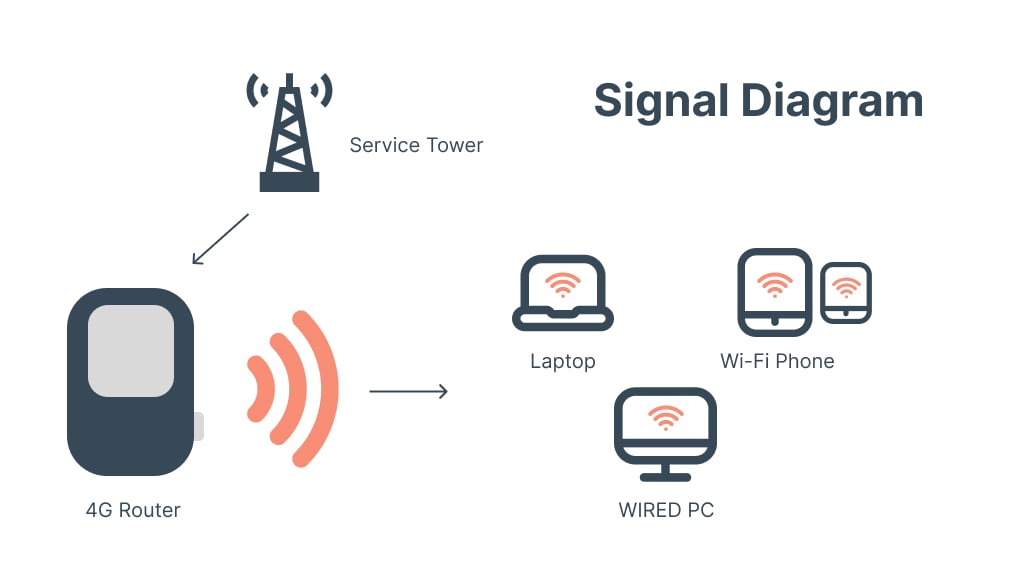
A pocket Wi-Fi or a portable internet router is a compact device that fits in your pocket and creates its own network access zone. It has an ordinary SIM card from a local operator inside, but you don’t need to bother with setting it up – it is ready to go. You can rent such a device in advance: it will be delivered to the airport or hotel. After the trip, the gadget is returned via a special mailbox.
Why do they still recommend it to tourists?
There are three reasons why.
- First, unlimited internet. If you are going to upload every day’s worth of videos on Instagram or use cloud services, there will be no limit.
- Second, stability. Even in the countryside, like the island of Hokkaido or the mountainous trails of Kumano Kodo, the line is hardly dropped – local carriers reach 98% of the country.
- Third, sharing. One of them can handle up to 10 connections, which suits friends or families.
Where else are portable Wi-Fi devices popular?
Outside Japan, demand exists in South Korea, where tourists can hardly purchase a local SIM without a resident phone number.
In Europe, these gadgets are used for car travel between several countries: there is no need to search for a new internet plan each time.
But now this is becoming different. For instance, in Germany or Spain, it is more convenient to sign up for an online eSIM card with two clicks than to take the trouble of renting or purchasing that equipment.
eSIM technology
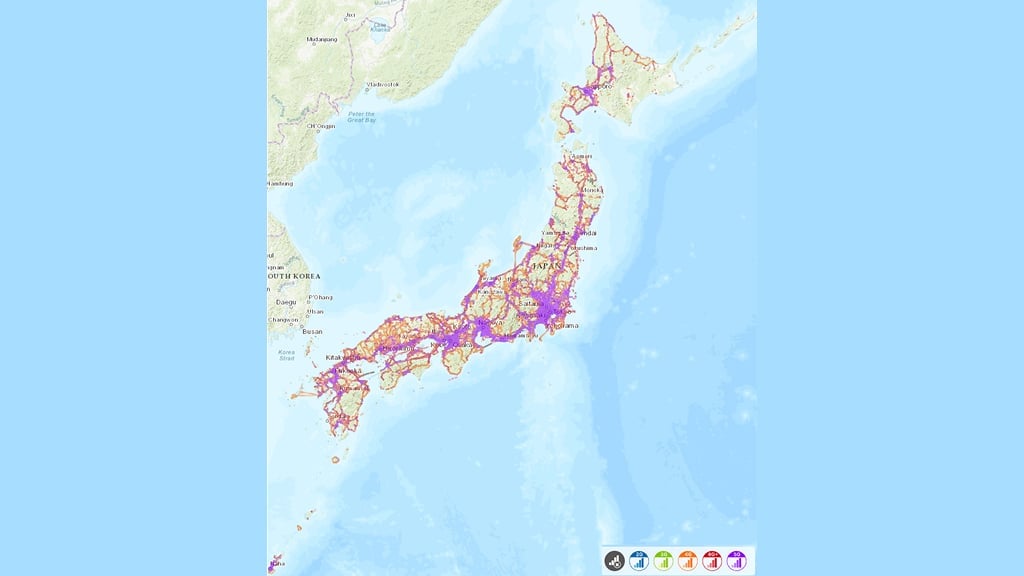
eSIM is a chip built into your smartphone that replaces a traditional removable SIM card. Instead of going to a store or waiting for a router to be delivered, you activate any tariff you need via a QR code. Upon arrival at the airport, in 2 minutes, you get the Internet working without any difficulties. The main advantage compared to a router is that there is no tethering to the device: you can simultaneously use a local mobile network to get the internet and keep your home number for calls. In the picture above, you can see that you will have excellent internet speed with 5G – 3G coverage almost everywhere in Japan if you use the digital eSIM.
In what ways is the eSIM technology inferior?
Not every device has an eSIM. As an example, older devices, or even budget Android phones, don’t have it. Before making a purchase, check the supported models list on the operator’s website. Another detail is traffic limitations. If you constantly stream or download big files, even 20 GB might run out in a week. In this case, an unlimited traffic router will suit you better.
When does eSIM win over pocket Wi-Fi?
- Time. In Tokyo, where every minute counts, you won’t have to spend an hour searching for a router store. Travel eSIMs can be downloaded and installed online.
- Flexibility. If your plans change (say, you decide to extend your trip or need more data), you can buy an additional data package through an app or a website.
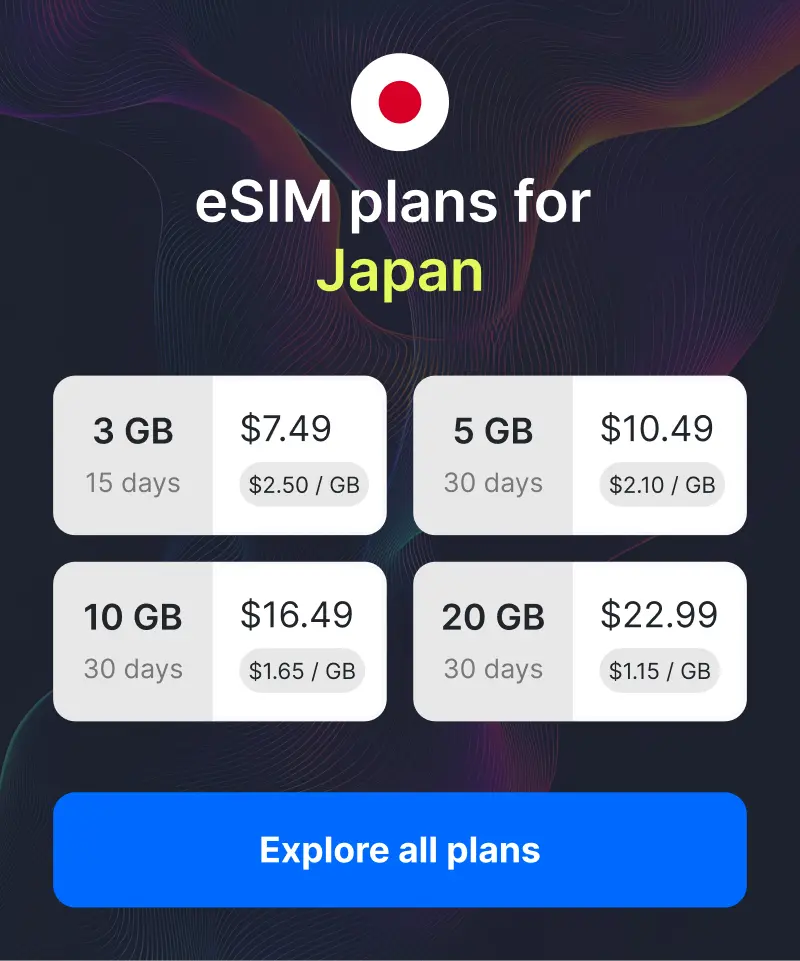
- Cost. Travel eSIMs might be cheaper than home operator roaming or contract plans, because you can choose data-only plans for a limited period of time. At Ohayu, for example, you can purchase a 3GB package for Japan starting from $7.49.
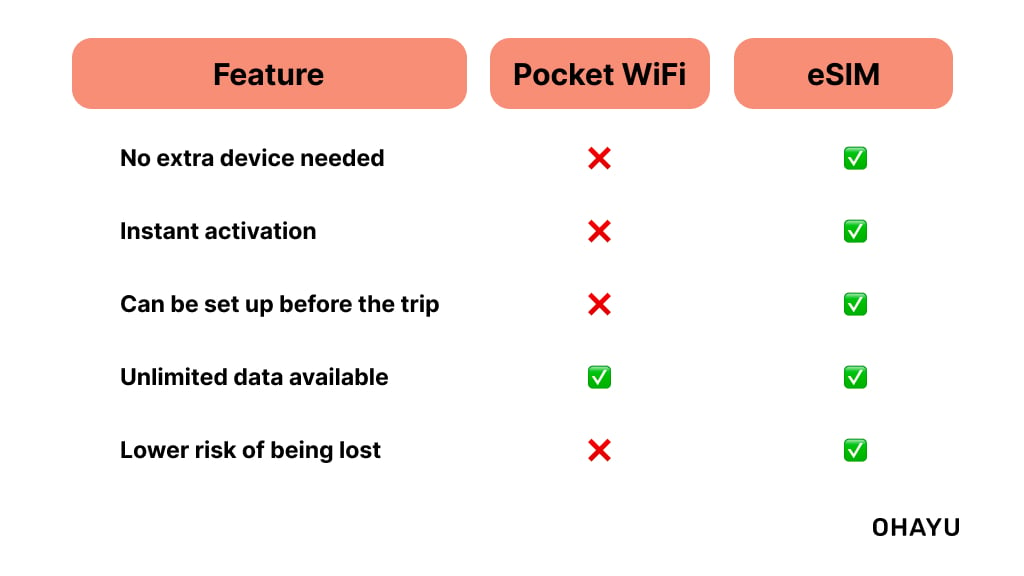
Pocket WiFi vs eSIM: why a digital SIM is the best choice
eSIM vs pocket WiFi is like the debate between cab and carshare. We believe both solve the problem, but one does it more elegantly. Let’s break down the key parameters to understand when to choose each of the options.
Save costs
The average price to rent a Pocket WiFi in Japan is about $3-$5 per day. For a 10-day trip, it’s at least $30, which is quite expensive. A digital eSIM profile for 7 days will cost you no more than $4.49. Agree that this is a huge range in price, even though the amount of data is different. Even if you buy the device rather than renting it, you will definitely need a physical SIM, which is even more expensive.
Convenience: free up space in your backpack
When traveling, we always value convenience and don’t want to lug around huge suitcases of stuff, especially if we have to walk a lot. This is also an important factor if we compare a router that needs to be stuck somewhere and a chip that is already soldered into your smartphone.
Additionally, pocket WiFi requires more attention, namely.
- Daily charging is mandatory because the battery will last for a maximum of 8 hours with active use.
- The hassle of returning the device (you have to send it by post before the flight). This is in case you rented it, not bought it.
- Constant checking to see if it’s still there. After all, in a hectic and unfamiliar city, you can easily lose your personal belongings.
With eSIM, the virtual mobile module relieves you of this inconvenience. The Internet lives in your phone. In Tokyo’s crowded subway system, where every second counts, you won’t have to rummage through your bag to change hotspots.
eSIM reaches everywhere
Routers from Japanese operators provide a stable signal even in the mountains. But modern eSIM services like Ohayu can connect you to the supported local networks and have similar coverage. An exception might be ultra-remote areas like Okinotorishima Island.
eSIM vs pocket WiFi security
Pocket WiFi risks: vulnerabilities that ISPs don’t talk about
Open networks: Many routers use the outdated WPA2 protocol by default. You’ve heard of the Aircrack-ng tool, no? Well, the people who can intercept your traffic are using it.
Physical access: A lost or stolen router gives access to your browser history through the admin panel (because users love weak passwords, something on the level of ‘tryt0hack1t’).
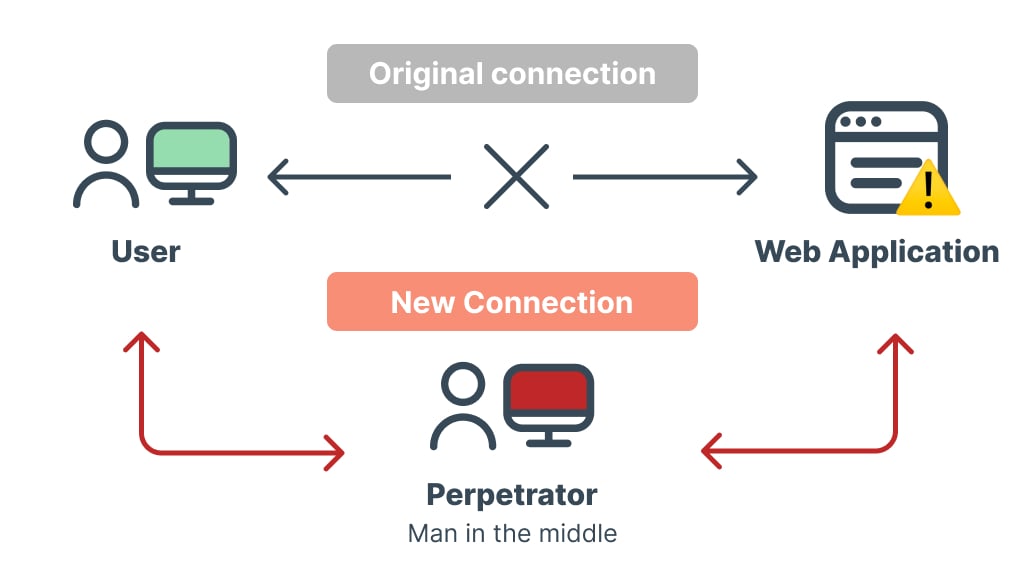
MITM attacks: DNS spoofing was detected on rented devices that redirected users to phishing sites.
How eSIM minimizes threats
Hardware encryption: Data is transmitted through secure carrier channels (e.g., some carriers use Internet Protocol Security). Hacking would require access to the cellular network infrastructure.
Lack of access points: Unlike Wi-Fi, connecting via eSIM does not create a public network that can be scanned.
Two-factor authentication: Some providers tie the eSIM to your device’s IMEI, blocking activation on other gadgets.
Compared to routers, the digital profile is much better protected. In both cases, you can get hacked, and it’s inevitable. But it is unlikely that someone will do it unnecessarily unless you are an important person. Although in such a case, you would hardly use a pocket router or a modern smartphone.
Guidelines for security
If you are worried about the safety of your personal data, you can follow these steps.
For eSIM:
- Activate EAP-SIM/AKA. On Android: Settings → Security → Advanced → EAP-SIM. Allows authentication via SIM, bypassing vulnerable methods like MS-CHAPv2.
- Disable CSFB (Circuit-Switched Fallback). In areas with VoLTE, this will prevent downgrading to 2G/3G and interception via IMSI-catcher. Instruction: *#*#4636#*#* → Phone Info → Toggle “VoLTE Enabled”.
- Use isolated profiles. On iOS 17+, create a separate Managed Apple ID for the corporate integrated connection module, restricting access to critical services.
For pocket WiFi:
Note: only do this with your own router!
- Change the default BSSID. Via Telnet: AT^NVWREX=8268,0,0,12,1,0,0,0,0,0,0,0,0,0,0,0,0,0. Reduces the risk of deauth attacks.
- Implement MAC filtering + 802.1X. Configure a RADIUS server (FreeRADIUS) to authenticate devices with certificates.
- Upgrade WPA3 with SAE. Disable WPS: iwconfig wlan0 wps off. Use Wireshark with filter wlan.fc.type_subtype == 0x08 && wlan_mgt.rsn.akms.type == 00:0f:ac:6 to analyze traffic.
Summing up eSIM vs pocket WiFi Japan
Pocket WiFi is reliable, but resembles a paper card in the era of smartphones: it requires charging, return, and extra space. eSIM is a modern and more flexible solution with multiple benefits: activation via QR code, saving time and costs, and access to Japanese local mobile operator services. Travel groups and streamers might still prefer a WiFi router. For the rest of us, a travel eSIM is often enough. Technology doesn’t stand still, and your phone has long been ready for digital solutions.