

The mobile industry is moving away from plastic SIM cards toward built-in digital solutions. Today, the two formats that matter most are eSIM and iSIM. Both options are created to simplify design and improve user experience because they remove the need for a SIM card tray, let you activate operator profiles online within minutes, and can store multiple profiles (for data and phone number lines) on one device. Services like Ohayu eSIM make this transition practical for travelers by letting you buy and activate eSIM data plans online.
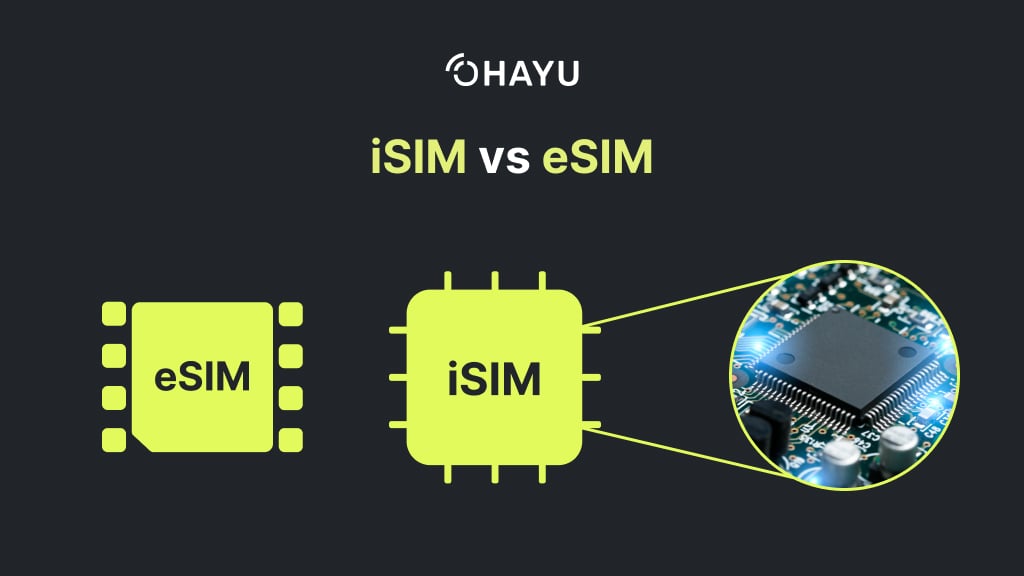
The main difference between iSIM vs eSIM is where they are located. eSIM is a physical chip soldered onto the device’s motherboard, while iSIM is a protected area integrated directly into the main processor (SoC, system on a chip). That single distinction makes them differ in cost, size, energy use, and adoption. In this article, we’ll break down what separates them and why it matters.
eSIM – convenience built into your device
The embedded subscriber identity module (eSIM) is the one you already see in practice on all modern smartphones. It is much more convenient and secure than traditional SIM cards. That’s why companies like Motorola, with its Razr 2019, and Apple, starting from iPhone 14 (only for the USA market), began producing eSIM-only smartphones that don’t have a SIM card slot.
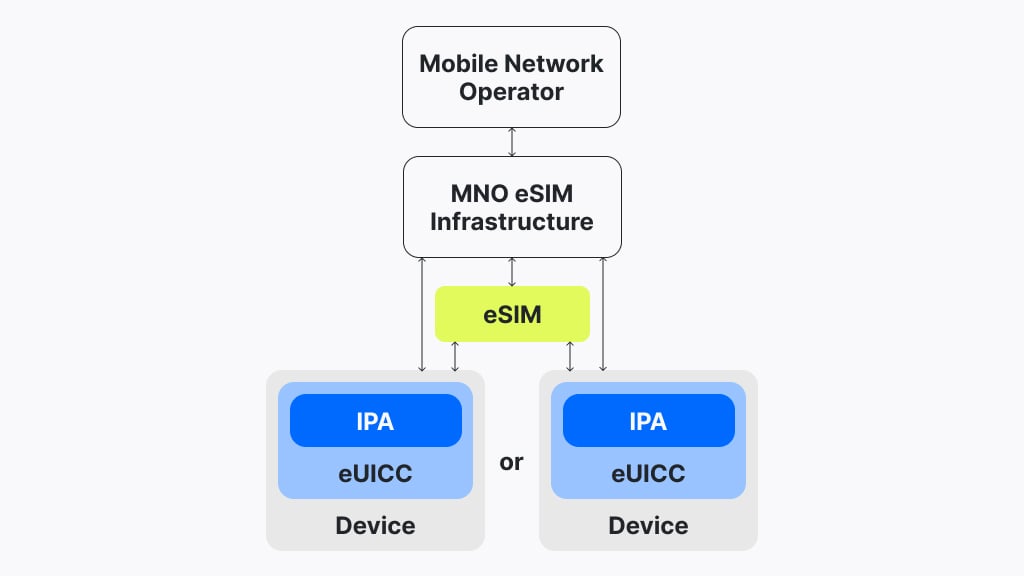
Now eSIMs are built into many new supported smartphones, smartwatches, laptops, and wearables. Instead of swapping plastic chips, as people did before, you can load and change your operator profile programmatically, without having to touch the card.
More than that, services like Ohayu make this even easier for travelers by delivering activation codes online, so you can install it by scanning a QR code and activate the profile using Wi-Fi when you arrive to the destination country.
How does it work in practice?
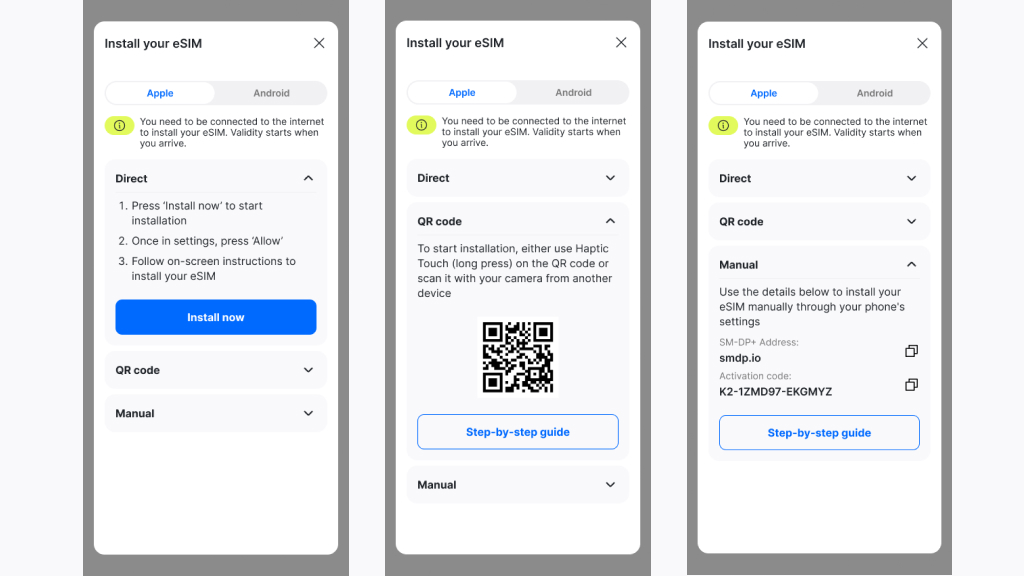
- Choose a local or travel plan from your mobile operator or through an eSIM provider such as Ohayu. After the purchase, you will receive a QR code or activation key in the iOS or Android app.
- Add eSIM to your device – open your device’s network settings, select “Add eSIM”, scan the QR code, or enter it manually. With the Ohayu newer Apple devices and some Android phones, users often have a one-click installation flow that allows them to press the “Install” button to start loading the profile automatically.
- Activate the plan using your provider’s instructions. Remember that if you use a travel eSIM, you should activate it only in your destination country using a reliable Wi-Fi source.
- Connection established – during the activation, the chip receives the necessary data from the provider (IMSI and authentication keys) via a secure, encrypted channel (LPA technology), and your device connects to the network.
What makes eSIM user-friendly?
- Instant activation and network change. You do not need to wait for delivery or visit a service center to get and activate a new SIM. This is particularly useful for international traveling, because a local tariff can be purchased and activated immediately after arrival. More than that, you can keep your home number active on the device while adding a local eSIM for data. This means you remain reachable on your regular line while avoiding high roaming charges by using a cheaper local or travel plan for internet access.
- Several profiles on one device. Modern phones allow storing multiple operator profiles – for personal use, work, or foreign networks. Switching between them in the settings takes a few seconds. This is a useful option for splitting traffic or using local network capacities when traveling.
- More robust and compact devices. Removing the physical SIM tray makes the device casing more sealed and resistant to dust or moisture. It also frees space that manufacturers often use for a larger battery or additional components.
- Lower environmental impact. Fewer physical cards are produced and disposed of, reducing the plastic footprint of mobile connectivity.
Your eSIM profile is stored in a secure element (SE) of the chip. This is an isolated environment, similar to a bank card chip, that is tamper-resistant. Critical data, such as your IMSI and authentication keys, never leaves this protected area.
Despite being a mature technology, eSIM support is still uneven. Smaller or regional operators may not provide the same level of compatibility, and moving a profile to a new device can still require you to call your mobile carrier and ask them for manual intervention. Industry standards such as GSMA SGP.22 are making the process easier, but implementation is progressing at different speeds.
iSIM – the future of miniaturization
If eSIM is a separate programmable module joined to the board, iSIM takes the next architectural step by removing the chip entirely. All SIM functions are integrated directly into the main processor, or more specifically, into its System-on-a-Chip. This is not just a space-saver, but a fundamentally different approach – it changes how connectivity is implemented at the hardware level.
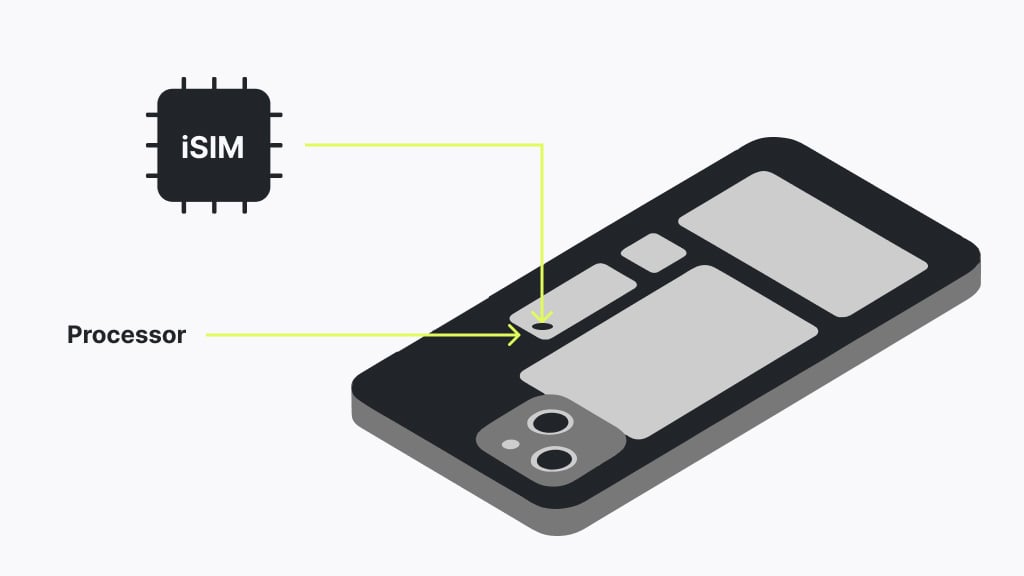
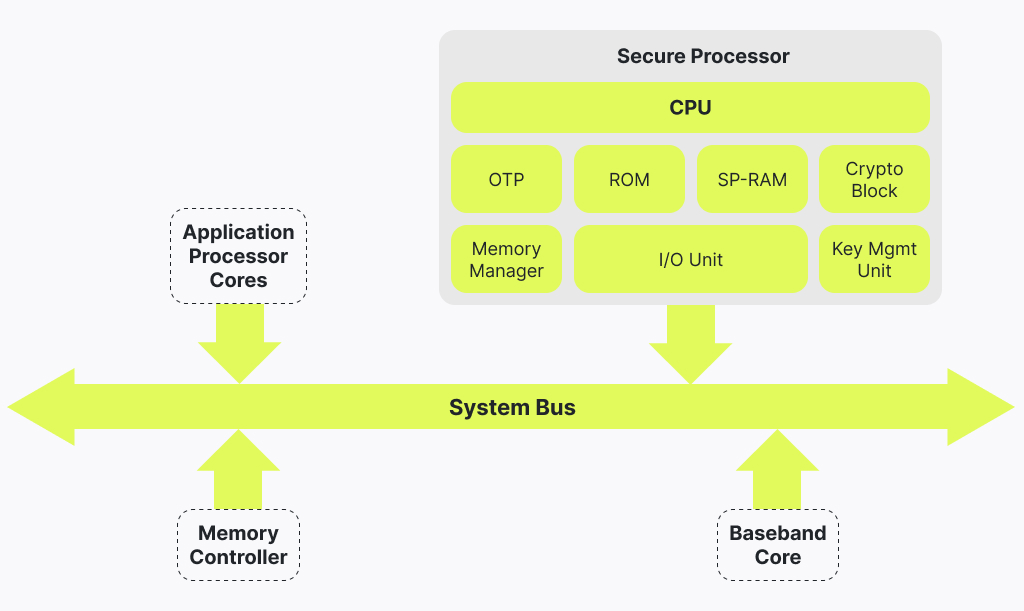
Manufacturers such as Qualcomm, MediaTek, and Samsung already allocate a protected hardware area inside their processors for this purpose. These zones, often based on isolated execution environments like Arm TrustZone, are separated from the operating system and applications. This is where critical operator profile data, such as IMSI and keys, is stored and processed. In practice, iSIM performs the same role as eSIM, but more compactly and efficiently.
Key Advantages
- Drastic space and energy saving. With no separate chip, housing, or soldering, iSIM is reduced to transistors within the SoC. This is key because every cubic millimeter counts in miniature devices such as medical sensors, industrial meters, or low-cost IoT tags. Power consumption is also lower, since iSIM shares the processor’s power management system.
- Lower device cost. By removing a separate component (the eSIM chip itself and the space for it on the board), the manufacturer reduces the bill of materials (BOM). This is critical for mass IoT, where the cost per unit must be minimized.
- Enhanced security potential. Because SIM functions sit in a processor’s isolated hardware environment, attacks become more complex. Instead of targeting a single chip, an attacker would need to break into the protected area of the SoC itself, which is quite problematic and requires skills. In practice, security is at least equal to eSIM and may prove stronger.
- Simplified production and design. Fewer components on the board reduce assembly complexity and give engineers more freedom in device layout.
No mainstream smartphones include iSIM yet, though prototypes exist. However, it is successfully proving itself in the IoT market, specifically in the following devices.
- Sensors for temperature, humidity, and vibration in agriculture or manufacturing.
- Trackers for logistics, animals, and valuable goods
- Smartwatches, connected cars, cameras, alarms, and laptops
Development in progress
So far, iSIM implementation is still limited. It requires cooperation between SoC manufacturers and software developers, but not all processors have iSIMs. Mobile operators also need to adapt their systems to support specific activation and profile management protocols, which are progressing at different speeds.
For end-users, there is currently no practical difference between iSIM vs eSIM. That’s why in smartphones, iSIM has not been rolled out on a large scale yet. Adoption is expected to expand first in IoT devices, where cost and size matter most, before moving into mainstream consumer electronics.
iSIM vs eSIM – practical comparison
Let’s now see the actual key areas where you can use iSIM vs eSIM technologies. For everyday users, the situation is simple: eSIM is already here; iSIM is not.
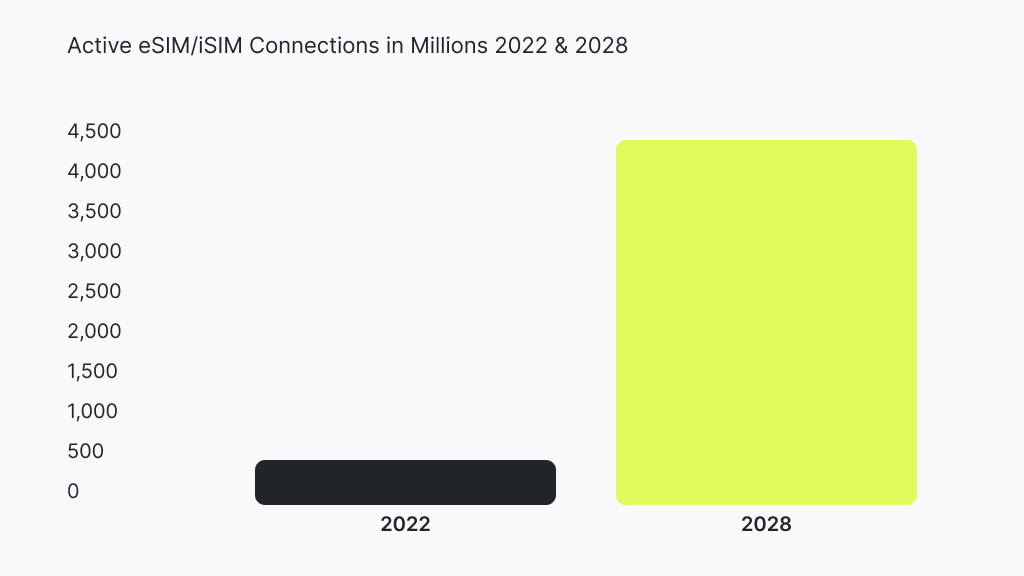
eSIM is supported in most new smartphones, tablets, and wearables. A vast majority of modern flagships and budget phones have this digital module. Major operators actively support it and provide activation options. It covers the main needs of consumers – managing multiple numbers on one device, transferring a profile to a new phone, and buying a travel plan online without visiting a store.
For active travelers, an embedded SIM is also a convenient choice. Services like Ohayu can connect you to the supported local networks in 170+ destinations. It also has a Global eSIM that covers 120+ countries and can automatically switch networks as you cross borders.
On the other hand, iSIM is still in the development phase for consumer devices. Its advantages, such as lower cost, smaller size, and reduced energy use, matter most for large-scale IoT deployments (sensors in agriculture, logistics trackers, or industrial equipment). For now, ordinary users will not notice a difference, but manufacturers and operators see iSIM as a way to scale connectivity to billions of low-cost devices.
Comparison table
To see how the two approaches compare across key factors, consider the table below.
| Criteria | eSIM | iSIM |
| What’s inside? | Separate microchip on the device board | The function is built into the main processor (SoC) |
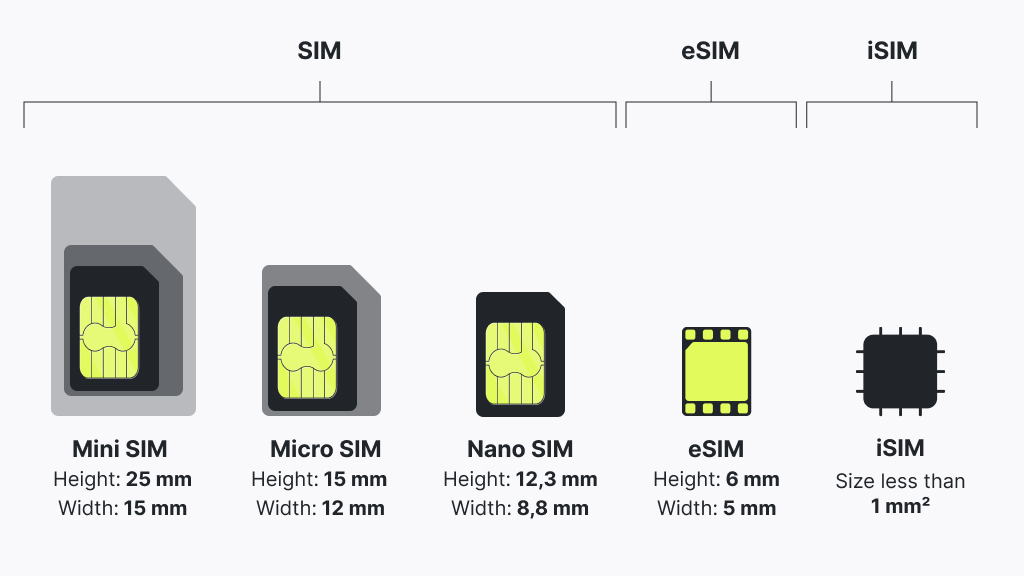
| Size | Very small (6×5 mm) | Takes up no space at all (inside the CPU) |
| Energy consumption | 3-7 mW*s in active mode (TX/RX) | 1-2 mW*s in active mode (TX/RX) |
| Where it works | Phones, watches, laptops | IoT mini-devices |
| Availability | In massive production and use | Extremely limited |
| Major plus | Flexibility and convenience here and now | The future of miniaturized and low-cost IoT devices |
iSIM vs eSIM security
Both eSIM and iSIM provide a level of protection unattainable by the classic plastic SIM card, which can be lost, copied, or physically damaged. Let’s take a microscopic look at how their security systems work and why it’s a nightmare for an attacker.
eSIM
In eSIM, security relies on a dedicated secure element built into the device.
Secure element (SE)
There is a dedicated microprocessor inside the chip. It has its own memory and OS (operating system), physically and logically separated from the main system of the device. Think of it as a non-removable smart card chip soldered into a circuit board. It is in the SE that stores all your critical data, such as:
- IMSI – your unique identifier in the network.
- Authentication Keys (Ki) – secret codes to confirm the legality of access to the operator’s network. They never leave the SE.
- Operator profiles.
Hardware protection
SE is designed to resist physical and logical attacks (probing, tampering). It is usually certified by Common Criteria EAL4+ or EAL5+. Any attempt at unauthorized access to data within the SE locks the chip or destroys the keys.
Encrypted management
eSIM loads and manages profiles through the local profile assistant (LPA) with strong cryptographic protocols such as SCP03t. All data is transmitted in encrypted form only directly between the subscription manager data preparation (SM-DP+) server and the secure element.
iSIM
With iSIM, the same protective functions are implemented inside the processor itself, rather than on a separate chip.
Processor hardware isolation
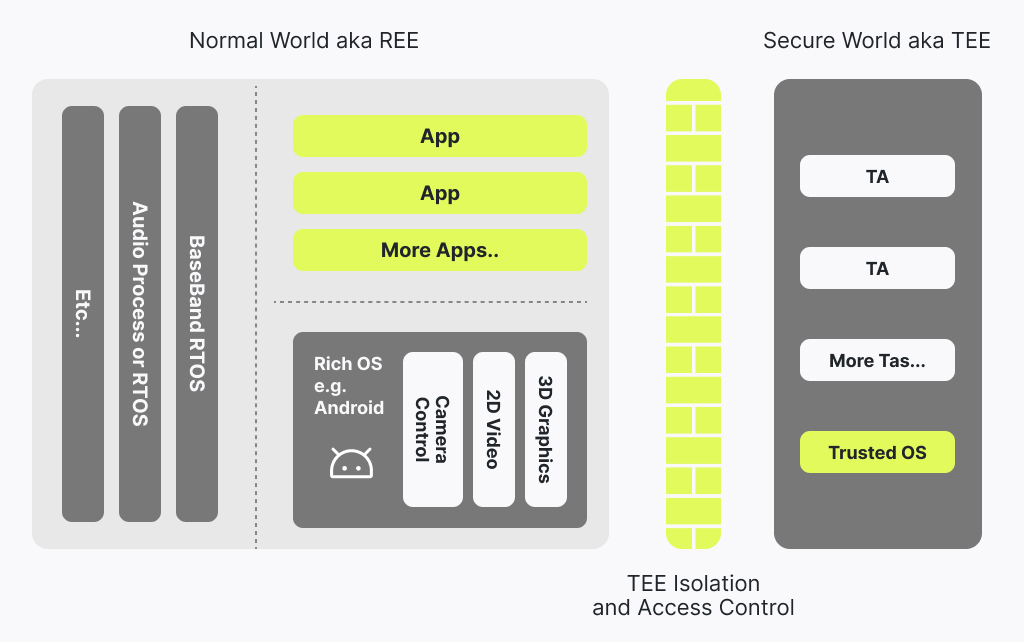
iSIM protection is based on dedicated, isolated hardware environments within the SoC itself. This is most often implemented using technologies like Arm TrustZone or Qualcomm and Apple analogs.
Trusted execution environment (TEE)
It is a secure processor area separated from the main OS.TEE has its own resources like memory and CPU, and runs only verified code. All SIM profile operations (authentication, encryption) take place exclusively here.
Root of trust (RoT)
Critically, the TEE is often based on a hardware Root of trust (RoT). This is immutable code written during SoC manufacturing that verifies the integrity of all software before it loads into the TEE. This protects against software tampering.
Integration advantage
Because SIM functions sit at the transistor level inside the protected area of the processor, it is extremely difficult to attack them physically – you have to hack into the SoC itself. Logical attacks are also harder due to the combination of RoT and TEE. Activation and management protocols, e.g., remote SIM provisioning (RSP), are as strict as for eSIMs.
iSIM vs eSIM safety experience
Both are incomparably safer than a traditional card that can be removed, copied, or damaged. Sensitive keys never leave their secure environment. Threats are more related to phishing or compromising an account with the operator than to hacking the programmable module itself or the processor integration. eSIM achieves this through a separate secure chip, while iSIM does it by embedding the same logic inside the processor itself.
A good example of why this matters is the case of IMSI catchers (also called “Stingrays”). These devices impersonate a mobile tower and can trick phones on older 2G networks into revealing their subscriber identity in plain text. With eSIM or iSIM, your credentials remain securely stored on the device, but protection against IMSI catchers mainly comes from modern network standards such as 4G/5G encryption and the use of temporary identifiers (TMSI). The real vulnerabilities today are less about breaking the chip itself and more about exploiting weak network standards or user accounts.
Practical tip: disable 2G support in your phone’s network settings if your device allows it. This closes the easiest attack vector and makes your connections run through 4G or 5G with strong encryption and authentication protocols.
To sum up
In the iSIM vs eSIM context, it is safe to say that iSIM is the next evolutionary step in eSIM technology, but it is not yet available in mass-market smartphones. Its benefits – smaller size, lower cost, and reduced power use – are currently most relevant for IoT devices.
Right now, eSIM remains the absolute leader in practicality and convenience for consumers. After all, it is supported by the majority of modern gadgets and carriers around the world. This offers real, tangible benefits: quick tariff changes, easy roaming, and the ability to keep multiple numbers in one device.
In the next few years, we can expect iSIM to complement rather than replace eSIM, starting with large-scale IoT deployments and gradually moving into end-user devices as standards and operator support mature.