

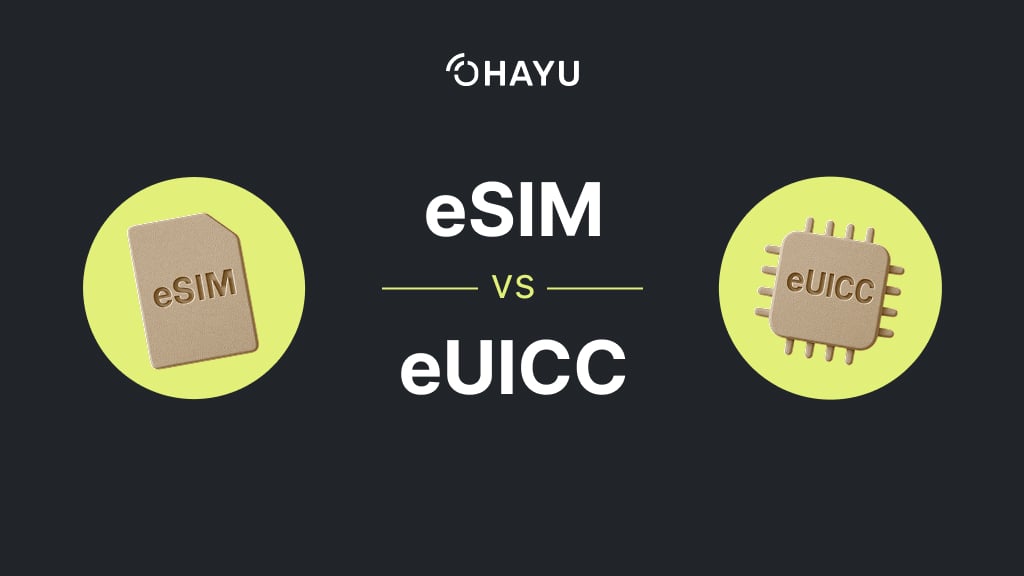
The main confusion about eSIM vs eUICC is simple: eUICC is the standard for managing digital profiles, and eSIM is the operator profile itself. The former is the “how”, the latter is the “what”: digital SIM card does not exist without eUICC.
Embedded Universal Integrated Circuit Card (eUICC) is a standard or a technical specification. It is not a physical thing, but an instruction implemented in the Secure Element of your gadget. It defines how a device (phone, smart watch, sensor) should securely manage and load digital communication profiles.
The embedded SIM is your digital profile with carrier data. In fact, it is a virtual analog of your old plastic card: a set of data (IMSI, security keys, network settings).
Why is it essential? Because understanding this difference opens your eyes to the flexibility this bundle offers: from simply changing operators without a card to managing millions of IoT devices.
eUICC as the invisible foundation of digital connectivity
Although it sounds complicated, but in essence it is just a standard or, to put it another way, a set of rules. It is not a piece of hardware, not a chip you can touch. eUICC is an instruction. An explanation of how a device (a phone, a smart watch, a sensor in a car) should be able to securely receive, store, switch and delete digital operator profiles. That’s the basic gist of it.
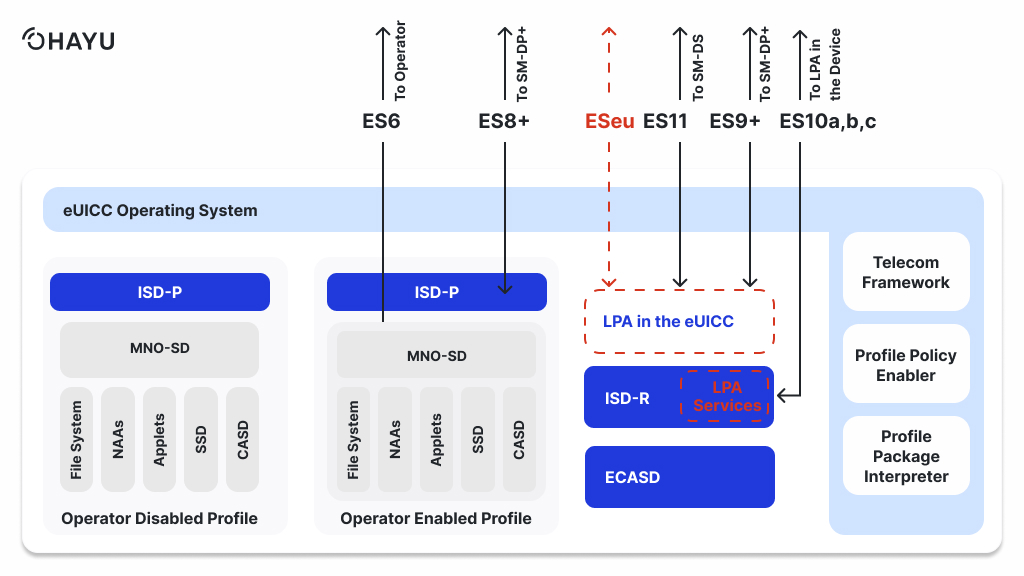
Inside your gadget, there is a special zone – Secure Element (SE). So, the firmware and the whole thing must comply with the eUICC standard and be able to do the following:
Negotiate with operators. Securely connect to their servers to download a profile.
Keep secrets under lock and key. Your network access keys are protected here, even if your phone gets hacked.
Change profiles. Easily switch between personal eSIM, work, travel – as many as your device supports.
Clean out the backlog. Delete an old profile if you run out of tariff or don’t like the operator. Makes room for a new one.
Who set the rules?
Engineers, not marketers, are behind this standard. The basic framework was developed by ETSI (European Telecommunications Standards Institute), the key European telecom standards institute. But tghey required unification for mass adoption in the mobile industry. GSMA (Groupe Speciale Mobile Association) took on this task, creating detailed Remote SIM Provisioning (RSP) specifications on the basis of eUICC. It is RSP (SGP.22) that defines exactly how eSIM profiles are securely downloaded, installed and managed over the air between the operator, device and SM-DP+/SM-DS servers. The eUICC is the standard for the capability, the RSP is the standard for implementing that capability over the WAN. Without eUICC, there would be no basis for RSPs.
eUICC as a baseline: deprivation, security and unification
The technical essence of eUICC’s value is in addressing three key challenges:
- Deprovisioning the profile from the hardware
The physical SIM is inextricably linked to the card chip. The eUICC breaks this bond by turning the operator profile into an independent digital object (eSIM). One can dynamically loade it onto any compatible equipment.
- Centralized security
All critical profile operations (key loading, authentication) take place only within the SE, isolated from the underlying OS, minimizing the risks of tampering.
- Global unification
The eUICC standard (via GSMA RSPs) guarantees that a profile from operator A will work on a device from manufacturer B in country B. This eliminates fragmentation and opens the door to mass IoT and global roaming. eUICC is not an option, but a mandatory technology foundation for eSIM. Without it, there is no secure, standardized management of digital identities across the network.
eSIM in the remote profile management system
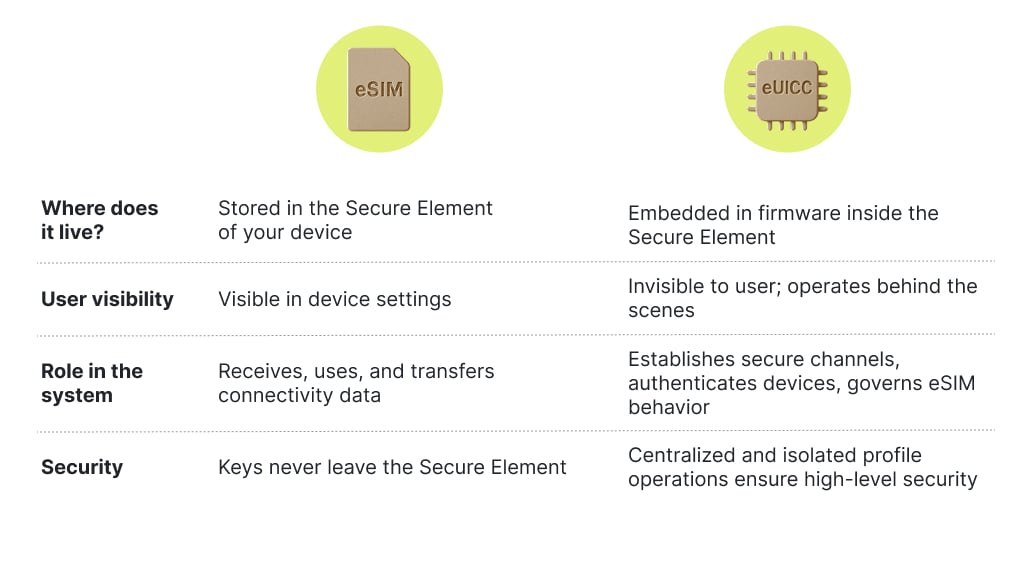
eSIM is a digital profile of your service provider. Everything that was on the plastic SIM chip – your unique in-network identifier (IMSI), secret authentication keys (Ki), APN settings, service codes – is now in a secure digital profile. In essence, it is your mobile identifier in its purest form, separated from the physical carrier.
Modern eSIMs can store multiple carrier profiles, e.g., you can keep your home operator profile with your phone number and have a travel eSIM, like Ohayu.com, to get online and connect to the supported local networks when traveling abroad.
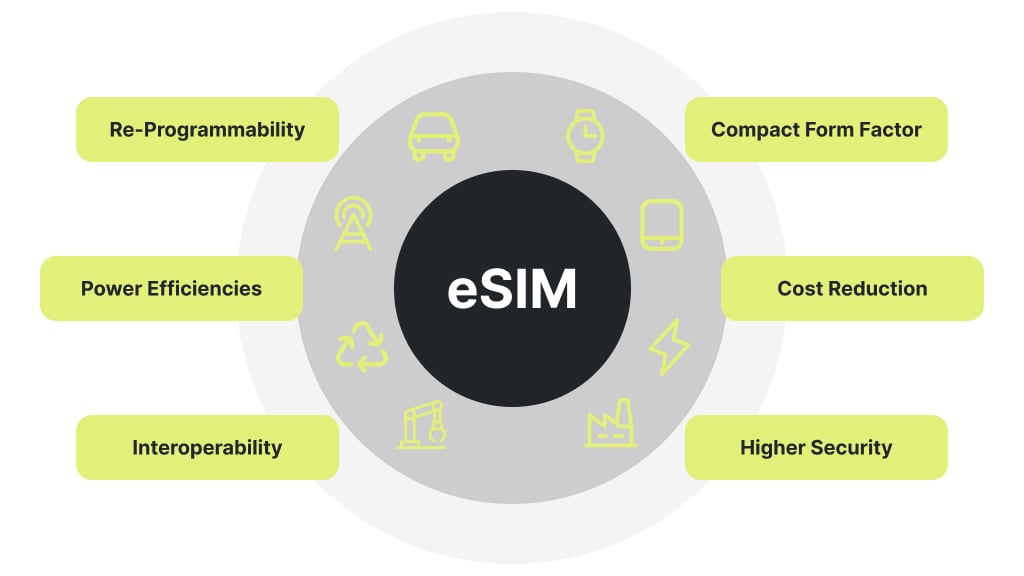
The creation process is strictly standardized by the GSMA (SGP.22):
- Generation. The operator, using its secure infrastructure (HSM – Hardware Security Module), creates a unique profile specifically for your device and the selected tariff. It is not a universal file!
- Security. The profile is encrypted and “packed” on a secure server of the operator – SM-DP+. This is essentially a digital warehouse of profiles.
- Over the Air (OTA) delivery. You scan a QR code (or enter an activation code) in your phone’s settings. Your device (or rather, its eUICC component) communicates via the internet with the SM-DS, which routes it to the right SM-DP+.
- Secure download and installation. The SM-DP+ authenticates the device and the eUICC, creates a secure communication channel, and transmits an encrypted eSIM profile. Your device’s eUICC accepts it, decrypts it inside its Secure Element, and installs it in a secure area. The profile is physically written to the SE memory, not just stored as a file in the OS.
- Activation. After installation, you activate the profile (either manually by you or automatically), and communication with the new operator begins.
Key characteristics of the eSIM
- Not a physical object: This is data, not a chip.
- Carrier-specific: Each profile is unique and tied to a specific carrier and tariff.
- Secure: Only lives and operates inside the Secure Element of the eUICC-managed device. Ki keys never leave the SE.
- Dynamic: You can activate it, deactivate, delete or replace by another profile via RSP mechanisms.
- Plurality: One eUICC can store several eSIM profiles (from different operators!), but usually one (or two if the device is dual SIM) is active at the same time.
eSIM vs eUICC – clearing the confusion once and for all
The eUICC is the foundation, the rulebook, or you could also call it the digital playground. It is the invisible logic inside your gadget that knows how to receive, store, switch and delete virtual communication profiles. By itself, it is an empty platform. It’s like an operating system for SIM cards.
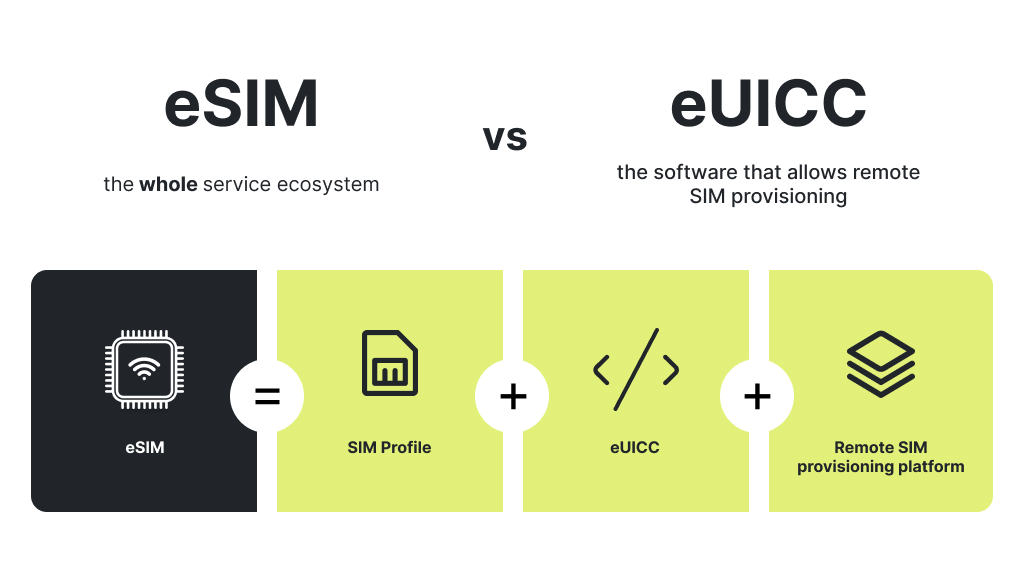
The eSIM is the virtual network pass itself. It’s a specific set of data: your number, secret keys, operator settings. At the same time it’s the content that runs on top of that platform, i works like an application in your mobile phone. One device can store a bunch of these “apps” – passes from different providers.
Why do people constantly confuse these concepts?
- Marketing is to blame
Brands shouting “We have an eSIM!” – it’s catchy. The technical (platform) is left out of the picture. The user sees only a digital pass in the settings.
- “e” confused everyone
Both terms contain “embedded”. But in the first case, it is about a standard embedded in the architecture. In the second case, it refers to data embedded programmatically.
- Platform invisibility
eUICC logic is low-level firmware on a secure chip. You can’t touch it, you can’t see it. A digital pass is tangible: you activate it, you use it, you see it on the list.
Can one exist without another?
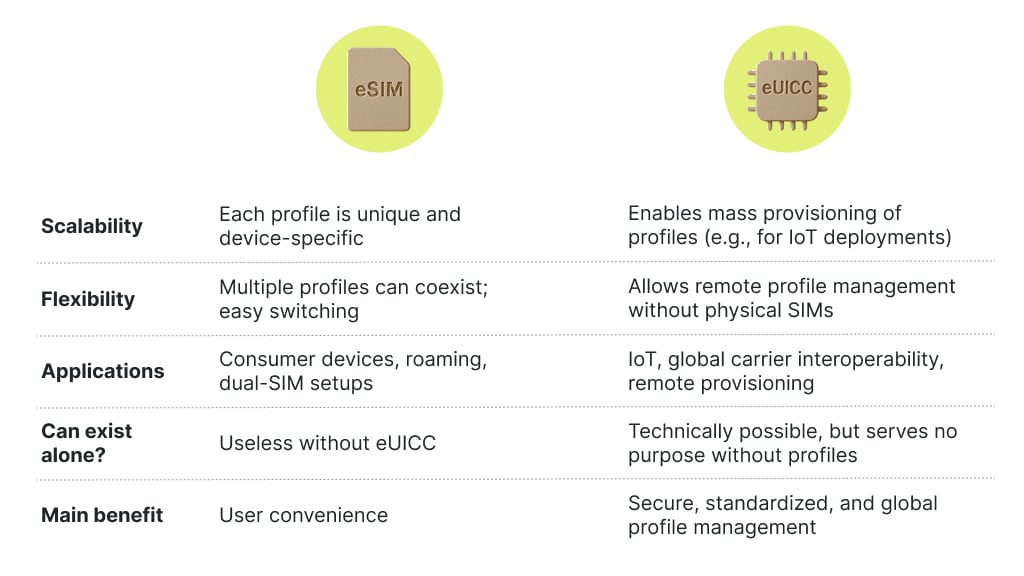
- A digital profile without its platform is dead weight. It’s like buying a software license but not having a PC with an OS. Nowhere to run it, nothing to manage. A useless set of bytes.
- A platform without a profile is empty power. It’s like a cool smartphone with no programs installed. The framework is ready, but it’s useless until you load operator data.
Why is this pairing perfect?
- Flexibility
The platform allows you to instantly download a new virtual pass without a trip to a telecom showroom. Or keep multiple profiles (personal, work, overseas) on the same iron, switching between them.
- Scale
With eUICC, all devices are ready to receive data. The operator remotely uploads profiles in batches in minutes. This is a breakthrough for IoT.
- Reliability
There is no flimsy slot. Everything lives inside a secure chip.
eSIM vs eUICC – advantages and applications
Pros for users
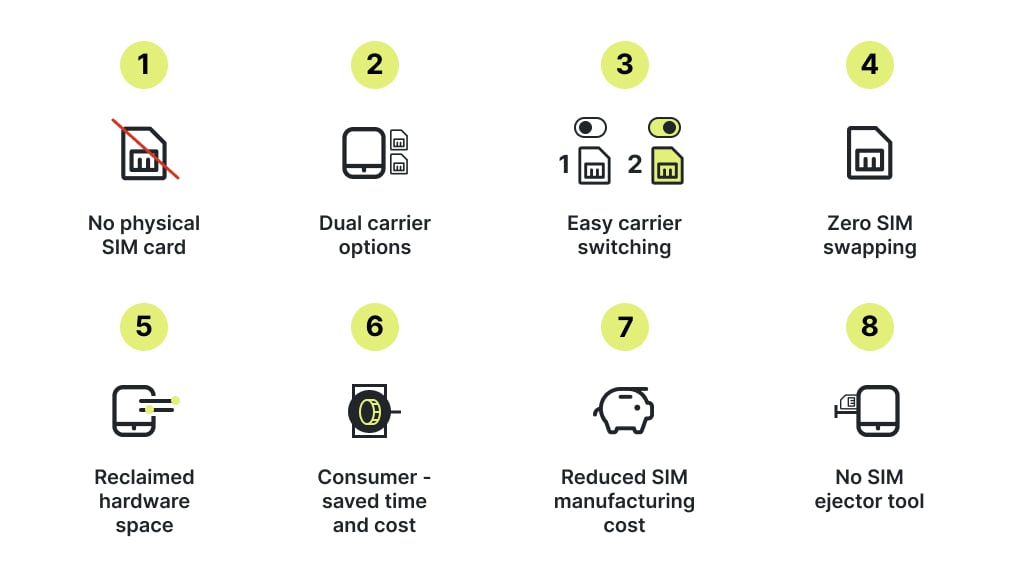
Changing operator – in minutes. Fed up with the tariff or gone abroad? Previously, you had to search for a salon and wait for a card. Now you scan the QR code of the new provider in your phone settings. The digital profile is loaded, and you are online.
Two or more numbers in one machine. Personal, work, cheap roaming? Easy. Switching between profiles is just a couple of taps. No more need for a second phone or a hybrid slot that sacrifices a memory card.
Durability and reliability. No fear of a physical connector breaking, a bent contact, or water getting in. The entire communication system lives in a secure chip. Even if your phone sinks, everything can be restored on a new device if your carrier allows it.
Benefits for gadget manufacturers
Simpler design, thinner case. Remove the fragile SIM slot – make room for battery, cooling or just make the device sleeker.
One skit for the whole world. No need to produce different versions of the phone for regional operators. A device with digital skip support is sold the same everywhere.
Fewer warranty cases. Slot failures are a frequent headache for service providers. Full integration of communication eliminates this problem.
To sum up
The confusion between eSIM vs eUICC is clear: eUICC is the standard, and the engine inside the device for managing digital profiles. The eSIM is the operator profile itself, which uses this engine. Their synergy is the basis for flexible communication. For users, it’s the convenience of changing operators or multiple numbers on one device. For the industry, especially IoT – a revolution: remote connection of millions of devices without physical access. The technology is already working now. For example, services like Ohayu offer eSIM profiles for traveling around the world.