


An Embedded Universal Integrated Circuit Card, or eUICC, is a digital SIM card that can be remotely loaded with operator profiles. It is physically soldered to the motherboard of your smartphone, tablet, smart watch, or other device. It cannot be removed like a regular SIM card.
It’s not just a convenience for travelers. It’s a key element for IoT devices, from smart refrigerators to industrial sensors. While regular cards require manual configuration, eUICC allows manufacturers to manage millions of gadgets through the cloud, changing carriers, updating tariffs, and even preventing cyberattacks.
Architecture and operation of the eUICC
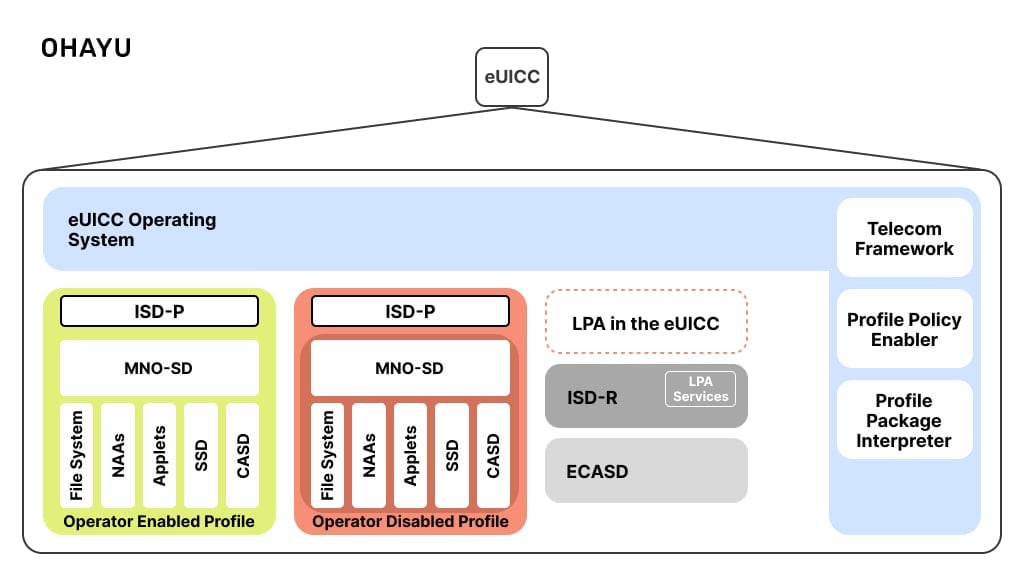
eUICC is a microchip embedded directly into the device, which performs the functions of a SIM card, but without its physical carrier. Unlike a classic variant, where operator data is “encrypted” at the manufacturing stage, this technology stores information in a rewritable memory. This is the best way to remotely activate, modify, or delete mobile network operator profiles through secure communication channels.
Why is it reliable?
The basis is the secure element module – an isolated memory area with hardware encryption. The chip is physically integrated into the device (smartphone, IoT sensor, automotive system), eliminating the risk of removal or damage typical of physical cards. For example, in smart energy meters, the module guarantees secure data transfer even under extreme temperatures or vibrations.
How does it work?
A profile is a digital “passport” that has authentication keys, network settings, and tariff data. When the device is first connected, it downloads the profile through the OTA (Over-The-Air) platform. If you change operators, the old profile is deactivated, and the new profile is installed without replacing the chip. The technology supports multiple profiles at the same time, but only one profile can be activated.
Evolution: from SIM to eUICC
Historically, SIM cards have progressed from Mini (1996) up to Nano (2012), reducing in size but maintaining the physical form. The GSMA SGP.02 standard (2016), establishing the eUICC specs for the mass market, was the breaking point. That paved the way for vendors to be able to release carrier-independent devices, such as smartwatches with eSIM, allowing the customer to customize on first purchase.
eUICC vs eSIM – what’s the difference?
Despite the consonance of the terms, eUICC and eSIM are not interchangeable. Embedded Universal Integrated Circuit Card is a standard that defines how an embedded chip should store and switch operator profiles. An eSIM is a special case implemented in a specific device, such as a smartphone or smartwatch. Roughly speaking, eUICC is the language in which the chip communicates with the network, and eSIM is the gadget that “speaks” this language.
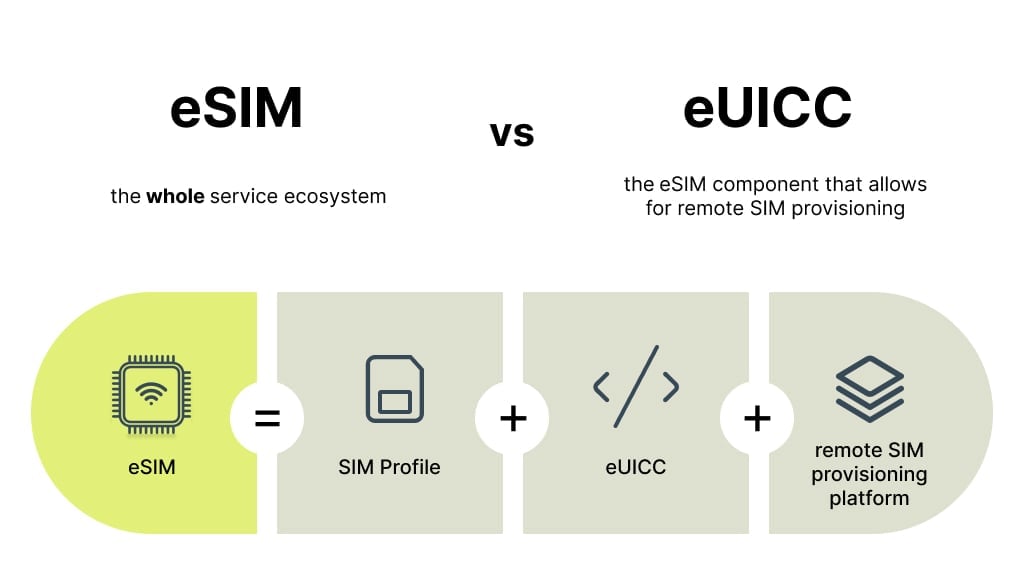
The main difference is in the application
- eUICC is the basis for scalable solutions. For example, a factory produces a batch of IoT sensors with one type of chip, and operator profiles are loaded later, depending on the destination country.
- The eSIM is all about user convenience. Activating SIM via QR code in iPhone, switching tariffs in Samsung menu – all this is eSIM. But eUICC works “under the hood”, allowing the chip to accept new profiles.
Benefits of eUICC – why it matters for business and users
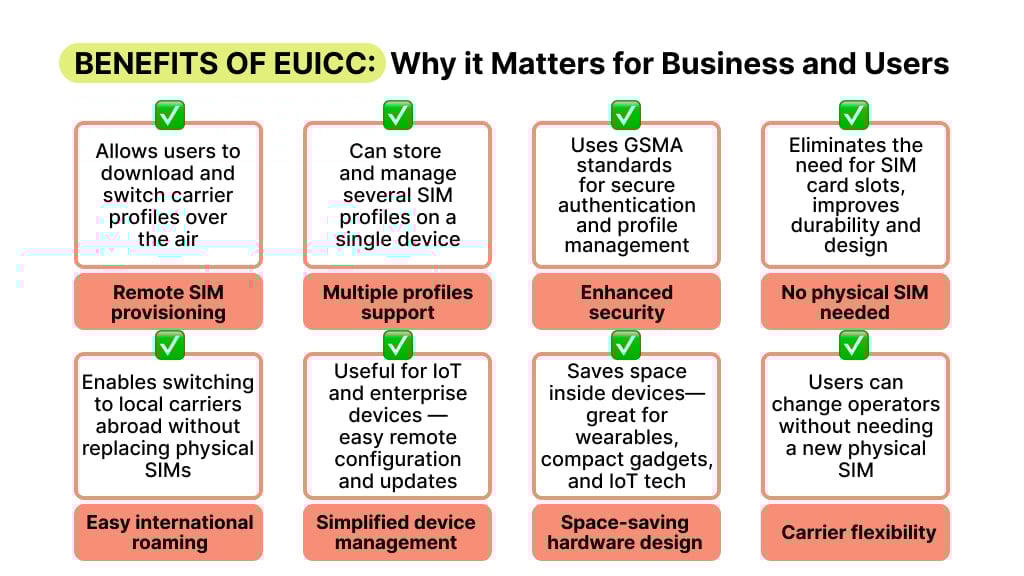
For business
- Reduced logistics costs
Manufacturers are no longer required to produce duplicates of devices for every operator. The company manufactures a single type of IoT device and delivers it to various markets. The mobile operator profile is loaded remotely, already on site, depending on the region or country.
- Accelerating time to market
IoT startups can test products globally without coordinating with hundreds of operators.
For consumers
- More freedom, lower costs
Tourists do without roaming and do not spend a lot of money per trip, as their phones automatically switch to local tariffs. For example, Google Pixel phones already have this feature.
- Safety
The security in this case is much higher. The embedded chip cannot be lost or damaged in any way without effort. Even if the device is stolen, an intruder will not remove the SIM for identity swapping.
Digital freedom for travelers
The eUICC technology offers us a great opportunity to get rid of the constant search for places to buy SIM cards and worry about expensive roaming. It is much easier to choose the right operator or service and connect in a couple of clicks without any fuss.
This is especially useful for people who are always on the road, such as bloggers or travelers. In one country, one tariff, in another – another. No problems, no overpayments.
With this technology, you feel that you don’t have to adjust to the world – now it adjusts to you. Everything is simple, convenient, and works exactly when you need it to.
eUICC security – how your data is protected and why it’s not a hole-in-the-wall technology
Hardware defense
At the heart of the eUICC is the Secure Element (SE), a physically isolated chip certified to Common Criteria EAL 4+ standards.
- All the cryptographic operations (authentication, key generation) are handled within the SE, with no data exchange with the device’s main OS.
- Even when the processor is hacked, an intruder won’t get to the operator root keys (Ki-keys) that are stored inside the SE.
Software mechanisms: dynamic keys and sandboxes
eUICC employs two levels of authenticated secure profiles:
- Mutual Authentication (MAPSEC) – both the operator and chip mutually authenticate each other before transmitting information.
- Session Keys – temporary session keys that change every 5-15 minutes and minimize the chance of interception to zero.
Operator profiles are housed in independent software containers. Even if a hacker has access to one profile (for example, on a telephone), he is not in charge of other profiles (on the same device or company network).
Certifications and audits

The GSMA SAS-UP standard requires that each chip undergo:
- Pentests for resistance to Side-channel (analyzing power consumption) and Fault Injection (voltage failures) attacks.
- Code Audits – checking for vulnerabilities in profile management software.
Myths vs reality: where are the weaknesses?
- Profile can be deactivated by an operator. However, eUICC does support a Fallback Profile mechanism – a backup profile (e.g., of a local operator) which becomes active when the primary profile is barred.
- There is a myth that hacking an embedded chip is easier than hacking a physical SIM. But this is not true at all; without the necessary equipment, there is no way to remove the chip from the phone. What can’t be said about the standard variant, where it is enough to pull out the tray, and that’s all.
eUICC trends and forecasts

Ecology as a driver of progress
With the transition to digital SIM solutions, the environment is coming to the forefront. In Europe, there is a strong trend to abandon plastic SIM cards in favor of embedded eUICCs. This decision is supported by leading smartphone manufacturers, including mass-market brands. The technology is also penetrating other industries: in logistics, for example, it allows flexible switching between carriers depending on geography, reducing downtime and increasing efficiency.
The main challenge is not technology, but regulation
While eUICC technology itself is ready for mass adoption, the main challenges lie in regulation and the battle to control standards. The largest countries are trying to secure key positions in this area. At the same time, alternative approaches are emerging on the market: some startups are creating decentralized networks in which devices automatically connect to the nearest access point without traditional operators.
To sum up
This technology is the next generation of SIM cards. Technologies such as Ohayu eSIM bring eUICC potential into reality – it offers the ability to control multiple profiles from one device. And in the case of Global eSIM plans, it’s one travel eSIM that can connect a device to hundreds of mobile operators abroad without manual switching.